Summary
India doesn’t have one primary law fixing how long probation must be - it comes down to what the employment contract says, what the employer’s HR policy sets, and what the applicable State Shops & Establishments Act allows. Three to six months is ordinary, but a specialised or senior role might sit on probation for a full 12 months before confirmation.
Introduction
Ask any HR manager what confuses new employees the most in their first week, and “probation period” will almost always come up. Is it a trial with no rights? Can you be fired without notice? Does PF even apply? These questions come up constantly - and the honest answer is that probation period rules in India are less standardised than most people assume.
Unlike some countries where probation length and protections are spelt out in a single labour code, India relies on a patchwork of employment contracts, company policy, and state-level Shops & Establishments Acts. This flexibility is useful for employers, but it also creates confusion - and sometimes disputes - when expectations aren’t clearly documented.
Getting the probation period rules in India right, from day one, protects employers from disputes and gives employees clarity about where they stand. This guide breaks down everything HR teams, founders, and employees need to know about probation period rules in India: how long probation should last, what rights employees have, when termination is legally and practically sound, how extensions work, and how the confirmation process should be handled. We’ll also look at how a modern HRMS platform like Mewurk can eliminate the manual guesswork from probation tracking altogether.
This guide outlines probation period rules in India for 2026. It is designed for startup founders drafting HR policies, HR managers establishing procedures, and employees seeking to understand their rights.
What is a Probation Period?
A probation period is a trial phase at the start of a job. During this time, the employer checks how well a new employee performs and fits in before making their position permanent.
Probation is a mutual evaluation period. Leadership assesses the employee’s technical performance against interview expectations, while the employee experiences the organisation’s workflow and team dynamics. This phase reveals how theoretical fit aligns with daily operations.
Why Companies Use Probation
- Skill verification: confirming that the worker’s practical competencies align with what was claimed during hiring.
- Cultural match assessment: looking at how the worker works with the group, handles comments, and adapts to company values.
- Reduced hiring risk: making it administratively less complicated to part ways if the hire absolutely isn’t working out.
- Structured onboarding: giving HR a natural checkpoint to formalise training, intention-setting, and feedback cycles.
Why It Matters for HR
Probation works best as a structured window for reducing long-term attrition, not a formality to get through. Clear goals, regular feedback, and documented check-ins during this period tend to translate into better engagement and performance after confirmation. Skip the structure, and probation tends to end differently - early exits, unclear expectations, and occasionally, disputes that land on HR’s desk.
Understanding the probation length in India as a basic HR matter - no longer just a legal technicality - is the first step towards constructing a policy that protects both the enterprise and the worker.
Is Probation Mandatory Under Indian Labour Laws?
No single central law mandates probation in India. Whether an employee is on probation, and for how long, depends primarily on the employment contract and company HR policy, subject to applicable state and central regulations.
This is one of the most misunderstood aspects of probation period rules in India. There is no standalone “Probation Act.” Instead, probation is governed by a mix of sources:
1. Employment Contracts
The offer letter and employment contract are the primary documents that establish probation. If a contract doesn’t mention probation, an employee is often presumed to be confirmed from day one - which is why every employer should explicitly state probation terms in writing.
2. Company HR Policies
Most companies spell out probation length, review frequency, and confirmation criteria in an internal HR policy - and that policy needs to match what’s actually written in the employment contract, not just sit near it.
3. State Shops & Establishments Acts
Since labour is a concurrent subject, most states have their own Shops & Establishments Act that may reference probation, notice periods, and termination procedures for the commercial establishment category. These vary significantly from state to state.
4. Industrial Employment (Standing Orders) Act, 1946
This Act covers industrial establishments and sets out model standing orders that define probation for “workmen” - typically capping it around three months, with room to extend, for factory and industrial workers.
5. Code on Wages, 2019 and Industrial Relations Code, 2020
The Code on Wages and the Industrial Relations Code - part of India’s broader labour law consolidation - cover wage payment timelines, termination steps, and retrenchment compensation, and these can extend to probationary employees in industrial settings as states bring the codes into effect.
Practical Employer Obligations
In practice, most private-sector employers (especially in IT, services, and startups) treat probation as a contractual matter governed by their own HR policy rather than a specific statute. That said, standard principles of fair treatment, non-discrimination, and statutory benefit compliance (PF, ESIC, gratuity eligibility calculations, etc.) nonetheless apply during probation.
Disclaimer: Employment laws vary by state and employer regulations. Employers must seek advice from legal experts.
Standard Probation Period Duration in India
Most Indian companies set probation periods between 3 and 6 months, though this can range from as short as 1 month to as long as 365 days, depending on the industry, role seniority, and organisational policy.
There’s no universal number here, but patterns emerge clearly once you look across industries. Here’s how probation period duration typically breaks down:
| Company Type | Common Duration |
|---|---|
| Startup | 3 Months |
| SME | 3-6 Months |
| IT Company | 6 Months |
| Manufacturing | 6 Months |
| Large Enterprise | 6-12 Months |
Why Durations Differ
Startups regularly use a shorter probation period (three months) because they want to move fast and can’t afford prolonged uncertainty in small teams.
SMEs normally use a mild range (3-6 months) to balance flexibility with giving new hires enough runway to prove themselves.
IT companies regularly standardise at 6 months, partly motivated by enterprise norms and the complexity of technical roles.
Manufacturing units regularly align probation with Standing Orders or state-specific rules, typically settling on around 6 months for worker categories.
Large firms may also extend probation by up to 365 days for senior, leadership, or especially specialised roles in which assessment takes longer.
Industry Practices and Legal Considerations
While organisations have discretion in setting probation periods, two practical guardrails count:
Consistency: Applying different probation periods arbitrarily across comparable roles can create discrimination claims. Policies have to outline the duration by role band, not by individual discretion.
Reasonable limits: Extremely lengthy probation periods (beyond twelve months) without justification can raise questions about whether the enterprise is using probation to avoid statutory benefits tied to confirmed status, which invites regulatory and legal scrutiny.
For most companies evaluating probation duration guidelines in India, a documented, role-based length table (like the one above) is the safest and most defensible approach.
Employee Rights During Probation
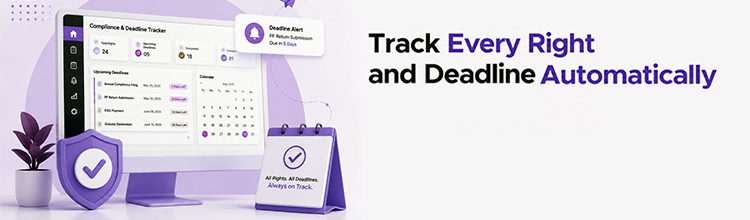
Probationary employees in India still get salary, statutory benefits like PF and ESIC, leave, safe working conditions, and protection against harassment - the trial period changes confirmation status, not the underlying rights.
A common misconception is that probationary employees have “fewer rights.” In reality, most statutory protections apply from day one of employment, regardless of confirmation status.
- Salary - Employees must be paid the agreed salary on time; probation does not permit underpayment or delayed wages beyond statutory timelines.
- Leaves - Depending on state Shops & Establishments Acts and company policy, probationary employees are usually entitled to at least a pro-rata allocation of casual and sick leave, if not full entitlement.
- Provident Fund (PF) - PF contributions typically apply from the date of joining if the employee’s salary falls within the applicable wage ceiling, irrespective of probationary status.
- ESIC - Employees earning below the ESIC wage threshold are generally covered from day one, probation notwithstanding.
- Professional Tax - Deducted per applicable state slab rates regardless of employment status.
- Working Hours - Standard working hour limits under the relevant Shops & Establishments Act apply equally to probationary and confirmed staff.
- Overtime - Where overtime rules apply to the role or establishment, probationary employees are entitled to overtime compensation on the same basis as confirmed staff.
- Holidays - National and festival holidays as per company policy and state regulations apply during probation as well.
- Gratuity Eligibility - Gratuity is generally tied to five years of continuous service (with some exceptions). Hence, probation time typically counts toward this tenure calculation once employment continues unbroken into confirmed status.
- Workplace Safety - Safety duties under applicable labour laws apply to all personnel, probationary or not.
- Anti-Harassment Protection - The Prevention of Sexual Harassment (POSH) Act, 2013 applies uniformly; probationary personnel have full access to the Internal Committee (IC) complaint mechanisms.
Understanding employee rights during probation is crucial not just for compliance but for building trust - personnel who recognise their rights are respected during this uncertain phase are much more likely to stay engaged.
Employer Rights During Probation
Employers can evaluate performance, provide structured training, extend probation with justification, and terminate employment during probation more simply than with confirmed staff - provided the process follows the employment contract and HR policy.
Understanding probation period rules in India from the employer’s side is just as important as understanding employee protections. Probation exists primarily as an employer safeguard, and Indian employment practice recognises several rights that come with it:
- Performance Evaluation - Employers can set specific KPIs and evaluate probationary employees against them more rigorously than confirmed staff.
- Training - Employers can mandate structured onboarding and skill-building programs as a condition of successful probation completion.
- Feedback - Regular, documented feedback cycles are both a right and a best practice - they protect the employer’s position if confirmation or termination decisions are later questioned.
- Extension - If performance is inconclusive, employers can extend probation (within reasonable limits, and per contract terms) rather than making a premature confirm-or-terminate decision.
- Confirmation - Employers manage the confirmation decision, usually formalised through a written confirmation letter.
- Termination - Employers usually have more flexibility to terminate a probationary employee than a confirmed one, often with shorter notice periods as described in the contract.
- Documentation - Employers have both the right and the responsibility to keep a clear performance and disciplinary record during probation - one that matters a great deal if a dispute comes up later.
Can an Employer Terminate an Employee During Probation?
Yes, employers in India commonly have greater flexibility to terminate employees during probation than confirmed employees. However, the employer must still follow the notice period specified in the contract and the basic principles of fair treatment.
This is one of the most-searched questions about termination during probation, and it deserves a nuanced answer rather than a blanket “yes” or “no.”
Legal Aspects
Indian courts and labour authorities generally recognise that probationary employment carries lower job security by design - that’s the whole point of the trial period. However, “easier to terminate” does not mean “no process required.”
Notice Period
Most employment contracts specify a shorter notice period during probation (typically 7-15 days) than post-confirmation (normally 30-90 days). This needs to be explicitly stated in the offer letter.
Employment Contract and HR Policies
Termination during probation should strictly follow the signed agreement and HR policy; deviating from the documented terms (e.g. terminating with zero notice when the agreement guarantees 15 days) can expose the company to legal claims for breach of contract, even if the termination itself may be justified on performance grounds.
Natural Justice
Even though probationary termination doesn’t usually require a full disciplinary inquiry (unlike termination for misconduct of confirmed employees), best practice strongly favours:
- Communicating performance concerns before the termination decision
- Giving the employee at least one opportunity to improve
- Avoiding termination that appears discriminatory or retaliatory
Documentation
A termination during probation holds up much better when there’s a paper trail behind it - documented performance reviews, missed KPIs, recorded feedback. Skip that, and even a termination that’s technically within the rules can turn into an expensive dispute.
Best HR Practices for Termination During Probation
- Always issue termination in writing, referencing the relevant contract clause.
- Settle final dues (salary, leave encashment where applicable) per statutory timelines.
- Provide a relieving letter or experience letter reflecting actual tenure.
- Avoid informal or verbal-only terminations.
Can the Probation Period Be Extended?
Yes, probation extensions are common and legal in India when performance is inconclusive, provided the extension is documented, communicated clearly, and doesn’t stretch indefinitely without review.
Probation extension rules exist precisely for situations where six months isn’t quite enough to make a confident confirm-or-terminate call.
When Extension Is Appropriate
- Performance is improving but hasn’t yet met the confirmation bar
- The employee was on extended leave during probation (medical, maternity, etc.) and effective working time was reduced
- Role requirements changed mid-probation
- The manager wants more data points before a permanent decision
Maximum Duration
While there’s no single statutory cap for most private-sector roles, HR best practice generally treats total probation (including extensions) capped around 12 months as a reasonable outer limit. Beyond that, both engagement and legal risk increase.
Documentation
Every extension should be documented via a formal extension letter that states:
- The reason for extension
- The new probation end date
- Specific, measurable goals for the extended period
Employee Communication
Extensions handled poorly - communicated late, vaguely, or without clear next steps - are a top driver of early attrition and disengagement. A short, honest conversation explaining why probation is being extended (with specific examples) goes a long way toward keeping the employee motivated rather than demoralised.
Performance Improvement Plan (PIP)
For borderline cases, pairing an extension with a formal Performance Improvement Plan - specific goals, timelines, and check-in points - gives both the employee and employer a structured, fair path to a final decision.
Employee Confirmation Process
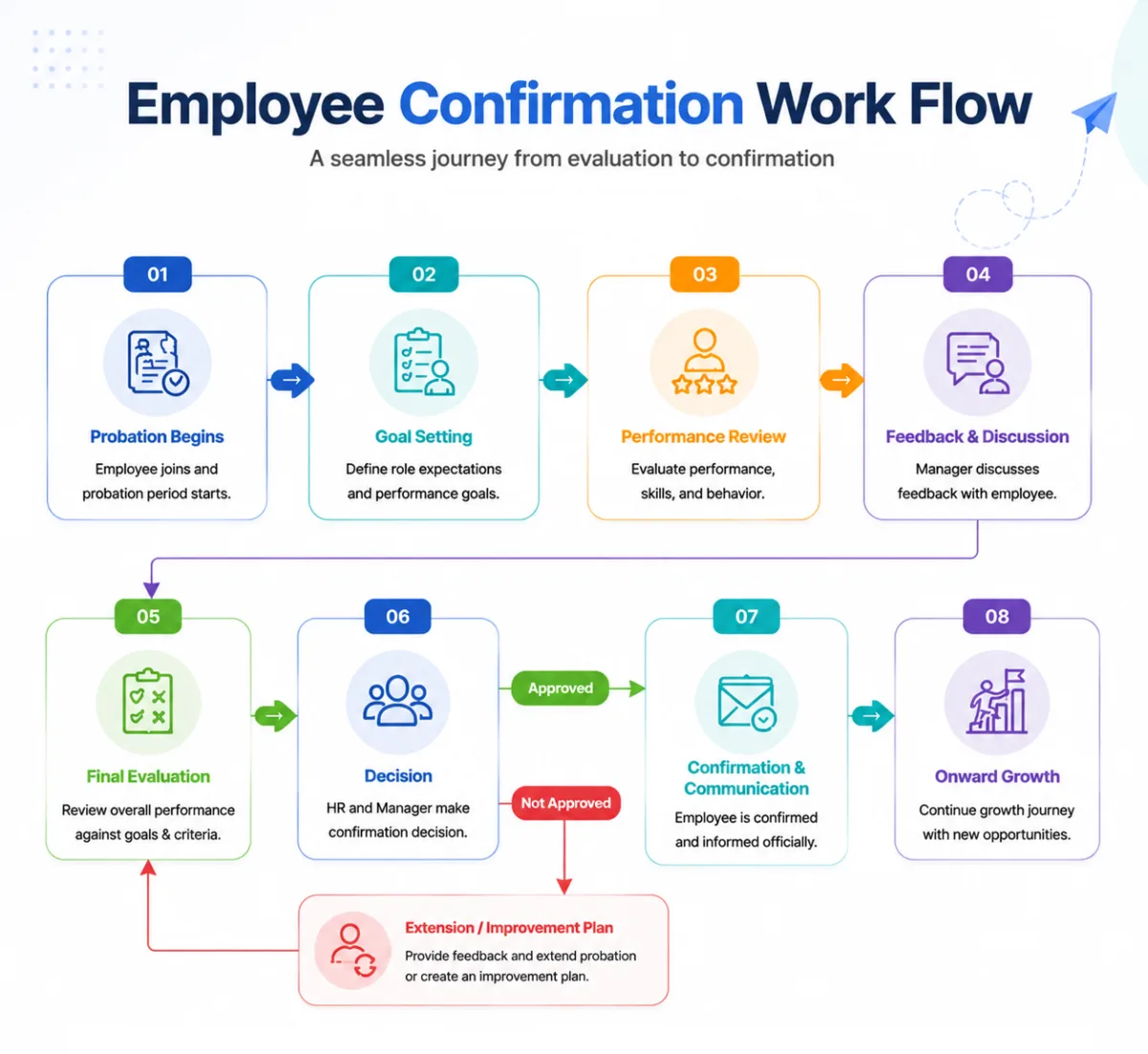
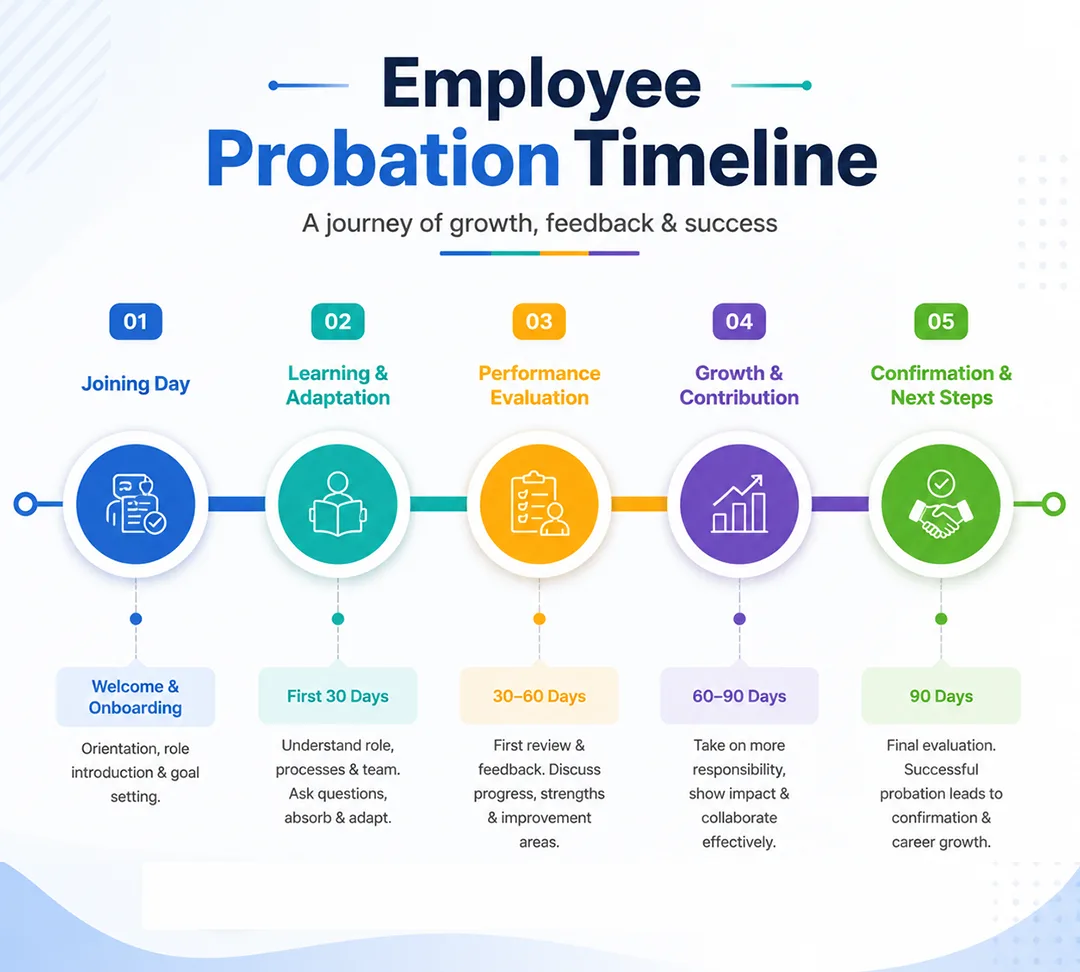
A well-run confirmation process moves through performance review, manager feedback, HR evaluation, compliance checks, and formal approval before a confirmation letter is issued and HR records are updated.
Here’s the step-by-step flow HR teams should follow for employee confirmation:
- Performance Review - Manager conducts a structured review against pre-set KPIs and goals.
- Manager Feedback - Direct, documented feedback shared with the employee, including strengths and improvement areas.
- HR Evaluation - HR cross-checks the review against attendance and conduct records, as well as any escalations during probation.
- Compliance Check - Verification that all onboarding documentation (ID proofs, background checks, statutory forms) is complete before confirmation.
- Confirmation Approval - Sign-off from the reporting manager and HR, sometimes requiring a second-level approval for senior roles.
- Confirmation Letter - A formal letter is issued, stating the confirmation date, updated notice period, and any revised terms (salary, designation, etc.).
- HRMS Update - Employee status is updated in the HR system, triggering downstream changes to notice period policy, leave entitlements, and benefit eligibility.
Delays or gaps anywhere in this chain are one of the biggest sources of employee frustration - which is exactly the kind of process an HRMS is built to eliminate.
Best Practices for Managing Probation

The most effective probation management combines regular feedback, documented milestones, and clear communication, supported by HR automation, to keep everyone on schedule.
- Weekly Feedback - Especially in the first month, short weekly check-ins catch issues early.
- Monthly Reviews - A slightly more formal monthly review creates a paper trail and keeps expectations aligned.
- Goal Setting - Clear, measurable goals set in week one give both the manager and the employee a shared reference point.
- KPIs - Role-specific KPIs (not generic ones) make evaluations objective rather than subjective.
- Documentation - Every review, feedback session, and milestone should be logged - ideally in an HRMS rather than scattered emails.
- Employee Engagement - Probation shouldn’t feel like being on trial in a hostile sense; onboarding buddies, team introductions, and regular check-ins matter.
- Transparent Communication - Employees should always know where they stand; surprises at the confirmation deadline are avoidable and damaging to trust.
- HR Automation - Automated reminders for review deadlines, confirmation dates, and extension approvals prevent the single most common failure: things simply falling through the cracks.
Common Mistakes Employers Should Avoid
The most common probation mistakes are lacking a written policy, skipping scheduled reviews, delaying confirmation decisions, and failing to document performance discussions.
- No Written Policy - Relying on verbal understanding instead of a documented probation policy invites disputes.
- Missing Review Schedule - Without fixed review checkpoints, probation drifts, and confirmation decisions get rushed at the last minute.
- Delayed Confirmation - Letting confirmation dates pass without action leaves employees anxious and legally ambiguous about their status.
- No Documentation - Undocumented feedback means undocumented justification if termination or extension is later challenged.
- Poor Communication - Employees who don’t know how they’re being evaluated can’t improve, and often leave voluntarily out of frustration.
- Automatic Extension - Extending probation as a default “safe” option, rather than a deliberate decision backed by reasons, damages morale and looks arbitrary.
- Ignoring Labour Laws - Overlooking state-specific Shops & Establishments Act requirements or statutory benefit obligations during probation creates compliance risk.
How HRMS Software Simplifies Probation Management
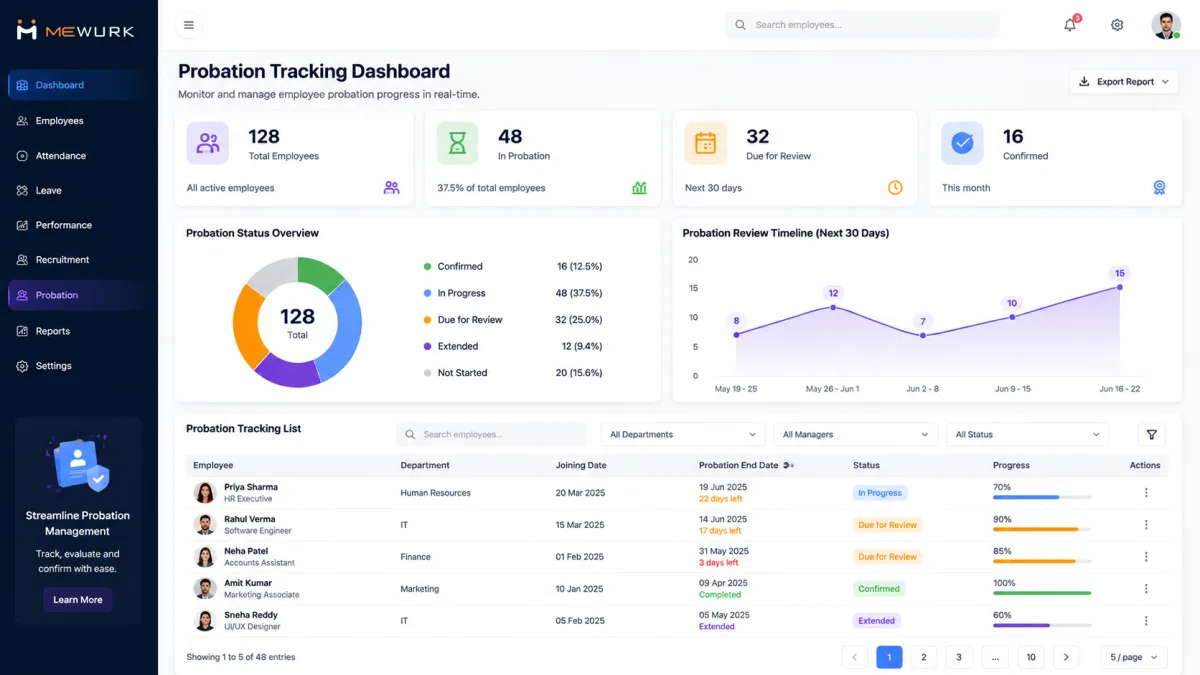
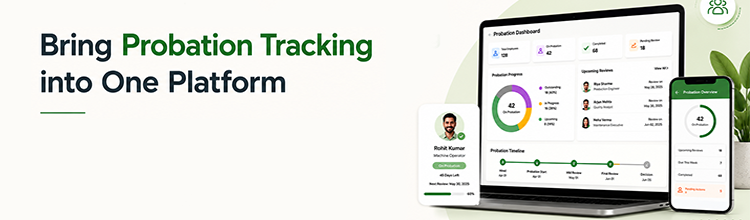
HRMS platforms like Mewurk automate probation tracking, review reminders, confirmation workflows, and documentation - reducing the manual errors and missed deadlines that cause most probation-related disputes.
Manually tracking probation dates, review schedules, and confirmation deadlines across a growing headcount is where most HR teams start to lose control - spreadsheets get outdated, reminders get missed, and confirmation letters go out late (or not at all).
Here’s how Mewurk helps HR teams manage the full probation lifecycle:
- Automated Probation Tracking - Every employee’s probation start date, expected end date, and status is tracked automatically, with no manual spreadsheet updates needed.
- Reminder Notifications - Managers and HR receive automatic alerts ahead of review deadlines and confirmation dates, so nothing slips through.
- Employee Performance Reviews - Structured, digital review forms replace scattered emails and disconnected documents.
- Confirmation Workflows - Multi-level approval workflows ensure confirmations go through the appropriate sign-offs before letters are generated.
- Document Management - Offer letters, extension letters, and confirmation letters are stored centrally and linked to each employee’s profile.
- Digital Approval Process - Managers and HR can approve extensions, confirmations, or terminations directly within the system, with a clear audit trail.
- HR Analytics - Dashboards show probation-to-confirmation conversion rates, average review turnaround, and attrition patterns during probation.
- Employee Lifecycle Management - Probation status feeds directly into broader lifecycle tracking, from onboarding through confirmation and beyond.
- Compliance Records - Statutory deduction records (PF, ESIC, professional tax) remain accurate and auditable from day one of employment.
- Audit Trail - Every action - review submitted, extension approved, confirmation issued - is time-stamped and traceable.
For HR teams juggling probation period rules in India across multiple states and business units, this kind of automation isn’t a luxury - it’s what keeps compliance consistent as the company scales.
Why Choose Mewurk HRMS?
Mewurk is a full-stack HRMS built for Indian businesses, covering onboarding, attendance, payroll, performance, and compliance in one platform - designed to remove the manual overhead HR teams face at every stage of the employee lifecycle.
Managing probation is just one piece of the employee lifecycle - and it works best when it’s connected to everything else HR handles. That’s exactly where Mewurk HRMS fits in:
- Employee Onboarding - Digital onboarding workflows that set the probation clock running automatically from day one.
- Attendance Management - Real-time attendance tracking that feeds directly into performance evaluations.
- Leave Management - Automated leave accrual and approval, correctly applied even during probation.
- Payroll - Accurate, compliant payroll processing including statutory deductions from the first payslip.
- Performance Management - Goal-setting, KPI tracking, and structured review cycles built for probation and beyond.
- Document Management - Centralised storage for every HR document, from offer letters to confirmation letters.
- Workflow Automation - Multi-step approval chains for extensions, confirmations, and terminations.
- Employee Self-Service - Employees can view their own probation status, review feedback, and documents without emailing HR.
- Mobile App - Full HR functionality available on the go for managers and employees alike.
- HR Analytics - Data-driven visibility into hiring quality, probation outcomes, and workforce trends.
- Affordable Pricing - Built with SMEs and growing startups in mind, not just large enterprises.
- Easy Implementation - Fast setup with minimal disruption to existing HR processes.
If your team is still managing probation period rules in India through spreadsheets and email threads, this is usually the point at which HRMS software starts paying for itself through saved time and reduced compliance risk.
Probation Policy Template (Sample)
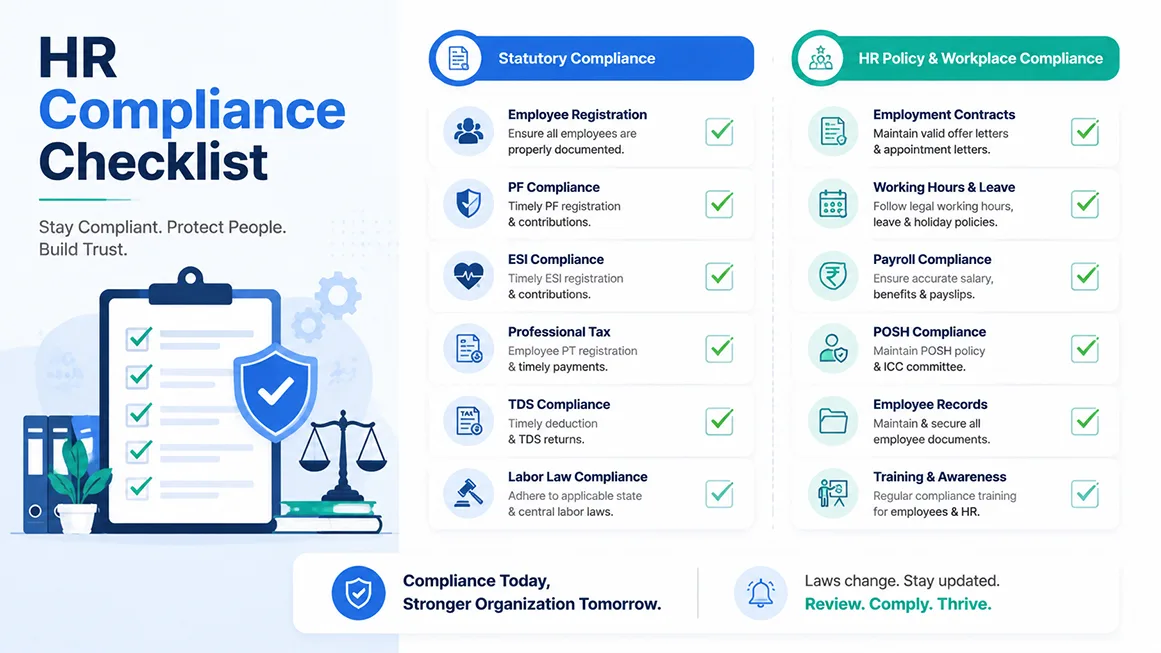
A basic probation policy should cover purpose, duration, evaluation process, extension terms, confirmation process, and termination clause - all stated clearly in writing.
Use this as a starting framework, then adapt it to your state’s Shops & Establishments Act and your industry norms:
- Purpose: This policy defines the probation period applicable to new employees to assess their performance, conduct, and suitability for confirmed employment.
- Duration: All new employees shall be on probation for a period of [3/6] months from their date of joining, unless otherwise specified in the offer letter.
- Evaluation Process: Performance shall be evaluated through monthly check-ins and a formal review at the midpoint and end of the probation period, based on pre-defined KPIs.
- Extension Clause: Where performance is inconclusive, probation may be extended by up to [3] months with written communication stating the reason and revised goals. Total probation, including extensions, shall not exceed 12 months.
- Confirmation Process: Upon successful completion of probation, the employee shall receive a written confirmation letter within [7] working days of the probation end date, along with any revised terms of employment.
- Termination Clause: Either party may terminate employment during probation by providing [7/15] days’ written notice, or payment in lieu thereof, as specified in the employment contract.
Probation Checklist for HR Teams
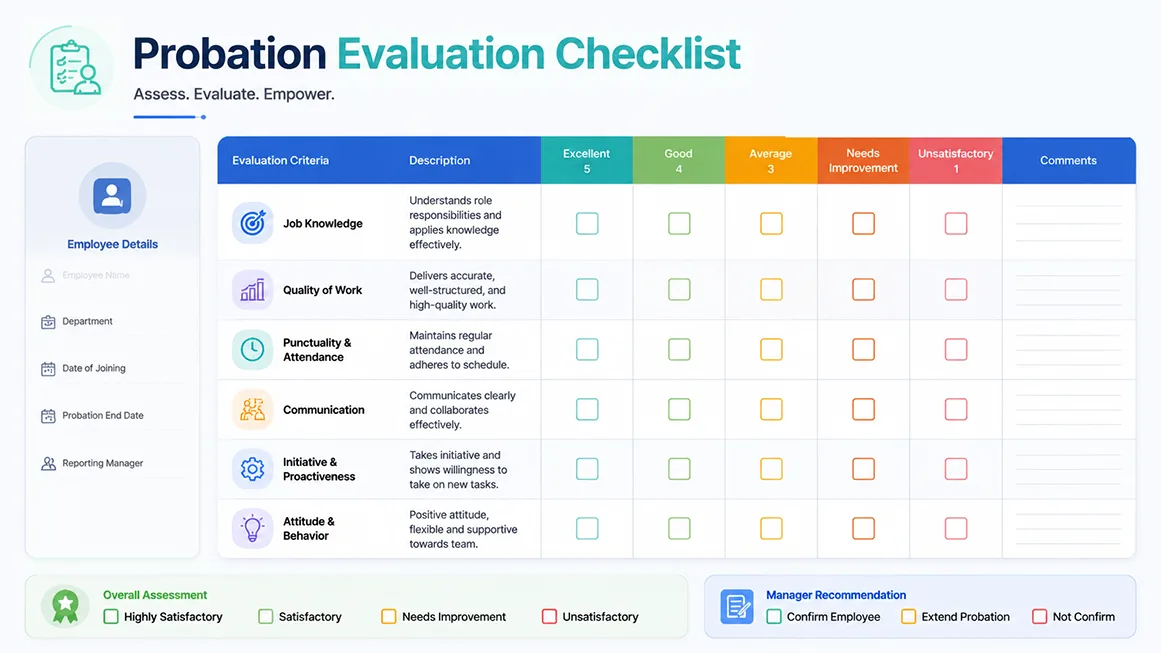
A practical probation checklist ensures nothing is missed between the offer stage and confirmation - from paperwork to goal-setting to the final confirmation letter.
| Checklist Item | Responsible | Status Tracking |
|---|---|---|
| Offer Letter Issued | HR | ✔ / Pending |
| Employment Contract Signed | HR | ✔ / Pending |
| Goal Setting Completed | Manager | ✔ / Pending |
| First Month Review | Manager | ✔ / Pending |
| Monthly Feedback Sessions | Manager | ✔ / Pending |
| Documentation Maintained | HR | ✔ / Pending |
| Compliance Verification | HR | ✔ / Pending |
| Confirmation Letter Issued | HR | ✔ / Pending |
Running this checklist inside an HRMS - rather than a static spreadsheet - means every item is time-stamped, assigned, and automatically flagged if overdue, making day-to-day compliance with probation period rules in India far less error-prone.
Frequently Asked Questions (FAQs)
Is probation legally required in India?
No single law mandates it - probation is set through the employment contract and company policy, subject to whatever state or industrial regulations apply.
Can probation be extended, and for how long?
Yes, when performance is inconclusive, and the extension is documented and time-bound. Most HR teams treat twelve months, including extensions, as a reasonable outer limit.
Is PF or ESIC applicable during probation?
Yes to both, generally from the date of joining, as long as salary falls within the applicable wage ceiling; probation status doesn’t change eligibility.
What’s the usual notice period during probation?
Commonly seven to fifteen days, compared with thirty to ninety days after confirmation - though it always depends on what the contract states.
Can an employer terminate without notice during probation?
Generally no. Even during probation, the notice period specified in the employment contract still applies.
Does probation count toward gratuity eligibility?
Yes, generally, probation time counts toward the five years of continuous service required, provided employment continues unbroken.
Conclusion
Getting probation period rules in India right isn’t about finding one universal answer - it’s about building a clear, consistent, well-documented policy that respects both business needs and employee rights. From setting a defensible duration to handling extensions transparently, to running a confirmation process that doesn’t leave employees guessing, every step matters for compliance and for retention.
The businesses that get this right treat probation not as a legal loophole, but as a genuine onboarding and evaluation phase - supported by regular feedback, fair documentation, and timely decisions.
If your team is still managing probation manually, this is exactly the kind of process that benefits from automation. Mewurk HRMS brings together onboarding, probation tracking, performance reviews, and compliance in a single platform - so nothing falls through the cracks, and every employee’s journey from day one to confirmation is smooth, transparent, and fully compliant.