PF & ESIC Compliance in India: Rules, Checklists, and Payroll Best Practices
Managing payroll in India means dealing with multiple statutory obligations. Among them, PF compliance and ESIC compliance create the most confusion for HR teams.
This blog explains the rules under the Employees' Provident Funds and Miscellaneous Provisions Act, 1952 and the Employees' State Insurance Act, 1948. You will get clear definitions, due dates, penalty structures, practical examples, and checklists your payroll team can apply today.
We will also look at contractor compliance, audit triggers, and how modern payroll systems handle PF and ESI compliance. If you run payroll for 20 or 2000 employees, this guide helps you stay audit-ready.
What Is PF Compliance and Why It Matters?
PF compliance is the adherence to all obligations under the EPF & MP Act, 1952. These include employee enrolment, correct wage calculation, timely deposit of contributions, and filing of returns.

Key Components of PF Compliance in India:
Applicability: Any establishment with 20 or more employees must register. Once covered, it remains covered even if the headcount drops below 20.
Contribution rate: 12% of Basic + DA from employee. Employer contributes 12% too. From the employer share, 8.33% goes to EPS for wages up to 15000 and the rest to EPF.
Wage ceiling: 15000 per month for mandatory coverage. Employees earning above ₹15,000 may join voluntarily with employer consent if they were not previously PF members.
Due date: 15th of the following month for payment. ECR filing is mandatory before payment.
Non-adherence to PF compliance rules can result in penalties under Section 14B and 7Q. Damages can range from 5% to 100% of arrears depending on the delay period.
Snapshot: PF Contribution Breakup for 20000 Monthly Wage
| Component | Employee Share | Employer Share | Head |
|---|---|---|---|
| EPF | 2400 | 734 | 3134 |
| EPS | 0 | 1250 | 1250 |
| EDLI | 0 | 100 | 100 |
| Admin Charges | 0 | 100 | 100 |
| Total | 2400 | 2184 | 4584 |
Note: EPS is capped at 8.33% of 15000. Admin charges are 0.5% of wages. EDLI is 0.5%.
Understanding ESIC Compliance Under ESI Act
Compliance under the ESIC Act is mandatory for establishments with 10 or more employees in the notified areas. Factories and businesses that meet this employee threshold must register under the scheme and contribute toward employee insurance benefits as per the prescribed rules.
Core rules for ESIC compliance:
- Wage limit: Employees earning up to 21000 per month are covered. For persons with disabilities, the limit is 25000.
- Contribution: Employee pays 0.75%. Employer pays 3.25%. Total 4% of gross wages.
- Benefits: Medical, sickness, maternity, disablement, dependent, funeral expenses, and unemployment allowance under the Rajiv Gandhi Shramik Kalyan Yojana.
- Due date: 15th of the following month for the contribution. Return is half-yearly.
You must maintain records like the Form 1 declaration, accident register, and inspection book. During my audits, I found that missing Form 1 is a common reason for notices under ESIC compliance.
Short Description: Key Forms in ESIC
Form 1: Employee Declaration
This is filled at the time of joining. It captures family details for benefits. Keep it signed and stamped.
Form 12: Accident Report
Submit within 48 hours of any workplace accident. Delay attracts scrutiny during ESI PF compliance inspections.

PF Compliance Checklist for Monthly Payroll
Having a strong PF ESIC compliance checklist will help you do away with last-minute errors. Use this before you process ECR (Electronic Challan cum Return).
- Master data: Verify UAN activation, KYC seeded, date of birth and date of joining match with Aadhaar. Incorrect DOB blocks withdrawals.
- Wage definition: Include basic, DA, retaining allowance, and special allowance. Exclude HRA, overtime, and bonus. The SC ruling in RPFC vs Vivekananda Vidyamandir clarified this.
- Arrears handling: Pay PF on arrears in the month paid. Update ECR with arrear wages separately.
- Exits: Mark the date of exit in the UAN portal within 15 days. Otherwise, you keep paying admin charges.
- Contractor employees: Ensure your contractor has a separate PF code. Collect ECR and challan copy monthly. This is critical for PF compliance for contractor management.
- International Workers: No wage ceiling. Pay PF on the full salary. Obtain COC if applicable.
Missing any of these steps can expose your company to a PF statutory compliance risk. Instruct your payroll team to run a variance report each month comparing headcount in HRMS vs ECR.
ESIC Compliance Checklist for HR and Payroll Teams
Your ESIC compliance checklist should run parallel to PF. Although there are many overlapping fields, the wage logic differs.
- Eligibility check: Run a report for employees with gross <= 21000. Include new joiners mid-month on a pro rata basis.
- IP number generation: Create an IP number within 10 days of joining. Delay means medical benefits are denied.
- Monthly calculation: 0.75% on gross, rounded to the next higher rupee. Employer 3.25% on gross. No rounding off.
- Overtime inclusion: Unlike PF, overtime is included for ESIC wages. This trips up many payroll systems.
- Challan generation: Pay through the ESIC portal by the 15th. Download the paid challan and file it.
- Accident compliance: Maintain Form 11 and Form 12. Report accidents even if minor.
Strong PF ESI compliance requires you to reconcile the PF and ESI headcount. If the PF count is 150 and the ESI is 120, you should be able to explain the 30 employees above 21000 or the non-implemented area.
Statutory Compliance of PF and ESI: Due Dates and Penalties
The statutory compliance of PF and ESI runs on fixed dates.
| Statute | Frequency | Due Date | Late Penalty | Interest |
|---|---|---|---|---|
| EPF | Monthly | 15th of next month | Damages may range from 5% to 100%, depending on delay | 12% p.a. under Section 7Q |
| ESIC | Monthly | 15th of next month | Penalties may apply for delayed payment and non-compliance | Interest applicable under ESIC provisions |
| ESIC Records & Returns | Periodic / Online | As applicable under portal requirements | Penalties may apply for delayed filing or incorrect records | Applicable as per ESIC rules |
The EPFO and ESIC both use CAIU (Central Analysis Intelligence Unit) to flag anomalies. If there happens to be a sudden wage drop, a high number of zero-contribution UANs, or a mismatch with GST turnover, it will trigger suspicion and attract audits. I recommend you run your own analytics before the department does.
PF Compliance for Contractor and Principal Employer Liability
PF compliance for contractor is where principal employers face the biggest risk. Under Section 8A of the EPF Act, you are responsible if your contractor defaults.
Best Practices We Recommend You Follow:
- Code verification: Collect the contractor's PF and ESIC registration copy. Verify on the unified portal.
- Monthly proof: Do not release contractor bills without an ECR and a paid challan. Match employee names with the muster roll.
- Wage parity: Ensure contractor pays at least minimum wages. PF must be calculated on that basis.
- Separate challan: Ask the contractor to pay PF for your site under a separate sub code if possible. It simplifies reconciliation during an audit.
The same applies to ESI and PF compliance. If an IP is not generated, the principal employer may need to bear medical costs. Labour officers now check Form D during inspections.
Common Errors in ESI PF Compliance and How to Fix Them
Here are some of the common errors in PF and ESI compliance and what you can do to avoid them.
Error 1: Wrong Wage Components in PF
Many companies exclude special allowance from PF. After the SC judgement, allowances which are universally paid are part of basic wages. Revisit your CTC structure. The EPFO conducts wage audits specifically for this.
Error 2: ESIC Deduction After Crossing 21000
Once an employee crosses 21000 in a contribution period, the deduction continues till the end of that period. If you want to stop it, do it only from next April or October. Stopping mid-period will result in breaking the ESIC compliance.
Error 3: Delay in UAN Generation
If UAN is not generated, the PF contributions will get deposited in a suspense account. Employees losing access to their passbooks can create unnecessary grievances and payroll concerns. So, generate the UAN as early as possible.
Error 4: Non-payment for Trainees
Apprentices under the Apprentices Act are exempt from PF and ESI contributions. However, trainees not covered under that Act need PF and ESI. Check appointment letter wording.
Payroll Best Practices for Accurate PF ESIC Compliance
Clear payroll processes make PF ESIC compliance easier to manage consistently month after month. Here are the best payroll practices to help HR and payroll teams reduce compliance mistakes and maintain accurate PF and ESIC records.
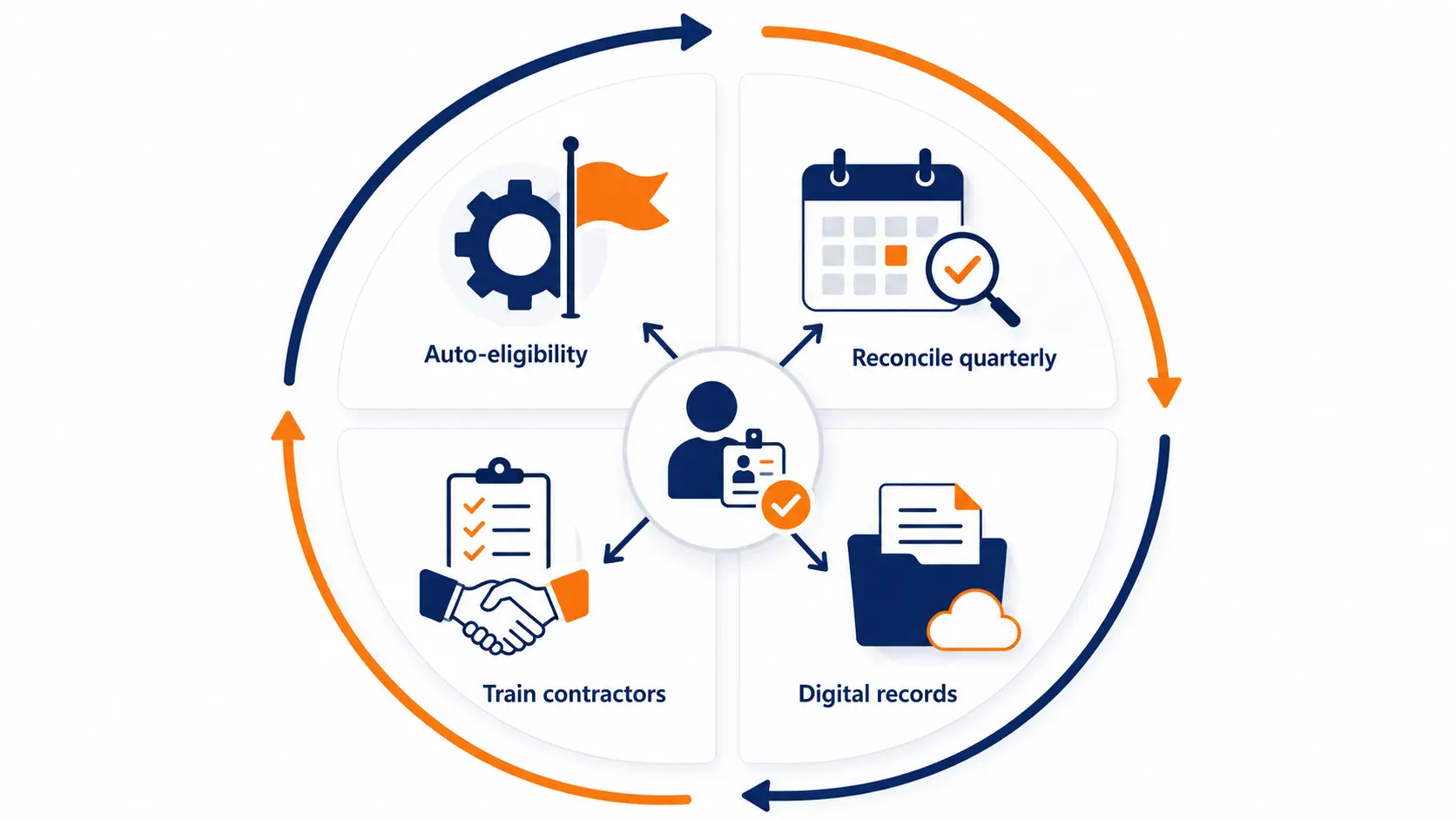
- Automate eligibility: Configure your modern payroll systems to auto-flag employees for PF and ESI based on DOJ, gross, and state.
- Integrate attendance: Link biometric or access data with payroll. ESIC contribution depends on the days paid, including paid leaves.
- Maintain digital records: Store Form 11, nomination Form 2, and IP declaration in DMS. ESIC and PF inspections are now virtual.
- Reconcile quarterly: Match GL, ECR, and ESIC challan with the salary register. Variance above 0.5% needs investigation.
- Train contractors: Conduct quarterly sessions for your contractors on ESI PF compliance. Give them a simple checklist.
Payroll leaders frequently point out that 80% of their compliance effort goes into correcting master data. Well-maintained and verified employee records make ECR processing more accurate and consistent.
How to Handle EPFO and ESIC Inspections and Compliance Notices
EPFO and ESIC conduct inspections under the CAIU risk-based assessment. Common triggers include low PF wages compared to industry, high attrition without exits marked, and GST vs PF turnover mismatch.
How to prepare:
- Keep the last 3 years of ECR, challans, and Form 5A ready.
- Maintain muster roll, wage register, and Form 12A.
- For compliance under the ESIC Act, keep the accident register and Form 1 bundle accessible.
- Designate a single point of contact. Inspectors prefer dealing with one informed person.
If you receive a notice, respond within the deadline. Pay admitted liability first. Then contest the disputed part. This decreases the risk of penalty exposure.
How Mewurk Supports Better PF and ESI Compliance Processes
Managing PF and ESIC compliance becomes far more difficult when payroll systems cannot adapt to different salary structures, state rules, contractor models, or company policies. This is where a smart configurable payroll software like Mewurk starts making a real difference for HR and payroll teams.
Flexible PF and ESI Compliance Management
Mewurk is an extremely reliable payroll software for managing Indian compliance requirements related to PF, ESI, and other statutory processes.
The platform is designed to support different business structures through flexible configurations that can be adapted based on industry requirements, state-level regulations, salary structures, and company policies.
Configurable Payroll Rules
For PF and ESIC compliance, Mewurk makes it easier for HR and payroll teams to configure eligible salary components, contribution settings, contractor structures, joining-date scenarios, overtime handling, and other organisation-specific rules without depending heavily on manual tracking.
This flexibility becomes especially useful for businesses operating across multiple states or payroll structures.
Contractor and Compliance Tracking
Contractor management is also built into the platform. Teams can maintain contractor-wise records, challans, employee details, and compliance-related data from one dashboard, which makes PF compliance oversight easier to manage on a monthly basis.
Better Payroll Visibility
Mewurk also helps teams maintain better control over payroll records, employee documentation, and statutory processes through organised workflows, audit visibility, and centralised payroll management.
If your team spends too much time reconciling PF and ESI manually every month, this kind of configurable payroll system is worth evaluating.
Conclusion
Strong PF and ESI compliance will protect your company from financial and legal risk. You must understand wage definitions, due dates, contractor liability, and inspection readiness. We hope this blog helped you understand the practical side of managing PF and ESIC compliance.
Use the checklists to identify compliance gaps, automate where possible, and maintain organised payroll workflows. The rules under the EPF and ESI Acts are detailed, but a disciplined process makes them manageable. Wishing you accurate payrolls and peaceful assessments ahead.
FAQ
1. What is the wage ceiling for PF compliance?
The mandatory wage ceiling for PF compliance is 15000 per month. Employees above this can join voluntarily with employer consent.
2. When is ESIC contribution not required?
ESIC contribution stops when gross exceeds 21000 at the start of the contribution period. Non-implemented areas are also exempt.
3. Who is responsible for PF compliance for contractor workers?
The principal employer is responsible if the contractor fails PF compliance for contractor employees under Section 8A.
4. What is the due date for ESIC compliance payment?
The due date for ESIC compliance contribution payment is the 15th of the following month for all establishments.
5. What documents are needed for the PF statutory compliance audit?
Keep ECR, challans, Form 5A, wage register, muster roll, and Form 2. Each of these has a special role to support PF statutory compliance during inspection.

Most Popular Post

Why Accurate Attendance and Leave Management Matters for Business Growth?
Read More →Why Accurate Attendance and Leave Management Matters for Business Growth?
How To Leverage Attendance Data For Better Workforce Management?
Read More →How To Leverage Attendance Data For Better Workforce Management?