Top 10 Human Resource Management and Performance Strategies for Modern Workplaces in 2025
Every seat in the conference room is taken. Focus settles on the quarterly performance metrics; the employee satisfaction scores are flashing red, and your CEO just asked the question every HR dreads to hear: “So, what's our strategy for keeping our best people?”
No, it's not a scene from a corporate drama. It's just another Tuesday in the life of modern HR professionals dealing with human resource management and performance challenges.
In today's hybrid workplaces, driven by purpose and powered by AI, adaptive agility in human resource management roles and responsibilities is essential. Tried-and-tested methods from 2020 have long been forgotten. Outdated systems will barely scratch the surface today.
In those cases, it helps to have proven strategies and actionable frameworks ready to deploy when your team needs them most. In this blog, we'll uncover 10 bold, practical strategies that leading organisations are using to reshape human resource management and performance.
What is Human Resource Management?
In the context of our conversation, it makes sense to look up the human resource management definition. Human resource management refers to the systematic approach to the acquisition, development, maintenance and disposition of human resources in an organisation to achieve its objectives. To put it plainly, human resource management functions across key strategic areas like hiring, training, performance evaluation, and employee engagement.
How to Strengthen Human Resource Management and Performance?
If optimising human resource management and performance is central to business success, then both must be closely aligned. Let's outline 10 practical ways through which modern organisations can effectively shift from traditional paradigms to human resource management evolution.
1. Build a Data-Driven HR Strategy to Improve Team Performance

Data analytics is reshaping human resource management and performance dramatically. With data-driven strategies, they help HR leaders to be more effective and faster in decision-making.
Burnout prediction models at companies like Microsoft utilise attendance data. They relate dips in productivity metrics to late arrivals. Interestingly, there has been a gradual growth in organisations' tendency to invest in smart tools that offer deeper HR analytics.
The market for cloud-based HR systems is expected to touch 4.3 billion USD by 2025. Tools that provide smart dashboards-for instance, Mewurk-help draw actionable insights from attendance trends, working hours, team comparisons, and employee behaviour patterns.
2. Switch to Continuous Employee Performance Tracking with Real-Time Insights

Today's work environment is too dynamic for rigid annual reviews to stay relevant. Contrary to how they did it in the past, these days, many firms are going with regular one-on-one employee performance interactions, with 41% replacing traditional quarterly reviews with more frequent and personal touchpoints.
Continuous performance management enhances feedback loops and helps yield better results in comparison to traditional methods. With an estimate by Gartner that outlines around 70 per cent of employees using AI tools daily by 2025, it won't be difficult for HR teams to tap into such possibilities for conducting performance evaluation in real time with a greater degree of accuracy and zero biases.
3. Make Shift Planning a Workforce Optimisation Strategy, Not Just Admin Work
Strategic allocation of shifts brings improvements to both operations and employee engagement. Especially sophisticated algorithms used by modern employee management systems consider a person's performance metrics, prior engagement data, personal preferences and overall workload to enhance efficiency in scheduling.
A noteworthy example of this comes from the retail giant Target. By forecasting peak customer service hours via predictive analytics, Target was able to achieve optimal staffing at its stores, which in turn led to a dramatic surge in its sales. To be precise, by about 15%. Employees who feel they have a work-life balance are willing to exert extra effort 63% of the time, highlighting how making schedules appropriately impacts workforce motivation and business results.
4. Track Absenteeism Trends to Improve Employee Engagement and Company Culture
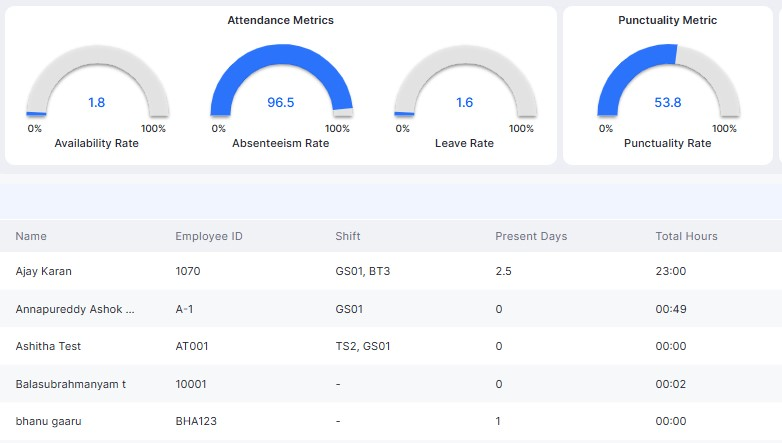
Absenteeism analytics play a crucial role in human resource management and performance. It can show you how sound an organisation's health is concerning employee engagement.
Nearly 3 in 5 employees who frequently take unplanned leaves reported negative impacts of work-related stress, which plainly indicates that there is a direct link between absenteeism, mental well-being, and declining productivity.
Companies can easily discover team-specific burnout signals or toxic management behaviours by analysing sick leave trends or workflow inefficiencies. For instance, frequent Monday absences are often seen as recovering from workplace strain, while scattered absences can signal disengagement with work or personal challenges needing positive intervention frameworks.
5. Use HR Automation Tools to Eliminate Manual Admin Work
The automation of minute and commonplace human resource management roles and responsibilities within organisations enables those personnel to focus on business-critical activities which add value to the firm. AI is predicted to reduce hiring costs by 30% as well as increase employee productivity by 30%. Most experts agree that this happens by eliminating or streamlining monotonous tasks. Click here
Key Administrative Areas That Can Be Automated:
- Leave and attendance tracking
- Employee onboarding workflows
- Payroll calculations and processing
- Document generation and digital filing
- Benefits administration
- Interview scheduling and candidate communication
- Routine employee surveys and feedback collection
- Compliance reporting and audit trails
Businesses that have automated onboarding, payroll, and leave approval processes report at least 40% time savings in human resource management and performance areas. This justifies the view that advanced HR interventions in key areas like talent management and workforce optimisation planning lead to measurable efficiency gains.
6. Exploit Attendance Analytics for Employee Engagement Tracking
Advanced attendance analytics provide insights beyond basic punctuality measurements. A performance management system that tracks productivity through employee engagement metrics can correlate clock-in times with task completion rates. Identifying optimal productivity windows helps align work schedules with individual work preferences.
Organisations make great strides in gathering valuable insights into human resource management and performance from tracking attendance alongside project deliverables. A good example of this is the observation that engaged employees tend to follow consistent schedules, while disengaged staff often display erratic patterns.
7. Improve Role Clarity in HR for Better Accountability and Team Performance
While small organisations have limited HR roles, when it comes to large organisations, the extent of human resource management roles and responsibilities expands significantly. In any organisation where strategic HRM is practised, there is a proper division of functions into clearly defined human resource management duties and responsibilities.
Defined job boundaries simplify processes and improve organisational and team decision-making, as well as enhance responsibility at every level of the company. Clarity regarding HR responsibilities increases productivity in everyday operations because the groundwork is laid by HR.
Workforce optimisation in human resource management roles and other roles requires smart planning. Initiatives supported by digital HR transformation bring focus and speed to it.
8. Create a Hybrid Work Strategy That Supports Flexibility and Fairness
Advanced fairness frameworks are needed to manage hybrid work. For that, you need to go beyond simple strategies of human resource management work from home. Only 11% of employees have access to collaborative policy settings, but 72% of hybrid employees prefer this arrangement over going fully remote. Furthermore, 82% consider their work environment unfair in some way, indicating crucial gaps that exist within hybrid management.
Also noteworthy is that 63% of high-revenue growth companies adopt productivity-anywhere permissive hybrid models. They are successfully implementing visibility tools that track deliverables rather than hours in order to ensure equitable progress, flexible schedules, and the need for work-life balance.
9. Shift Focus From HR Policy to Employee Experience Platforms

Modern employees have shifted further away from policy documents prioritising digital touchpoints designed around employee experience. Over 70% of job seekers consider employee experience a deal-breaker in their decision to accept or reject a job offer. Existing employees share similar sentiments, with 52% believing their current employee experience software is outdated and difficult to use.
In response to these evolving expectations, 60% of corporate leaders plan to embrace HR technology trends, particularly by incorporating AI and automation within the next five years. We're already seeing a massive rise in intuitive self-service portals for tasks like leave requests, document access, and communication. In short, digitalised HR services, accessible anywhere and mobile-optimised, are set to replace outdated, manual processes.
10. Make Performance Transparent - Not Political
Bringing transparency to human resource management and performance assessment is critical for bringing down subjective biases. Data-driven dashboards and clearly defined goals ground evaluations in measurable outcomes rather than office politics or personal perceptions.
Here too, modern technologies like AI play a powerful role in tightening the grip on fairness and objectivity. Reports indicate AI can substantially improve these outcomes to a range of 71% increase in employee engagement and a 33% reduction in assessment bias.
Conclusion
And there we are. The 10 bold, practical strategies to supercharge your human resource management and performance in 2025. Which of these do you already use? Which one sparked an idea? We'd love to hear your thoughts. Take a moment to jot down your experience in the comments.
Looking for the best HR management software to elevate your human resource management and performance? Let Mewurk handle the mess behind the scenes. Get started with a free demo today!
FAQ
What are the biggest HR challenges companies face in 2025?
HR management in 2025 is becoming increasingly complex. Recruitment, selection and retention of top talent, managing hybrid work dynamics, integrating suitable remote workforce solutions, employee engagement, conducting regular training and development activities, the list of challenges goes on.
How can AI-powered tools improve HR decision-making?
AI in HR decision-making is gaining significant momentum since the very introduction of advanced algorithms and machine learning capabilities. AI-powered HR analytics and tools can be very helpful in predicting attrition, analysing engagement trends, automating screenings, detecting early burnout, and showing live insights into human resource management and performance.
What are the key metrics for effective employee performance tracking in modern workplaces?
Some of the key metrics that help in effective workplace personnel management include goal completion rate, peer feedback scores, attendance consistency, learning progress, engagement index, and productivity trends like total worked hours against the team. To get a well-rounded view of both individual and team human resource management and performance, it helps to track and analyse each of these metrics independently and collectively.
How can small businesses implement HR strategies with limited resources?
Whether you are a small business or a big business, you need smart systems to be successful in implementing HR strategies efficiently. Start small with affordable cloud-based HR software which helps automate key admin tasks. Workforce optimisation tools offered by trusted platforms like Mewurk use smart AI to streamline onboarding, attendance, shift planning, human resource management and performance tracking without causing you a budget stretch.

Most Popular Post
Why Accurate Attendance and Leave Management Matters for Business Growth?
Read More →Why Accurate Attendance and Leave Management Matters for Business Growth?
How To Leverage Attendance Data For Better Workforce Management?
Read More →How To Leverage Attendance Data For Better Workforce Management?