Summary
The hire-to-retire journey covers every part of an employee’s experience, from their first interview to their last day. In this guide, you’ll look at each main stage, identify common HR problems, and see how an all-in-one Human Resource Management System like Mewurk combines hiring, onboarding, attendance, payroll, performance tracking, compliance, and exit steps into a single, smooth process designed for growing companies.
What happens between the day a candidate signs an offer letter and the day they walk out after their final settlement? In most companies, there are many occasions when HR and employees clash, with numerous email threads and hundreds of spreadsheet records.
This blog breaks down the hire-to-retire process, stage by stage, and shows how using the right HRMS software can turn the difficult, confusing journey into something you can manage, measure, and improve.
What Is the Hire to Retire Process?
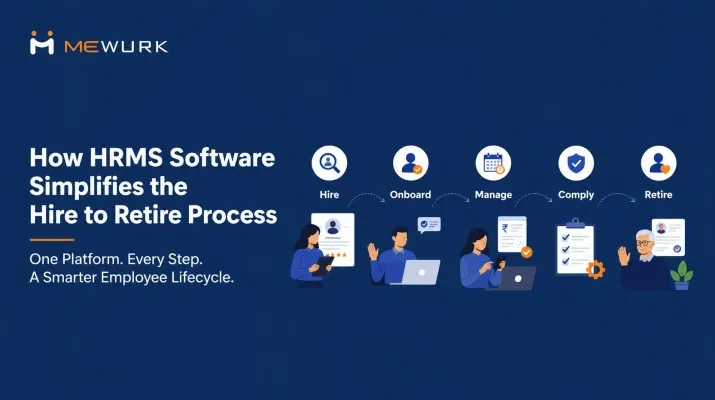
Often abbreviated as H2R, this process covers every touchpoint an employee has with an organisation - from recruitment to exit. It isn’t a single HR function but a chain of connected stages: talent acquisition, onboarding, attendance and leave management, payroll, ongoing performance management, learning and development, and finally offboarding.
In plain terms, it’s the complete employee lifecycle mapped into a single continuous workflow.
Each stage feeds data into the next. A candidate’s details from your Applicant Tracking System (ATS) should flow into the onboarding process. Onboarding data should then flow into payroll. Attendance records should flow into performance reviews. It is quite drastic to let any of these stages operate in isolation, because it will force your HR teams to re-enter the same information five or six times. Consequently, you will have errors penetrating the scene at every handoff.
Many HR teams track parts of this journey in Excel, parts in email threads, and parts in whatever software their finance department picked years ago. Technically, it works. You can still get somewhere. But it will be slow and with a lot of unnecessary effort.
Hire to Retire Process Flow: The Stages Explained
These are the core phases, roughly in the order they occur for most organisations.
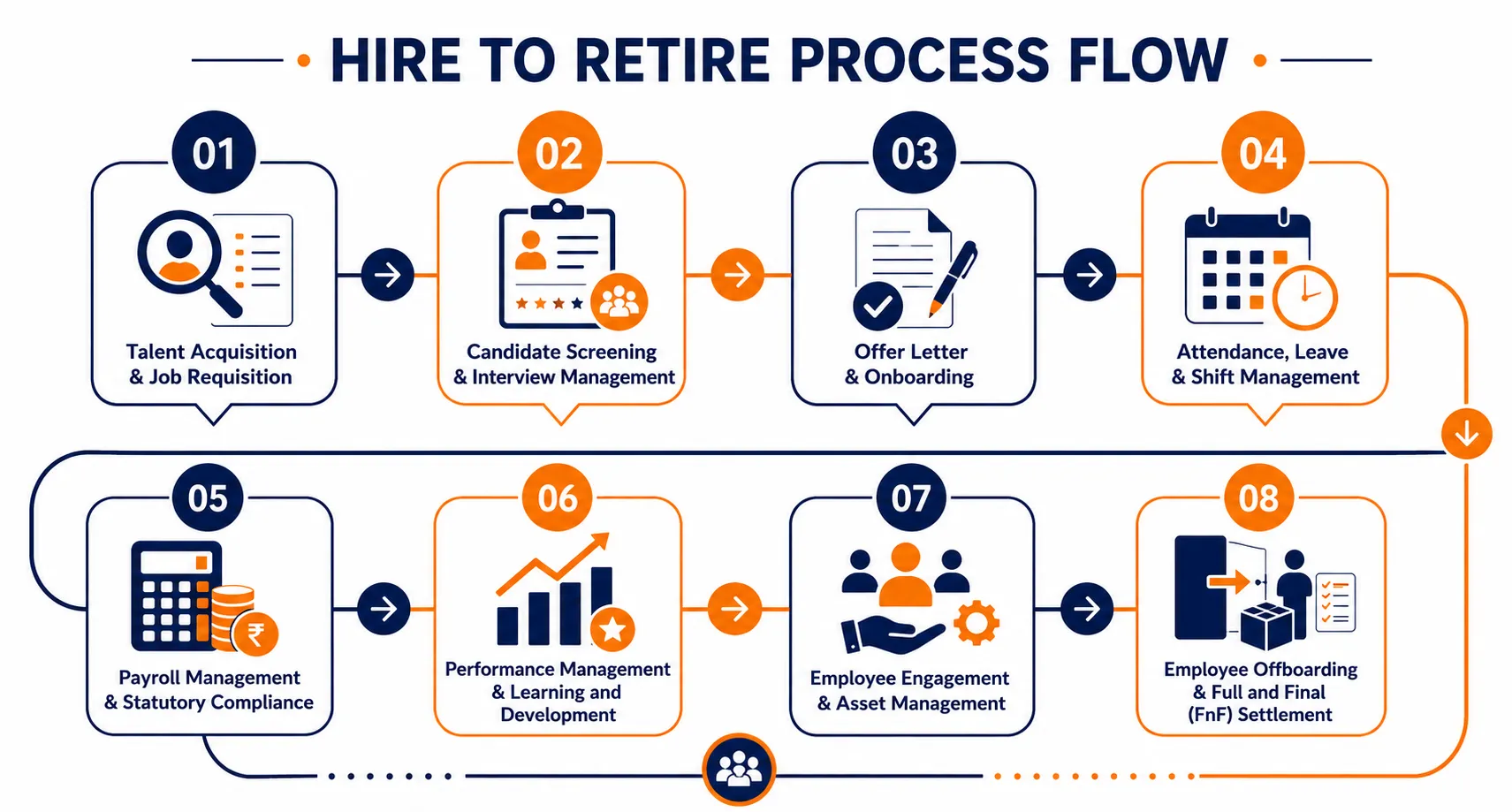
1. Talent Acquisition and Job Requisition
The cycle begins with a job requisition - the formal request to fill an open role. From there, recruiters move into candidate sourcing, pulling applicant details from job boards, referrals, and increasingly, AI-assisted tools that scan resumes against role requirements in seconds.
A solid Applicant Tracking System keeps applications organised in one place and matches candidates by skill, which prevents a strong resume from getting buried among hundreds of others.
2. Candidate Screening and Interview Management
Once applications start coming in, the pool gets narrowed through screening. Many companies now lean on AI-based assessments and structured interview tools to reduce bias and speed up decisions - instead of five recruiters comparing notes across spreadsheets by hand, scoring runs against preset criteria, and scheduling interviews automatically.
3. Offer Letter and Onboarding
Once a candidate accepts, this stage sets the tone for the entire employment relationship - and it’s also where a surprising number of companies drop the ball. A disorganised start pushes new hires toward disengaging within their first six months.
Digital onboarding tools handle document collection (offer letters, ID proofs, tax forms, bank details), auto-create employee records, and give new joiners access to a self-service portal - so payslips and leave balances are a login away instead of a request to HR.
4. Attendance, Leave, and Shift Management
Once someone is onboarded, day-to-day workforce operations take over. This includes attendance management, leave management, and for many industries, shift scheduling.
Attendance methods vary by workplace - biometric devices at a factory gate, mobile GPS check-ins for field staff, or a simple web-based clock-in for office teams. Whatever method you use, the data from all need to get synced automatically to payroll.
Although this may look quite basic, many organisations take it for granted and end up incurring expensive repairs. Manual attendance errors alone can cost a mid-sized company thousands of rupees a month in payroll disputes and rework.
5. Payroll Management and Statutory Compliance
Payroll management is central to the hire-to-retire process because it touches almost every other stage. Your employees’ attendance data, leave balances, tax declarations, and reimbursement claims are funnelled into a single payroll run each month.
Additionally, meeting statutory compliance in India requires keeping up with Provident Fund, ESI, professional tax, gratuity rules, and TDS calculations. These change periodically and carry penalties for non-compliance.
The most practical way to calculate these deductions correctly is to use an automated payroll engine that can generate payslips and file statutory returns without requiring manual cross-checking of rate tables.
6. Performance Management and Learning and Development
The hire-to-retire business process doesn’t stop once someone is settled into their role. Things like performance management, including goal setting, appraisals, and 360-degree feedback, are to be followed up. They are essential to keep employees aligned with business objectives.
Alongside this, you need learning and development (L&D) programs to close skill gaps and prepare people for the next step in their career.
Reports show that weaker employee retention happens mostly in companies that treat performance reviews as an annual formality. Those running continuous feedback cycles see better retention trends.
7. Employee Engagement and Asset Management
Engagement - pulse surveys, recognition programs, the everyday things that make people want to stay - matters more here than it gets credit for, since retention costs far less than rehiring.
This is accompanied by practical asset management, which involves tracking company property such as laptops, ID cards, and SIM cards assigned to each employee. Keeping accurate records of these items becomes particularly critical during the offboarding process.
8. Employee Offboarding and Full and Final (FnF) Settlement
Every hire-to-retire process eventually reaches the employee offboarding stage. This includes exit interviews, revocation of system access, asset recovery, and the Full and Final (FnF) settlement, in which pending salary, unused leave encashment, bonuses, and deductions are calculated and paid out.
FnF settlements in India must be processed within a set number of days following the last working day. Some companies unintentionally delay this process and damage their employer brand on review sites like Glassdoor.
Manual Process vs HRMS-Driven Hire-to-Retire Process
A glance at the table below will show you the key differences between handling the hire-to-retire process manually and using dependable integrated HRMS software.
| Stage | Manual Approach | HRMS-Driven Approach |
|---|---|---|
| Recruitment | Spreadsheets, email chains, manual resume screening | ATS with AI recruitment and automated candidate scoring |
| Onboarding | Physical paperwork, repeated data entry | Digital forms, auto-generated employee records |
| Attendance | Registers or standalone biometric devices | Real-time tracking synced directly with payroll |
| Payroll | Manual calculations, separate compliance filing | Auto-calculated statutory deductions and payslips |
| Performance | Annual paper appraisals | Continuous, trackable performance cycles |
| Offboarding | Manual FnF calculation, scattered asset tracking | Automated FnF workflows with asset checklists |
Why HRs Should Consider HRMS for Hire-to-Retire Process?
There’s nothing wrong with handling this manually, but modern workplaces are increasingly built for greater connectivity.
- Self-Service Access for Distributed Teams: Remote and hybrid employees now need direct access to their own records, as physically handing out documents, such as payslips, isn’t practical.
- Regulatory Compliance: Compliance requirements often shift, and manual tracking increases the risk of missing a statutory deadline.
- Candidate Experience and Talent Acquisition: Modern candidates expect an efficient, digital onboarding experience. A cumbersome hiring process negatively affects candidates’ perceptions and directly reduces offer acceptance rates.
- Data Integration Across the Employee Lifecycle: Workforce data - such as attendance or performance metrics - yields significantly greater value when integrated across all stages of the employee lifecycle to inform broader organisational decisions.
This is exactly where a platform built specifically for this journey, like Mewurk, changes the equation. Mewurk brings attendance, leave, shift scheduling, payroll, document storage, HR task management, field visit tracking, expense management, and AI-powered recruitment and assessment tools into one connected system.
Common Mistakes Companies Make in Their Hire to Retire Process
- Treating the first day as the finish line instead of the start of a weeks-long process.
- Running payroll and attendance on separate, unconnected systems.
- Neglecting statutory updates until an external audit forces corrective action.
- Skipping structured exit interviews, losing valuable feedback in the process.
- Letting asset recovery slip during offboarding can lead to security and cost issues.
The Hire to Retire Process in Numbers
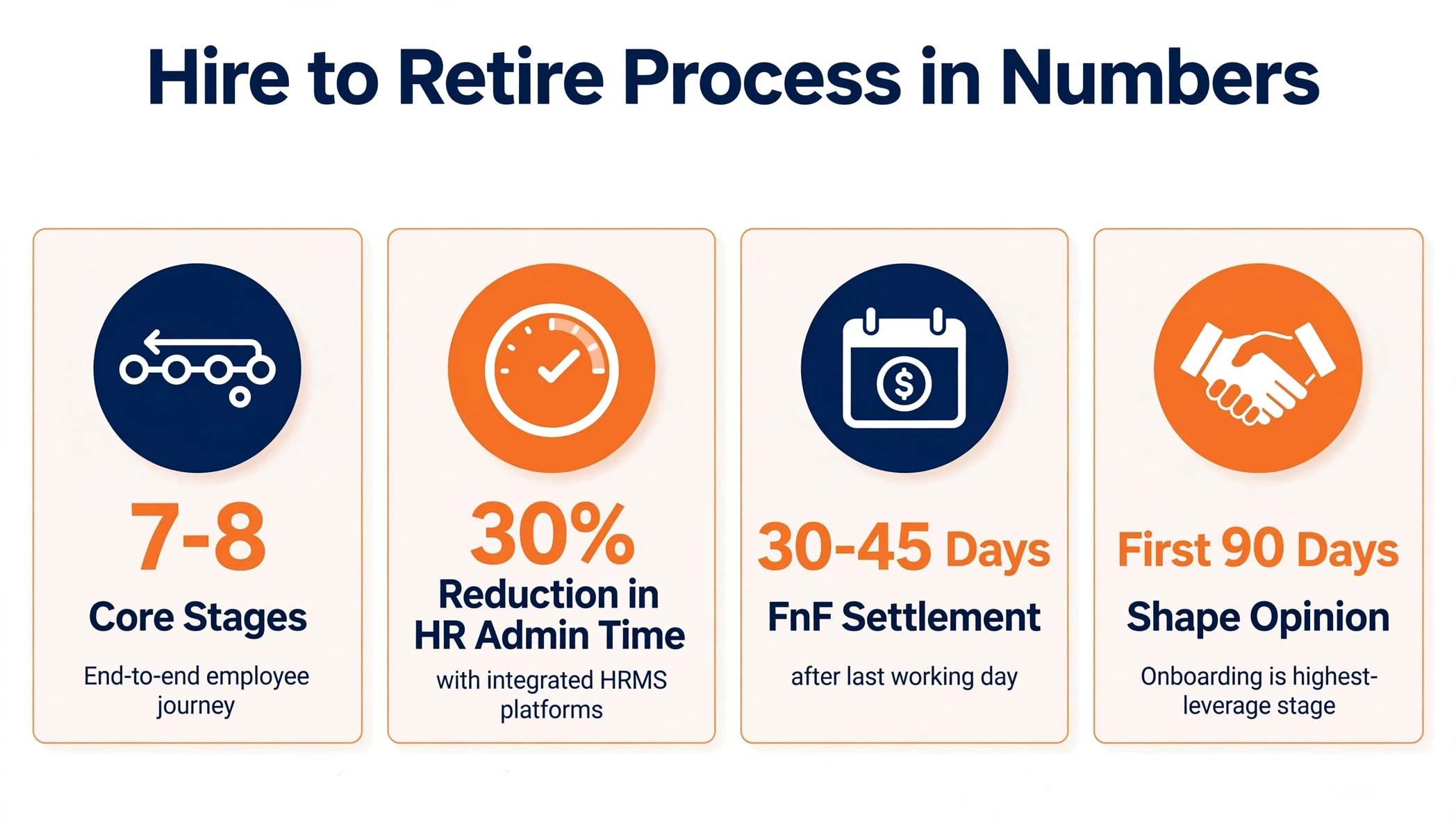
- 7-8 core stages make up a full hire-to-retire process
- Up to 30% reduction in HR administrative time reported by companies after adopting integrated HRMS platforms
- FnF settlements generally expected within 30-45 days of an employee’s last working day, depending on company policy
- New hires form their opinion of an employer largely within the first 90 days. Onboarding is thus one of the highest-leverage stages in the entire cycle.
At this point, you can see that the hire-to-retire process is far more than an HR concept. It serves as the operational foundation of how a company treats its people from initial recruitment to final separation. If you integrate these stages rather than managing them in departmental isolations, you will benefit from cleaner data, reduced compliance risks, and higher employee engagement. And that’s the gap Mewurk was built to close for growing companies.

Conclusion
This blog set out to break down the hire-to-retire process into something practical you can apply to optimise your workforce management. By integrating every stage of the employee lifecycle into a unified HRMS like Mewurk, you can gradually improve the employee experience. Hope we could help you understand how to make your HR processes, from hire to retire, smoother and more connected.
FAQs
1. What is the hire-to-retire process in HR?
The hire-to-retire process is the complete employee journey from recruitment through onboarding, payroll, performance, and offboarding.
2. What are the main stages of hire to retire?
Talent acquisition is the first and foremost stage in the hire-to-retire process. It is followed by onboarding, attendance and leave management, payroll, performance management, learning and development, and offboarding with FnF settlement.
3. How does HRMS software help the hire-to-retire process?
An integrated system connects all stages on a single platform, reducing manual data entry, reducing compliance errors, and giving employees self-service access to their records.
4. Why is FnF settlement important in offboarding?
Delayed or incorrect FnF settlements damage employer reputation. Companies that delay this stage often face compliance issues, leading to avoidable disputes.
5. Is hire-to-retire the same as employee lifecycle management?
Both the hire-to-retire process and employee lifecycle management are closely related. Hire-to-retire specifically frames the lifecycle as a business process, while the employee lifecycle is the broader concept it operationalises.