What Is Full and Final Settlement? Rules, Process, Calculation & Format Explained
Summary
Full and final settlement is the process of clearing all financial dues between an employer and an exiting employee. It includes salary, leave encashment, gratuity, PF, bonuses, and deductions like notice pay recovery. This guide explains Indian F&F settlement laws, timelines, calculations, formats, PF procedures, and HR best practices for compliant employee exits.
When an employee exits a company, there is one last financial obligation that HR and payroll teams must fulfil correctly: full and final settlement. Poor settlement execution risks litigation, ill will, and statutory violations.
In this blog, you will find a complete breakdown of what full and final settlement means, what the Indian labour law says about it, how to calculate it, what the format looks like, and the timelines your team must follow.
What Is Full and Final Settlement?
Full and final settlement, commonly called F&F settlement, is the process by which an employer settles all outstanding dues with an employee after their last working day. It marks the financial closure of the employment relationship.

The settlement typically covers unpaid salary, earned leave encashment, gratuity (if applicable), reimbursements, bonus, provident fund, and deductions such as notice pay recovery or any outstanding loans.
Here is a quick snapshot of what gets included as well as excluded in the full and final settlement of employee.
| Component | Payable or Deductible |
|---|---|
| Salary for days worked in last month | Payable |
| Earned leave encashment | Payable |
| Gratuity (if 5+ years of service) | Payable |
| Bonus (pro-rata, if applicable) | Payable |
| Notice pay (if served) | Payable |
| Notice pay recovery (if not served) | Deductible |
| Outstanding loans/advances | Deductible |
| TDS on taxable components | Deductible |
Full and final settlement of employee accounts is mandatory. And you should treat this process with the seriousness it deserves.
Full and Final Settlement Law in India: What Does the Law Say?
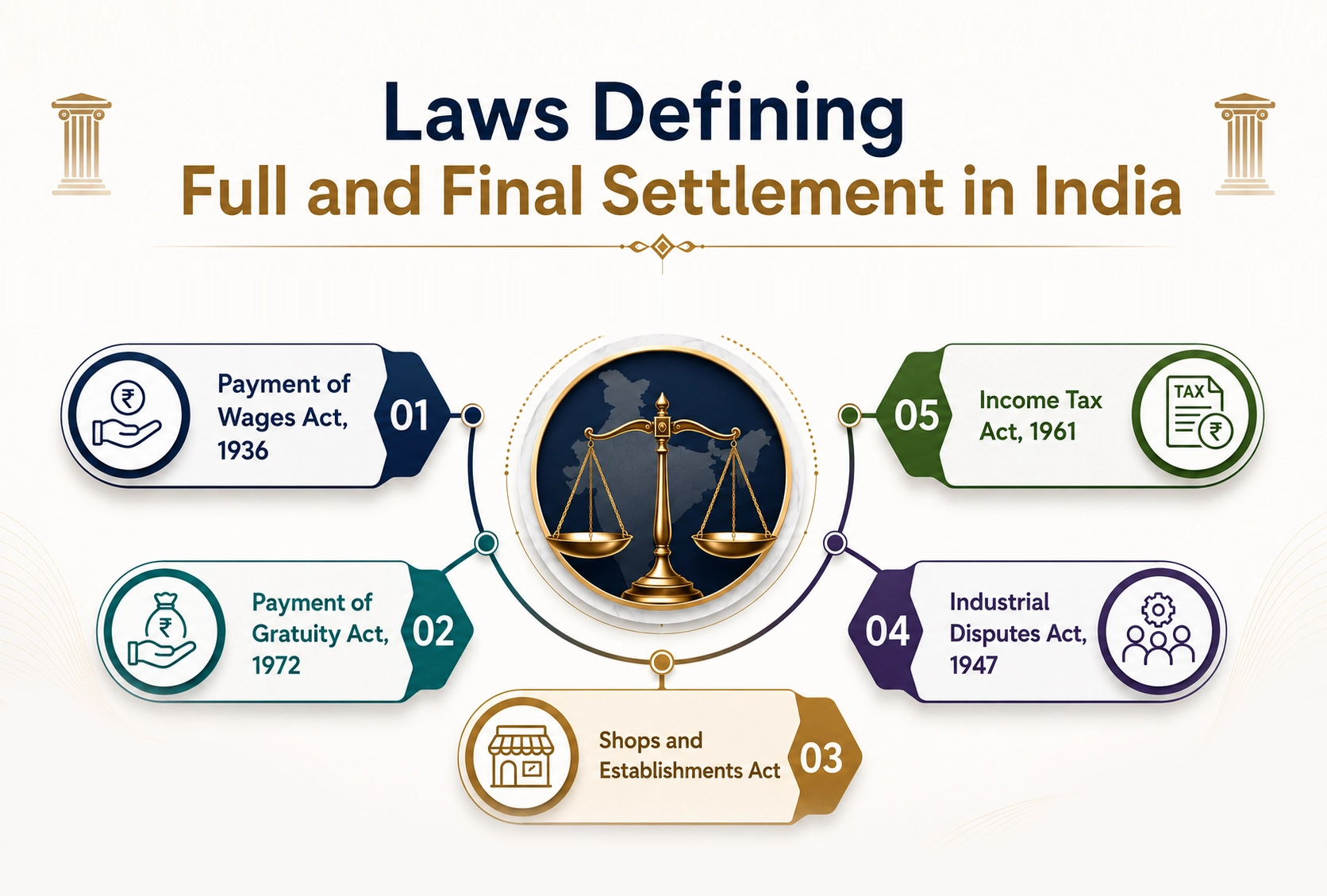
Indian labour law does not have a single standalone statute to exclusively govern F&F settlement. However, there are multiple laws that together form the legal framework. Let's understand each of these full and final settlement rules.
Payment of Wages Act, 1936
As per this act, if you are an establishment with fewer than 1,000 employees, you must complete paying out all the pending wages (which form the key part of the full and final settlement) within two working days of the termination of the employee. If your employee headcount is more, the full and final settlement timeline will be seven days.
Payment of Gratuity Act, 1972
An employee who has completed five or more years of continuous service in an organisation is entitled to gratuity. The employer must pay gratuity within 30 days of it becoming payable.
Shops and Establishments Acts (State-wise)
Each state has its own version of this Act, and several specify the timeline for settling dues after an employee leaves. In Maharashtra, for instance, the Maharashtra Shops and Establishments Act sets specific guidelines.
Industrial Disputes Act, 1947
In cases of retrenchment or termination, this Act prescribes dues and notice periods that should feed into F&F calculations.
Income Tax Act, 1961
TDS obligations apply to certain components of the full and final settlement, particularly leave encashment above the exemption threshold, gratuity beyond the exempt limit, and any ex gratia payments.
Understanding the full and final settlement policy as per labour law is mandatory. It requires HR teams to map their state, industry, and employee category to the right set of statutes.
Full and Final Settlement Rules Every HR Team Should Know
The following are the everyday payroll rules that matter in practice when you handle full and final settlement calculations.
- Resignation vs. Termination: The timeline and components differ in these cases under the full and final settlement policy as per labour law. A resigned employee who serves full notice gets different treatment from someone who is terminated without cause.
- Notice period buyout: If an employee does not serve the notice period and sends a full and final settlement mail to HR citing the reasons, the equivalent salary can be deducted. In reasonable cases, the company can waive the notice, and the employee receives it.
- Gratuity eligibility: Five years of continuous service is the threshold for gratuity. Even if the employee resigns one day before five years, technically, the claim may not hold unless a court interprets it otherwise.
- PF full and final settlement form: Employees must submit Form 19 (PF withdrawal) and Form 10C (EPS withdrawal) or use the UAN-based online process. Your HR team should guide employees through the PF full and final settlement form process.
- Leave encashment: Only earned leave (privileged leave) is generally encashed. Sick and casual leave are usually lapsed unless your company policy says otherwise.
- Relieving letter and full and final settlement: Both are separate deliverables. The relieving letter confirms the last working day; the F&F settlement is a financial transaction. Many employees confuse them. Even if the employee sends the request for relieving letter and full and final settlement together in one email, the processes might run on different tracks.

Full and Final Settlement Calculation: Step-by-Step
Let us now walk you through a practical example of calculating the F&F settlement. Assume an employee's cost to the company (CTC) is ₹6,00,000 per annum. They resign after 6.5 years of service, serve 30 out of 60 days of notice, and have 18 days of earned leave pending.
Step 1: Last Month's Salary (Pro-rata)
Monthly gross = ₹50,000. If the last working day is the 20th of the month, payable days = 20/30 × ₹50,000 = ₹33,333.
Step 2: Notice Pay Recovery
30 days not served × daily rate = 30/30 × ₹50,000 = ₹50,000 deducted.
Step 3: Leave Encashment
Formula: (Basic salary / 26) × number of leave days = (₹20,000 / 26) × 18 = ₹13,846.
Step 4: Gratuity
Formula: (Last drawn basic salary × 15 × years of service) / 26 = (₹20,000 × 15 × 6.5) / 26 = ₹75,000.
Step 5: TDS Calculation
Add all taxable components to the employee's income for the financial year and compute TDS accordingly. Leave encashment up to ₹25 lakh is exempt for non-government employees under Section 10(10AA). Gratuity up to ₹20 lakh is exempt under Section 10(10).
Step 6: Final Payable Amount
| Item | Amount (₹) |
|---|---|
| Pro-rata salary | 33,333 |
| Leave encashment | 13,846 |
| Gratuity | 75,000 |
| Total gross payable | 1,22,179 |
| Less: Notice pay recovery | (50,000) |
| Less: TDS | (as applicable) |
| Net payable | 72,179 (pre-TDS) |
One important thing to remember here is that a full and final settlement calculation requires meticulous attention to each variable. Even a small error in basic salary or leave balance can create compliance complications later.
Full and Final Settlement Format and Letter
The F&F settlement letter is the formal document that communicates the settlement to the departing employee. Since it can serve as legal proof that you have settled all dues and there are no claims pending on either side, make sure the full and final settlement letter contains accurate documentation for compliance and audit purposes.
What the Full and Final Settlement Format Must Include
Header Section
- Company letterhead
- Date of letter
- Employee name, designation, and employee ID
- Last working date
Body Section
- Statement of all payable components with amounts
- Statement of all deductions with reasons
- Net amount payable
- Mode and date of payment
Closing Section
- Acceptance clause (employee signs to confirm receipt)
- HR/Finance signatory
- Company seal
A full and final settlement format for employee use should be clear enough that the employee does not need to follow up with a dozen clarifying questions. Keeping a full and final settlement format in Excel for internal computation and then generating the letter as a PDF is a common practice among companies.
Full and Final Settlement Timeline in India
The full and final settlement timeline is a frequently debated topic between exiting employees and HR teams.
Here is what the law broadly prescribes:
| Type of Separation | Prescribed Timeline |
|---|---|
| Resignation (notice served) | Within 30-45 days of last working day |
| Termination | Within 2-7 working days (Payment of Wages Act) |
| Retrenchment | As per Industrial Disputes Act, usually immediate |
| Retirement | Within 30 days |
In practice, most Indian companies take 30 to 60 days after the last working day to process the settlement. However, if you haven't processed F&F settlement and 45 or more days have passed, the employee has grounds to send a formal full and final settlement not received mail to HR as an escalation, and eventually, a legal notice.
Full and Final Settlement Mail: What HR Should Send
The full and final settlement mail to employee is the formal intimation of payment. Once the settlement is processed and the amount is credited, HR should send a detailed breakup email.
What The Full And Final Settlement Mail Must Cover
- Reference to the employee's last working day
- Itemised breakup of all payable and deductible components
- Net amount paid and the payment date
- Confirmation that all dues are settled
- Instructions to submit outstanding assets (laptop, ID card, etc.) if not done yet
On the flip side, many employees write a full and final settlement mail to HR asking for a status update or pushing back on the amount calculated. You, if you are the concerned HR, must respond promptly, professionally, and with a documented trail.
If an employee has not received the settlement, a full and final settlement not received mail to HR typically goes like this: it refers to the last working date, requests an update on the settlement amount and payment date, and asks for the full and final settlement letter in writing.
PF Full and Final Settlement: A Separate but Linked Process
PF withdrawal and settlement run on a parallel track. The employee must submit the PF full and final settlement form through the EPFO member portal using their UAN. If the UAN is not activated or the Aadhaar is not linked, the process stalls.
HR's responsibility here is to ensure that the employee's UAN is active, KYC is complete, and the employer has digitally approved the claim on the EPFO employer portal. Delays in PF settlement are usually HR-side administrative failures. They do not have much to do with EPFO processing time.
The standard EPFO processing time is 20 working days for online claims. If you are doing the old way, offline claims via Form 19 and Form 10C, it might take longer, though.
What Your Company Document Should Address Regarding Full and Final Settlement Policy
It is non-negotiable to have a well-written, full and final settlement policy. It not only clears away the scope of ambiguity for the HR team but also removes the legal risk. The policy document should answer these questions:
- What is the standard timeline for processing F&F after the last working day?
- Which components are included in the settlement?
- What is the procedure for disputes?
- How is leave balance calculated and encashed?
- What is the process for recovering company assets before releasing the settlement?
- How is gratuity triggered and computed?
Many companies attach the F&F policy as an annexure to the appointment letter. The good part of it is that employees will be informed about the terms early on.
Conclusion
Full and final settlement is the last formal step between an employee and the company.
Although it looks like a routine HR process, getting the calculation right, following the legal timelines, sending a well-structured settlement letter, and guiding employees through PF withdrawal are all non-negotiable responsibilities.
We hope this blog gives you a clearer understanding of how to handle F&F settlements correctly.
Wishing your payroll and HR teams smooth, compliant, and timely settlements every time.
Frequently Asked Questions (FAQs)
1. What is the legal timeline for full and final settlement in India?
The Payment of Wages Act requires settlement within 2-7 working days of termination. For resignations, most companies take 30-60 days, though faster is always better practice.
2. Is gratuity always part of the full and final settlement?
Gratuity is included only if the employee has completed five or more years of continuous service. It is mandated by the Payment of Gratuity Act, 1972.
3. Can an employer withhold full and final settlement?
No. Withholding settlement without a valid legal justification will expose the employer to legal claims under labour law and can attract penalties.
4. What should an employee do if the settlement is not received on time?
The employee should first send a formal full and final settlement not received mail to HR, then escalate to the Labour Commissioner if unresolved within a reasonable period.
5. What is the PF full and final settlement process for a resigned employee?
The employee must file Form 19 and Form 10C or use the EPFO online portal with their UAN. The employer must approve the claim digitally for faster processing within 20 working days.
6. Why do full and final settlement delays happen?
Delays in full and final settlement arise when the HR team don’t have employees’ accurate leave balances. It is quite common particularly among companies that haven’t switched to digitalisation of compensation management and still rely on manual proecures. Popular payroll automation tools like Mewurk helps you speed pending approvals and verification of employee records.

Most Popular Post

Why Accurate Attendance and Leave Management Matters for Business Growth?
Read More →Why Accurate Attendance and Leave Management Matters for Business Growth?
How To Leverage Attendance Data For Better Workforce Management?
Read More →How To Leverage Attendance Data For Better Workforce Management?