Summary
AI interview software for conducting structured interviews. It captures and transcribes answers, evaluates each answer on role criteria, and provides recruiters with a ranked list with complete evidence. This guide explains how AI interviewers work in nine steps and where they beat manual screening. It also covers what to check before choosing one and why the final hiring call should always stay human.
Here's a Tuesday each recruiter knows. One open role. 240 applications by lunch. A hiring manager is asking for a shortlist by Friday. And a calendar that allows, at best, eight proper screening calls a day.
The maths doesn't work, and it hasn't for a while. So screening quietly becomes resume skimming, thirty seconds per person, and good people slip through because their CV formatting is dull. That's the gap AI interviewers showed up to close.
It's a system that runs the first-round interview for you. Every applicant gets the same structured questions, answers on video at a time that suits them, and receives a per-question score. Your recruiter reviews transcripts and rankings instead of running forty identical calls. The screening gets automated. The decision doesn't.
Key Takeaways
- An AI interviewer automates the repetitive first round, not the hiring decision.
- Every candidate gets the same structured questions, which makes comparison fair and defensible.
- Recruiters review scores, transcripts, and recordings, then decide with evidence in hand.
- SMEs often gain the most, since they don't have a large recruiting team to absorb screening volume.
- Look for editable questions, transparent scoring, proctoring, and human override before you buy.
What Is an AI Interviewer?
An AI interviewer is software that conducts and scores candidate interviews without a human present in the session. It asks structured, role-based questions and records the person's video answers. It transcribes everything and scores each answer against rules set for the role.
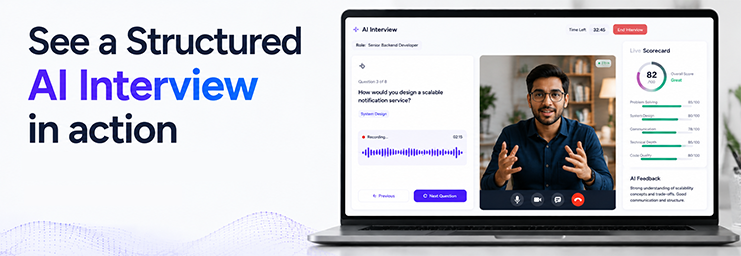
Think of it as the difference between a tool that helps you interview and a system that runs the interview itself. A scheduling tool saves clicks. An AI interviewer saves the forty hours of first rounds and then presents the results in a form a human can quickly judge.
What it is not: a hiring decision-maker. In any responsibly built platform, the AI screens and the recruiter decides. That line matters, and this article will keep returning to it.
How Does an AI Interviewer Work?
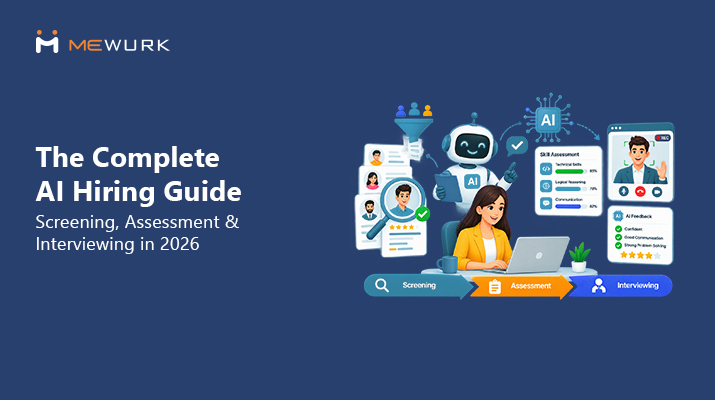
The workflow from job to shortlist consists of nine steps. Four of them happen once. The rest run themselves:
- Create the job. Role, department, location, and the hiring managers who own it.
- Upload or define the job description. The JD becomes the source the system works from.
- Generate interview questions. The platform drafts a structured set of questions from the JD. Good platforms keep each question editable because you own the bar.
- Configure scoring criteria. Grading rubrics get linked to each question, so scoring is transparent rather than a black box.
- Invite people. Individually or in bulk, instantly or on a schedule. Candidates pick a slot that fits their life.
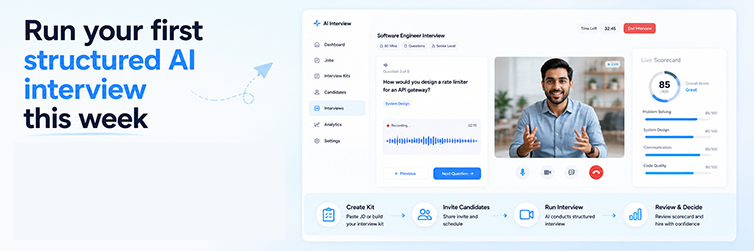
- The AI conducts the interview. Structured questions, video responses, any hour of the day. Recording and transcription run throughout.
- Responses get evaluated. Each answer is scored against the rubric, question by question.
- The recruiter reviews everything. Scores, transcript, recording, strengths and gaps, plus any proctoring flags, all in one place.
- A human makes the final call. Shortlist, hold, or pass. The recruiter can override any score because context beats computation.
Notice where the effort moved. Steps one to four happen once per role. Steps five to seven run themselves at any volume. Human judgment concentrates where it counts: the review and the decision.
Why Traditional Candidate Screening Is Becoming Difficult
The old screening model assumed a manageable pile. That assumption died quietly somewhere around the one-click apply era.
Today, a single mid-level posting in an Indian metro pulls in hundreds of applicants within days. Many are copied, pasted, and sent to fifty firms. Meanwhile, the people worth hiring are employed, busy 9 to 6, and gone in a week if you're slow. Add remote hiring across time zones. Five interviewers, five question styles. Recruiters are burning their sharpest hours on repeat screens. The picture is clear. The manual model wasn't bad. It was built for a volume that no longer exists.
AI Interviewer vs Traditional Interviewing
| Aspect | Traditional first round | AI interviewer |
|---|---|---|
| Scheduling | Email chains, calendar Tetris | Candidate picks any hour, even 11 PM |
| Questions | Varies by interviewer and mood | Same structured set for every applicant |
| Documentation | Scribbled notes, memory | Full recording, transcript, per-question scores |
| Throughput | A handful of screens per day | Every applicant, in parallel |
| Comparison | Gut feel across days of calls | Side-by-side scores on the same criteria |
| Final decision | Human | Still human, now with evidence |
The last row is the one that matters. The format changes. The decision-maker doesn't.
Key Benefits of AI Interviewers for Recruiters
Faster Candidate Screening
Each applicant can be screened in parallel rather than one by one. A backlog that meant two weeks of calls becomes a ranked list waiting the next morning. Speed here isn't a luxury. It's how you stop losing employed people to faster rivals.
Consistent Interview Questions
Each person applying for a role faces the same core questions. No easy interviewer, no tough one, no eighth-interview-of-the-day drift. Consistency is what makes comparison honest.
Structured Candidate Evaluation
Answers are scored against rules written before the rounds start, not made up afterward. Decades of hiring research back this: structured interviews predict on-the-job success far better than free-flowing chats.
AI Scoring and Insights
Per-question scores, not one mystery number. Strengths and gaps in plain words. A recruiter sees where a person shone and where to probe in the next round.
Better Interview Documentation
Each session leaves a recording, a transcript, and a scorecard. When a hiring manager asks, "Why this person?" the answer is a link, not a memory.
Scalable High-Volume Hiring
Fifty applicants or five hundred, the first round costs your team the same effort: nearly none. Seasonal drives and campus rounds are no longer logistics projects.
Candidate Experience
People interview at times that fit real lives, including those who are only free at night. A structured round also feels fairer than a rushed call. One condition, though: tell people an AI is running the round. Honesty here isn't optional. Well-built platforms say it up front.
How AI Interviewers Help SMEs With High-Volume Hiring
The assumption is that AI hiring tools are used by big companies. The reality runs the other way.
A 5,000-person company has a recruiting team to absorb screening volume. A 60-person company in Ahmedabad has one HR person handling recruitment, payroll, and attendance disputes. When that company needs six sales hires or twenty field technicians before the season, the founder either loses two weeks to screening or builds the shortlist on resume skims.
An AI interviewer changes that maths. The one-person HR team invites every applicant, and structured first rounds run overnight. The human effort starts at the review stage, with a ranked list of people who have already answered the real questions. For SMEs, the tool isn't an efficiency gain on a large team. It's the team that was never there.
What Features Should You Look for in an AI Interviewer Platform?
The direct answer: editable questions, clear scoring, recording and transcripts, proctoring, bulk handling, and recruiter override on each score. Here's why each matters.
- Editable interview questions. Generated kits are a start, never the end. If you can't change the questions, you don't own the bar.
- Scoring you can see into. Rubrics are linked to questions; weights are controlled by you. A score you can't explain is a score you can't defend.
- Full documentation. Recording, transcript, per-question scores, always.
- Proctoring with judgment left to humans. Signals like tab switches or face presence should inform review, never auto-reject anyone.
- Candidate handling at volume. Bulk invites, resume parsing, and status tracking, or the tool creates its own admin.
- Human override. The recruiter can adjust or overrule any AI score. Non-negotiable.
Why Recruiters Are Moving Toward AI Interviewers: Where Mewurk Fits
Maya, Mewurk's AI interviewer, is built on one principle: hand off the repetition and keep recruiters in charge.
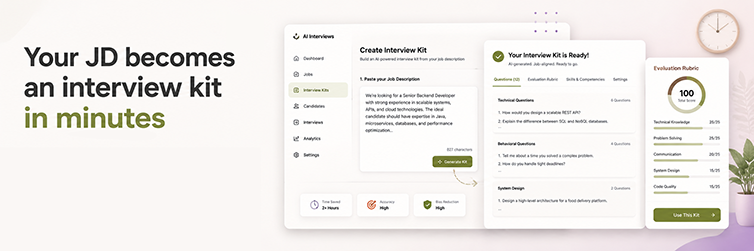
The flow starts with the AI Interview Kit. Upload a JD, and Maya drafts the round: questions, follow-ups, grading rubrics, and the intro and closing scripts. Each section is editable and can be regenerated independently. The hiring team approves the bar before any candidate sees it.
Candidate management handles the volume side. Bulk resume uploads get parsed into structured profiles and scored against the JD. Invites go out instantly or on schedule, with tracking from sent to done. Sessions run at any hour and include recordings, transcripts, and per-question scores. Strength-and-gap summaries tell your team where to probe.
Integrity comes from proctoring insights, face presence, voice activity, tab-switch alerts, and noise checks, rolled into one simple risk flag. Two design choices matter here. People are told about monitoring before the session. And no proctoring signal auto-rejects anyone. Flags land with the recruiter, who reviews with context. Scores work the same way. Recruiters have an override on each one.
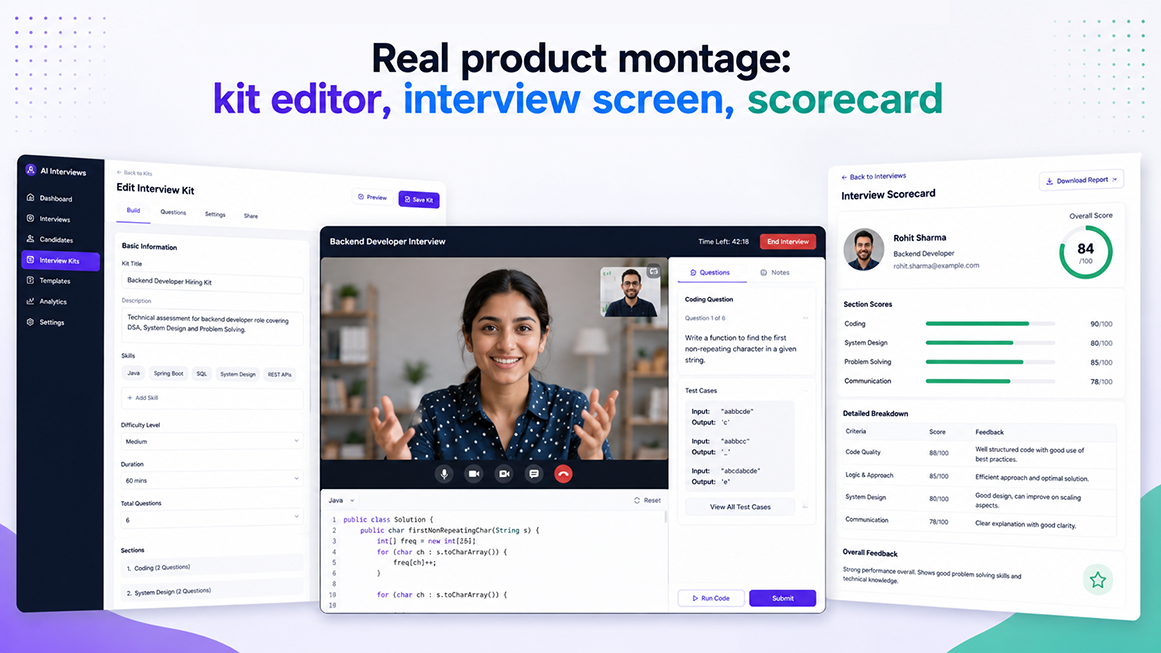
The result is an end-to-end first round within a single platform, sitting alongside the rest of Mewurk's HR software. And once someone's hired, the AI Assessment side covers ongoing training checks, which is a different job for a different day.
AI Interviewer vs Manual Screening: The Four Approaches Compared
The market context, honestly laid out:
| Approach | What it does | Where it stops |
|---|---|---|
| Manual screening | A human reads every resume and calls shortlisted people | Breaks past a few dozen applicants. Consistency varies by day |
| ATS-based screening | Filters resumes by keywords and criteria | Judge the paper, not the person. Good candidates with odd CVs vanish |
| AI-assisted screening | Ranks resumes with smarter matching | Still resume-only. Nobody has answered the question yet |
| AI interviewing | Runs structured first-round interviews and scores real answers | Ends at the shortlist. Humans take it from there |
Each tier answers more of the question, "Can this person do the job?" The first three evaluate documents. Only the last one evaluates answers.
Does AI Replace Human Recruiters?
No, and any platform promising otherwise deserves suspicion. AI interviewers handle the repeatable layer: asking the same questions well, at any volume, and scoring answers consistently each time. Everything human about the job stays human. Judging culture fit. Reading drive. Talking money. Handling someone's hard moment. Making the call.
What actually changes is where recruiter hours go. Less time performing round one for the fortieth time. More time on the talks that decide whether someone thrives. Recruiters who use these tools well don't shrink their role. They upgrade it.
Challenges and Considerations When Using AI Interviewers
Balanced means naming the hard parts too.
- Bias doesn't vanish on its own. AI can reduce certain biases through structure and uniformity. But a system set up carelessly can carry bias at scale. Audit outcomes regularly. Never claim or believe that any tool "eliminates" bias.
- Transparency with people. People should know that an AI is running the session and that monitoring is in place. Hidden automation kills trust the moment it's found.
- Data privacy. Rounds are personal data: video, voice, transcripts. Know where it's stored, how long it's kept, and what people can ask about it. Prefer platforms that don't store biometric templates.
- The over-automation trap. If a person never meets a human before the offer stage, the process feels cold, and your employer brand pays the price. Keep humans visible.
- Rubric quality decides everything. The AI scores against what you wrote. A lazy rubric produces confident nonsense. Invest the hour.
How to Choose the Right AI Interviewer Software
Keep the selection simple and evidence-based. Shortlist platforms that meet the feature bar above. Then run a real test: take a live JD, generate the interview, edit it, and have two or three volunteers go through it. Review what the recruiter actually receives. If the scores make sense, the transcript is usable, and overriding a score takes one click, you've found a workable tool. If the vendor resists a hands-on trial, that's your answer too.
Price last, not first. The cost that matters is recruiter hours, and you now know how to count those.
Conclusion
Screening broke down because the applied volume exceeded available human hours. Not because recruiters got worse. The AI interviewer fixes the layer that broke. Each applicant gets a real, structured first round. Each recruiter gets evidence, not a pile of it.
The principle worth carrying into any purchase is the one this article kept repeating. The AI screens. The human decides. Held to that line, an AI interviewer doesn't make hiring robotic. It makes the human parts of hiring possible again.
Frequently Asked Questions (FAQs)
1. What is an AI interviewer?
Software that conducts structured first-round rounds without a human present in the session. It asks role-based questions, records and transcribes video answers, and scores each response against set criteria, providing your team with a ranked shortlist and full evidence to review.
2. How does an AI interviewer work?
You create the job, upload the JD, and the platform generates editable questions with scoring rubrics. Candidates get invited, interview on video at any hour, and each answer is scored. The recruiter reviews transcripts, recordings, and scores, then makes the decision.
3. Can AI interview candidates?
Yes, for the structured first round. AI handles the same questions, recording, transcripts, and scoring at any volume. What it can't do is judge culture fit, negotiate, or make the hiring call. Those stay with recruiters in any well-designed process.
4. What are the benefits of AI interview software?
Parallel screening instead of one-by-one calls. The same questions for fair comparison. Clear per-question scores. Full records of each session. And first rounds at hours people can actually make. Your team spends its time deciding, not repeating.
5. Can AI interviewers reduce screening time?
Substantially, because rounds run in parallel and around the clock. A pile that meant weeks of sequential calls becomes a ranked shortlist by the next morning. The exact gain depends on your volume, but the one-by-one bottleneck disappears entirely.
6. Is an AI interviewer better than manual screening?
For the repeat first round at volume, yes. Steadier, fully recorded, and far more scalable. For judgment, relationships, and final decisions, humans remain better, which is why good processes combine both rather than choosing one.
7. How does AI score candidates?
Against grading rubrics defined for the role, linked to each question. Each answer gets its own score, and summaries flag strengths and gaps. In well-built platforms, the rubric is visible and editable, and recruiters can override any score.
8. Is AI interviewing suitable for SMEs?
Especially. Small teams lack a recruiting department to handle the volume of hiring. So, handing off the first round returns the most hours exactly where they're scarcest. A one-person HR team can run structured interviews for every applicant.
9. Does AI replace recruiters?
No. It removes the need for repeated screening layers so your team can focus on judgment, culture fit, offers, and relationships. Platforms promising to replace recruiters misunderstand the job. The final decision should always sit with a human.
10. What should recruiters look for in an AI interviewer platform?
Editable questions. Clear rubric-based scoring. Full recordings and transcripts. Proctoring that informs rather than auto-rejects. Bulk candidate handling. And recruiter override on each score. Then insist on a hands-on trial with a real JD.