Summary
AI hiring means software does the first pass. It checks resumes, looks at skills, conducts video interviews, and helps assess candidates for the role. Set up well, you hire faster and treat every person the same. Set up badly, you get a black box full of scores nobody can explain. This guide keeps you on the right side of that line.
Three hundred resumes. One cold coffee. A shortlist due by five.
That was one recruiter's Friday, the way she told it to me. She didn't call it recruiting. She called it triage. And that's the exact problem AI hiring turned up to fix.
AI hiring software is becoming part of recruitment for many companies. Here's a look at how it works, what it can handle, and where recruiters still need to make the final call.
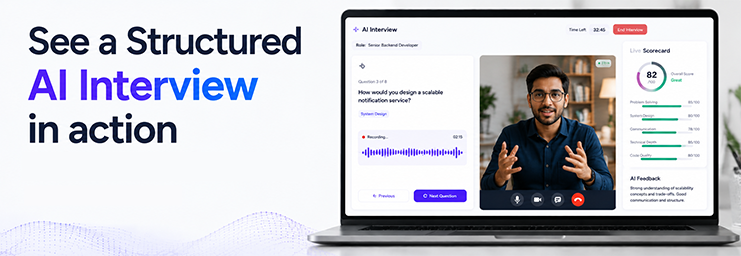
What AI Hiring Really Means in 2026
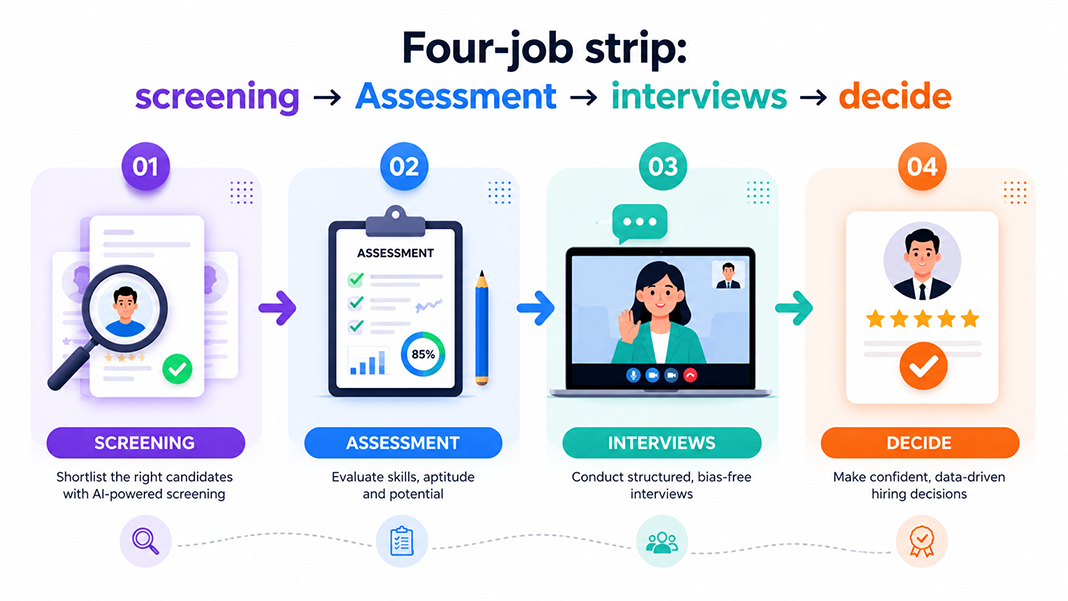
People say "AI hiring" as if it were a single tool. It isn't. It's four jobs at four points in the funnel:
- Screening. Software reads resumes and aligns them with the role.
- Assessment. A test shows whether someone can do the work, not just talk about it.
- Interviews. Video or voice. Sometimes AI leads. Sometimes it assists.
- Decision support. Scores and side-by-side views that inform a manager. They don't replace one.
What will have changed by 2026? Not just speed. AI can now run a structured first-round interview at 11 PM on a Tuesday. In the person's own language. At any volume you throw at it. The manager gets a scorecard, not forty video links nobody will watch. That's a real jump from the old keyword tools.
Let's be clear on one thing, though. AI hiring doesn't pick who gets the job. It cannot remove bias when the data used to train the system is already skewed. It also needs regular review rather than being set up once and left alone. It's a fast, steady first filter. Nothing more. It buys your team time for the work that needs a human: reading culture fit, talking money, making the call.
Why Traditional Recruitment No Longer Scales
The old way worked when you hired ten people a year. Read each resume. Call each good fit. Book each interview by hand. Then volume grew, and it broke.
Why it keeps breaking:
- Too many applications. One mid-level job post can pull hundreds of applications in days. Many send the same resume they sent to fifty other firms.
- Good people don't wait. They're gone in days, not weeks. Take three weeks to book a first chat, and someone faster wins.
- Interviews aren't even. Five interviewers may have different views of the same candidate. The hiring decision can sometimes be influenced by the interviewer's personal impression and the candidate's skills.
- Remote adds friction. Try booking a panel across three time zones for every applicant. It doesn't hold.
- Recruiters burn out. Screening hundreds of resumes a week is dull, low-judgment work. It drains the energy the real job needs.
None of this blames recruiters. The manual way was never built for this load. Pretend it was, and the strain lands on the people applying.
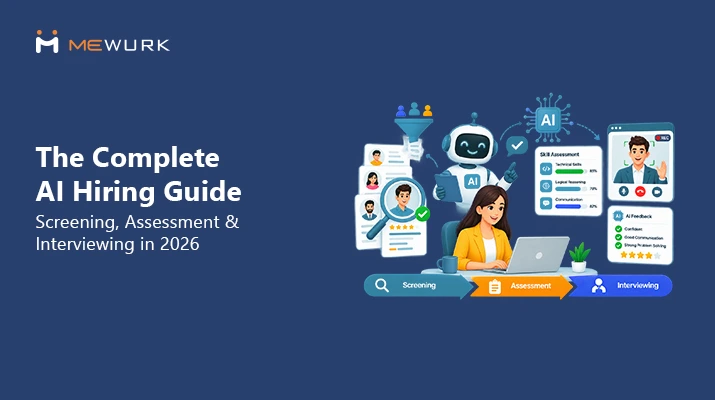
A typical AI-assisted funnel runs in ten stages:
- Job requisition created
- Job posted across channels: careers page, job boards, LinkedIn
- Applications received
- AI resume screening and ranking. Clearly unfit profiles drop out.
- Skills-based assessment. A short, role-specific test or task.
- AI video interview with structured, job-based questions
- AI-generated scorecard
- Human review and shortlisting by the hiring manager
- Final round with a human panel
- Offer and onboarding
Look at where the human sits, reviewing the shortlist and making the call. Not grinding through round one by hand. That's the whole design idea. AI narrows the funnel. People own the decision.
Resume Screening with AI
Screening is the first traffic jam in most hiring. It's also where AI proves itself fastest.
How it works
Good screening moved past keyword matching years ago. Today it tends to:
- Turn each resume into clean data: skills, roles, education, time in each job
- Match that data against what the job asks for
- Rank people by fit, not by buzzword count
- Flag gaps or career switches for a human to read, instead of binning them in silence
Where it helps most
Picture a retail chain filling 40 store roles across a city. That post could pull 2,000 applications in a week. AI screening can turn the pile into a ranked list of maybe 150 real fits within hours. Done by hand, that's days of reading. Gone.
Where to be careful
Here's the catch. Train a model on your old hiring data, and it can soak up your old habits. Maybe it starts favouring a few college names. Maybe it marks down career gaps without saying anything about skills. A good platform lets you open the hood and change what it screens for. A locked box you just have to trust? Not good enough.
Skills-Based Candidate Assessment
A resume describes a person's previous work and experience. A skills test shows what they can do today. That gap grows every year. Resume inflation is real, and AI-polished cover letters make paper claims even softer.
Common types of assessments
| Assessment type | Best suited for | Example |
|---|---|---|
| Coding challenge | Software roles | A live or timed coding task in a sandbox |
| Case study or scenario task | Sales, marketing, consulting | "How would you respond to this client objection?" |
| Cognitive or aptitude test | Entry-level, high-volume hiring | Logical reasoning, basic numerical ability |
| Job simulation | Customer support, operations | A simulated ticket queue or call |
| Portfolio review | Design, content, creative work | Real work samples scored against a rubric |
A real-world example from manufacturing
Say a factory is hiring shift supervisors. Skip the generic aptitude quiz. Give them a scene instead: "A machine on your line just stopped mid-shift. You're falling behind target. What do you check first?" Score the answers on a rubric that real plant managers wrote. You'll learn more than any resume line that says "5 years of supervisory experience."
Keep tests short and tied to the job. A 45-minute personality test may not be suitable for a warehouse applicant and could make the hiring process less convenient.
AI Video Interviews Explained
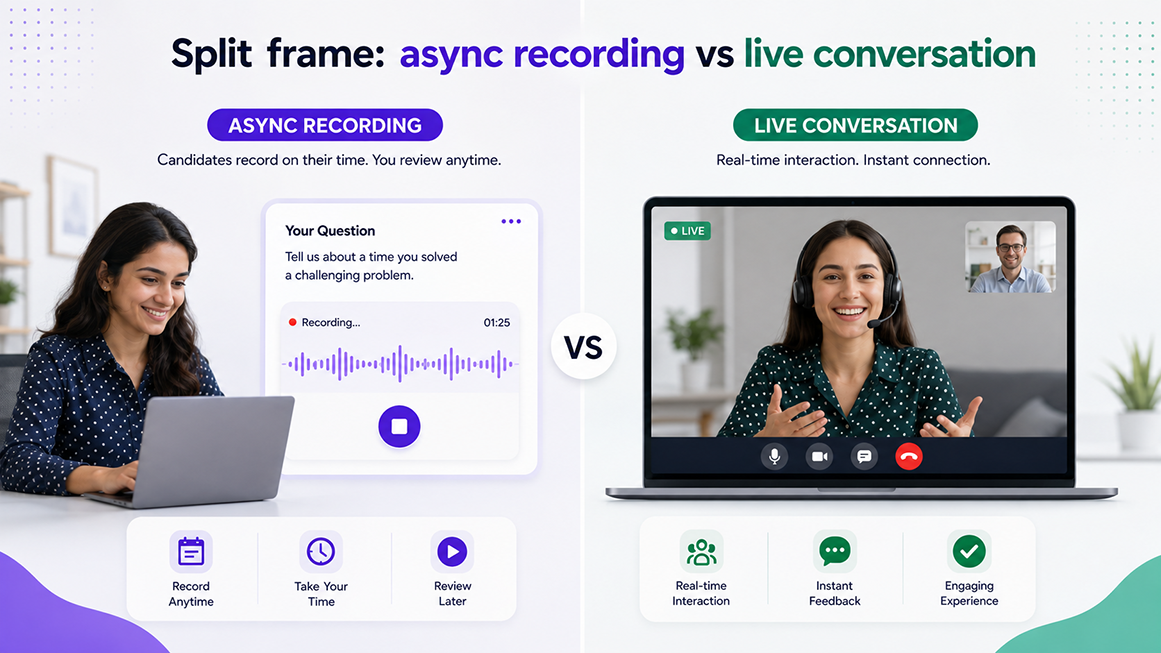
This is the most misunderstood corner of AI hiring. One term covers two different things.
Asynchronous interviews. The person records answers to set questions whenever it suits them. The AI transcribes and scores. A recruiter reviews later.
Live AI interviews. The AI talks with the person in real time. It asks follow-ups based on what they just said. A good recruiter probes a vague answer the same way.
Why companies use them
- Scheduling pain disappears. No more email chains across three time zones.
- Everyone answers the same core questions. Comparing them gets fairer.
- Recruiters read a scorecard and transcript, not hours of raw video.
- People interview when it suits them. Nights. Weekends. Between shifts. That matters a lot in hourly hiring.
A campus recruitment example
Say you're hiring across a dozen colleges. Don't fly recruiters around for a week. Run AI video interviews for 800 final-year students in one week instead. The shortlist then meets a human panel. Nobody gets an offer without first talking to a real person.
What a good AI interviewer should and shouldn't do
A well-built AI interviewer sticks to structured, job-based questions. It's fair. It doesn't rush people. And it says, up front, that it's AI. What it should never do is make the hire-or-reject call on its own. And there must always be a clear path to a real person when something breaks.
Introducing Maya: Smarter Hiring Conversations at Scale
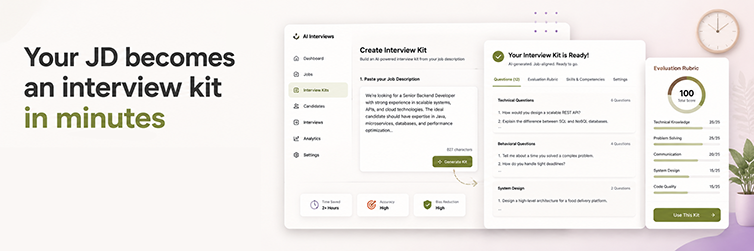
As AI becomes more common in hiring, teams need more than resume screening. They need a system that runs initial interviews, evaluates responses based on the role, and gives managers a clear summary, with the final decision remaining with the hiring team.
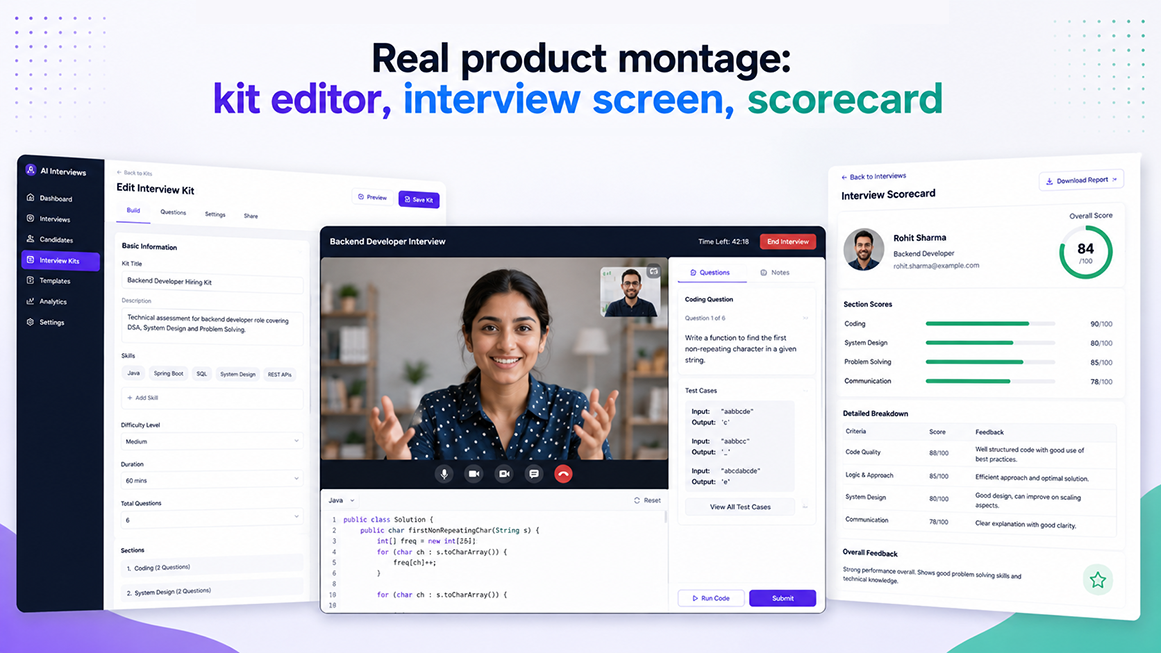
Maya AI, the Mewurk AI Interviewer, is built for that first-round layer. You upload a job description. Maya drafts the interview kit: questions, follow-up questions, and grading criteria. Every piece stays editable because you own the bar, not the tool. Candidates take a structured video interview at any hour: proctoring, a live transcript, and a full recording come built in.
Where Maya helps most:
- High-volume screening with no scheduling bottleneck
- The same structured first round for every applicant
- Answers scored against role-specific criteria, question by question
- Clear strengths-and-gaps summaries for managers
- Less repeat work for recruiters
- Humans in charge. Recruiters can override any AI score.
The goal was never to replace recruiters. It's to make up for the hours lost to repeat screening. Spend those hours on motivation, culture fit, hard conversations, and the final call.
AI-Powered Candidate Scoring
You've got resume data, test results, and interview answers. Scoring turns all that into something a manager can act on.
What a solid scorecard includes
- A skills-match view against the job description
- Results from any test or coding task
- Interview scores split by competency, not one lump number
- Signals on communication and problem-solving
- Flags on anything odd that deserves a human double-check
Why one overall score isn't enough
Say someone scores 72 out of 100. So what? That number alone tells you almost nothing. They could be great at the work and bad at explaining it. Or the reverse. Managers need the breakdown. Maya breaks down performance by question and competency, with strengths and gaps in plain language. You see where to dig deeper next round. No mystery number, no blind trust.
Structured Interview Frameworks
AI interview tools are only as good as the structure they are built on. And decades of hiring research point one way. Unstructured interviews, in which each interviewer asks whatever comes to mind, rank among the weakest predictors of job performance. Structured interviews beat them. Again and again.
The core ideas
- Every candidate for a role gets the same core questions
- Each question maps to a real competency, not small talk
- The scoring rubric exists before interviews start, not after, to dress up a gut call
- "Tell me about a time" beats "What's your opinion on"
Sample competency questions for a customer support hire
- "Tell me about a time you handled an angry customer. What did you say first?"
- "A customer's problem fits none of your scripts. Walk me through your next step."
- "How do you decide when to escalate and when to handle it yourself?"
This is where AI interviewers shine. They hold the structure every single time. No drifting into small talk on the eighth interview of a long day.
How AI Reduces Hiring Bias
This claim is disputed. It deserves a straight answer, not a sales one. Yes, AI can cut certain kinds of bias. But only if you build it with care and keep watching it after launch. Nothing gets fairer just because you flipped a switch.
Where AI genuinely helps
- It's consistent: same questions, same way, for every person. A tired interviewer is no longer a factor.
- It can screen blind. Some tools hide names, photos, or graduation years in the first pass. Affinity bias drops.
- Its scores leave a trail. A gut feeling can't be audited. A scorecard can. A team can review it and fix it when a bias pattern is detected.
Where AI can make things worse
- Training data that mirrors your own biased history
- Leaning on proxies like college prestige or career gaps
- Accent and language issues in speech tools that weren't tuned with care
A healthcare example
A hospital network was hiring nurses across branches. Its manual screening continued to favour a few familiar nursing colleges. Nobody meant to. It was a habit. So the team changed the base: license, clinical hours, and a structured skills test. Then they audited outcomes by group every cycle. The gap closed a great deal over the next two rounds.
The point stands. AI doesn't excuse you from watching for bias. It hands you sharper tools to catch it if you use them.
Human + AI Collaboration in Recruitment
The setups that work treat AI like a research assistant. Never the decision-maker. A simple split:
| Task | Better handled by |
|---|---|
| Screening hundreds of resumes | AI |
| Scheduling first-round interviews | AI |
| Asking consistent, structured interview questions | AI |
| Scoring answers against a rubric | AI |
| Deciding who gets the offer | Human |
| Negotiating pay | Human |
| Judging team and culture fit | Human |
| Handling a candidate's sensitive concerns | Human |
Take an IT firm hiring backend developers. AI screens resumes and runs a structured first round, technical plus behavioural. The system-design round and the offer talk stay in human hands. AI clears the volume. People make the judgment calls.
Benefits of AI Hiring for SMEs
Many small firms assume AI hiring is a big-company kit. It's the other way around. Smaller teams often gain more because there isn't a large recruiting team around to absorb the manual work.
The clearest wins:
- Founders and small HR teams stop losing whole days to resume reading
- Faster hiring lets a small firm beat bigger names to the same talent
- Structured interviews replace one manager's gut feel
- Cost per hire drops next to agency fees or a role sitting empty for months
- Hiring scales up and down with no new recruiting headcount
A startup example
Picture a 25-person startup building its first six-person sales team. Do it by hand, and the founder loses two full weeks to screening. With AI on the first round, the founder shows up for final talks with five or six strong people. That's it.
AI Hiring for Enterprises
Big-company hiring has its own weight. Huge volume across locations. Compliance rules. And dozens of hiring managers who've never met, all holding one standard.
What do enterprises need from AI hiring:
- A clean fit with the ATS and HRMS already in place
- Role-based access and audit trails, for compliance
- One interview standard across regions and units
- Funnel numbers that show how hiring performs firm-wide
- Room to run seasonal or campus drives without falling over
A high-volume example
A logistics firm needs 500 warehouse staff before peak season. AI screening and testing clear thousands of applicants in days, not weeks. AI interviews run the first round. Regional HR only meets people who have already cleared one steady bar.
Common AI Hiring Mistakes
Good intentions fail in the same few ways. Watch for these:
- Treating the AI score as the verdict, not one input
- Skipping the bias audit, at launch or after
- One generic test for every role, no matter the job
- Hiding the AI from candidates. Trust dies when they find out.
- Automating so much that the whole thing feels cold
- Ignoring gaps with your ATS or HRMS, which means duplicate data entry
- Never revisiting the scoring rules as the role changes
Pros and cons at a glance
| What AI hiring gets right | What goes wrong when done badly |
|---|---|
| Faster screening and scheduling | Inherits bias from flawed training data |
| Consistent, structured interviews | Feels impersonal when overused |
| Scales for high-volume hiring | Needs ongoing audits and oversight |
| Frees recruiters for higher-judgment work | Integration gaps with older systems |
| Data-driven candidate comparisons | Candidates lose trust without transparency |
Ethical AI Recruitment Best Practices
- Tell people AI is involved. Say it up front. Explain roughly how it works.
- Keep a human on final decisions. No score should reject anyone on its own.
- Audit for bias on a schedule. Not once. Check outcomes by gender, ethnicity, age, and disability where the law allows.
- Give candidates a channel to ask questions or flag what felt off.
- State how long you keep data. Resumes, video, scores. And how someone can ask you to delete theirs.
- Prove your tests predict the job. Not just traits that look good on paper.
- Skip personality scoring from tone or facial cues. The bias risk is real. The science is shaky. Several places ban it outright.
AI Hiring Myths vs Reality
| Myth | What is true |
|---|---|
| "AI hiring wipes out bias completely" | It can cut some bias and add new bias when the training data is flawed. Audits are not optional. |
| "AI makes the final hiring decision" | In well-built systems, AI informs the decision. A human makes the call. |
| "Candidates hate AI interviews" | Many prefer the flexible timing and faster feedback, as long as the process is open about it. |
| "AI hiring only suits big companies" | Small firms often see the payoff sooner. There's no big recruiting team to fall back on. |
| "One AI tool works for every role" | Tests and questions need to be tailored to the role, or they predict nothing useful. |
| "AI hiring runs itself" | Good AI hiring is people plus software. Not software instead of people. |
AI Hiring Implementation Roadmap
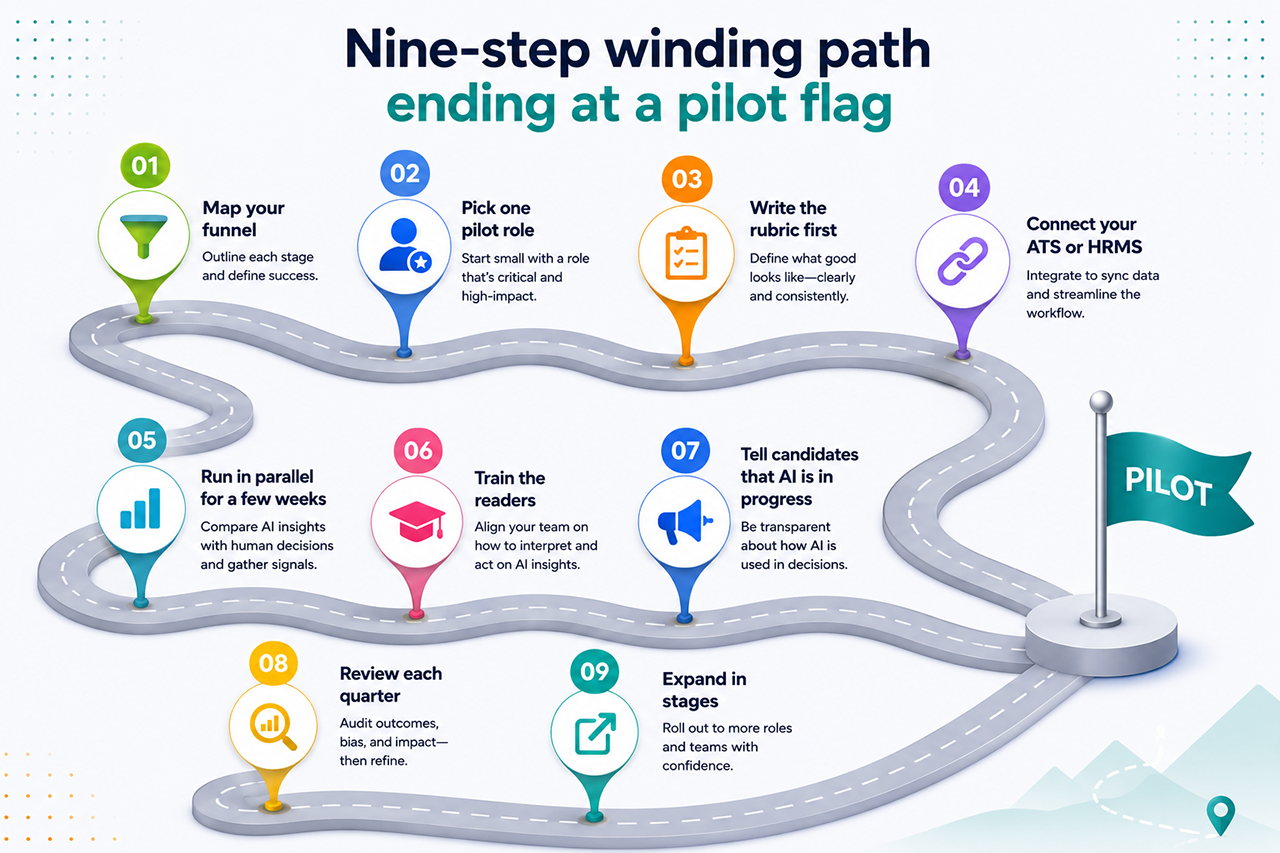
Nine steps that won't blow up your current process:
- Map your funnel. Find the real bottleneck. Screening? Scheduling? Uneven interviews?
- Pick one pilot role: high volume, high repeat. Impact shows fastest there.
- Write the rubric first. Questions and scoring criteria come before any automation. The AI is only as good as the rubric you hand it.
- Connect your ATS or HRMS. A second, disconnected system requires weekly hand cleanup.
- Run in parallel for a few weeks. Compare the AI shortlist with your team's pick. Study the gaps.
- Train the readers. Recruiters and managers should know how to read a scorecard and when to override it.
- Tell candidates that AI is involved.
- Review each quarter. Hire quality, time-to-hire, and fairness numbers. Adjust.
- Expand in stages once the pilot proves out.
AI Hiring Readiness Checklist
Run through this before switching on any AI hiring tool:
Future Trends in Recruitment
Worth watching:
- Skills-first hiring is pulling ahead of degree-first, as tests get better at predicting the job
- Voice and conversational AI interviews are getting closer to a real recruiter chat
- Deeper HRMS ties, so hiring data flows into onboarding and planning instead of a silo
- Tighter rules, with more places requiring disclosure and bias audits by law
- Candidate-side AI, from resume polishers to prep bots, pushing recruiters toward tests that measure real skill and resist gaming
Final Summary
AI hiring was never about swapping recruiters for algorithms. It's about getting back the hours lost to repeated screening. Spend them where they count: culture-fit talks, offer talks, the final call. Add structure, oversight, and honesty with candidates, and hiring gets faster without going cold.
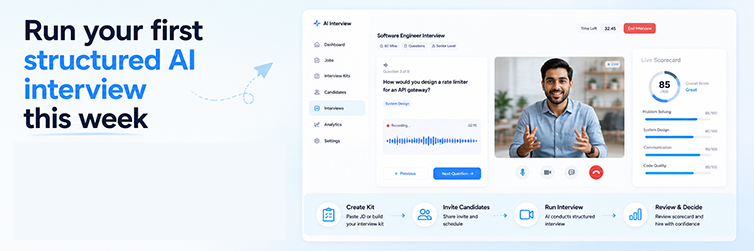
Maya, the Mewurk AI Interviewer, packs that first-round layer into one place. Resume parsing. Editable interview kits. Structured video interviews. Question-by-question scorecards with strengths and gaps. Proctoring and full transcripts. And recruiters have override on every score. Not sure where to start? Pick one high-volume role and run a pilot. It's the lowest-risk way to see the difference yourself.
Frequently Asked Questions
1. What is AI hiring?
It's using AI for recruiting tasks. Screening resumes, testing skills, running video interviews, scoring candidates. Recruiters then spend their time on final decisions, not manual shortlists.
2. Is AI hiring fair to candidates?
It can be. The conditions: audit the screening rules and rubrics for bias on a schedule and keep a human in the final decision-making process. Skip those, and it can end up as biased as manual hiring. Sometimes worse.
3. Do candidates know when AI is interviewing them?
They should. Ethical practice means saying so before the interview starts. Any platform worth using makes that clear up front.
4. Can AI hiring replace recruiters altogether?
No. It's great at high-volume, repeat work like screening and first rounds. Final decisions, offer talks, and culture-fit judgments still need a person.
5. Is AI hiring only useful for big companies?
No. Small firms and startups often see the payoff sooner. They have no big recruiting team to fall back on.
6. How does AI hiring cut time-to-hire?
It automates screening, scheduling, and the first round of evaluation. Weeks of screening compress into days. Managers meet a qualified shortlist much sooner.
7. What should I look for in an AI hiring platform?
Structured interview frameworks you can edit. Scoring split by competency. A fit with your ATS or HRMS. Real bias-audit tools. And clear language for telling candidates that AI is involved.