Top Benefits of Realtime Attendance Software for SMBs and Remote Teams
An HR professional with over a decade of experience across manufacturing, IT, and retail in India said recently that the biggest shift in workforce management has been moving from paper registers and Excel sheets to realtime attendance tracking tools.
Convenience is one of the biggest factors for liking a realtime attendance software, but equally promising are reasons like operational accuracy, cost control, and compliance rolled into one.
For small and medium businesses (SMBs) and distributed remote teams, especially, the shift from manual attendance tracking to automated, live data systems can redefine how HR functions entirely.
Why Manual Attendance Tracking Increases Costs for Businesses
Putting a number on the problem is the only way to see what it (manual attendance tracking) is costing you.
A 2024 study by Deloitte found that over 40% of SMBs in India still rely on manual HR processes, and attendance tracking is among the most error-prone of those.

Issues like buddy punching, mis-punches, inconsistent overtime calculations, and payroll errors drain business revenue every month. In a 50-person company, even a few minutes of inaccurate daily time tracking per employee can accumulate into hundreds of thousands of rupees in payroll errors annually.
The problems with manual attendance management fall into three broad categories:
- Data inaccuracy: Spreadsheet entries are human-entered, which means they are susceptible to typos, forgotten entries, and deliberate manipulation.
- Payroll delays: HR teams spend excessive hours reconciling attendance data before each payroll cycle. The time theft is often invisible but consistent.
- Compliance blind spots: Under Indian labour laws like the Factories Act, Shops and Establishments Act, and applicable state-level regulations, accurate attendance records are a legal obligation. Manual records rarely meet audit-grade standards.
Realtime attendance software addresses every one of these pain points head-on.
What Is Realtime Attendance Software?
Realtime attendance software is a digital workforce management tool that can capture, process, and display employee attendance data the moment it is recorded without requiring any manual entry or delay.
Unlike legacy systems, where data was aggregated at the end of a shift or a day, realtime solutions show you who punched in, who is late, who is absent, and who is on leave all at this very second.
Key Technologies Powering Realtime Attendance Software
| Technology | What It Does | Where It Works Best |
|---|---|---|
| Biometric Fingerprint Readers | Captures unique fingerprint data to authenticate punch-in | Manufacturing, warehouses, field offices |
| Facial Recognition | Contactless attendance marking via camera | Post-COVID hygiene-sensitive workplaces |
| Geo-Fencing & Geo-Tagging | Locks attendance to a GPS-defined boundary | Remote teams, field sales staff |
| Mobile App Clock-In | Employees mark attendance via smartphone | Hybrid and work-from-home employees |
| RFID / Smart Cards | Quick-tap attendance using proximity cards | Large campuses, multi-floor offices |
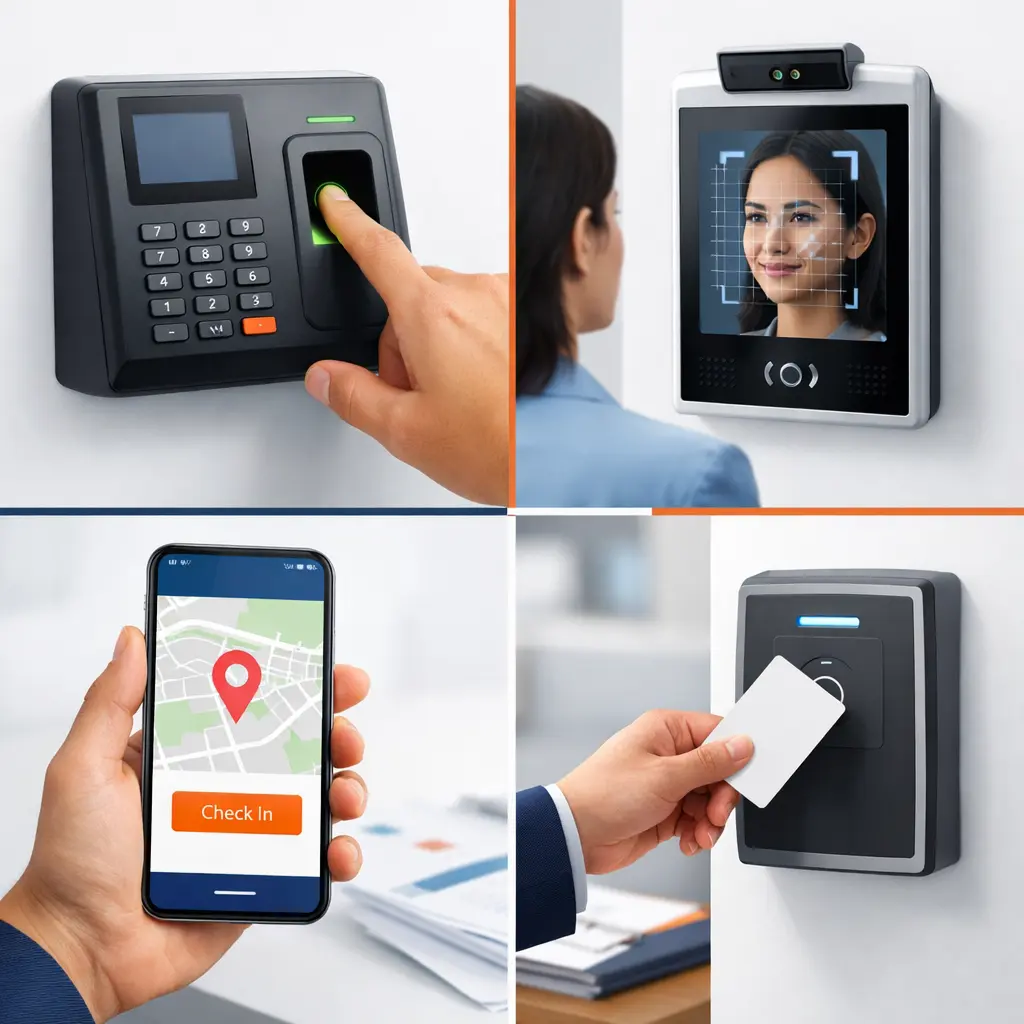
Realtime biometric attendance software like Mewurk integrates these hardware inputs directly with cloud-based HR management systems. At once the data is captured, it is analysed and acted upon in real time.
Top Benefits of Realtime Attendance Software for SMBs
Using realtime attendance management software can help an organisation deal with several challenges, like:
1. Elimination of Time Theft and Buddy Punching
Time theft is one of the most underestimated cost leakages in Indian SMBs. It happens when an employee marks attendance on behalf of an absent colleague. This practice is generally known as buddy punching.
Studies suggest that buddy punching costs businesses up to 2.2% of their total gross payroll annually.
Realtime biometric fingerprint attendance machine software solves this by binding attendance records to a unique biometric identifier. It means no one can punch in for someone else.
The moment an employee places their finger on the sensor or looks into the facial recognition camera, the software logs the exact timestamp and syncs it to the central HR dashboard. HR managers can see the data on their screen before the employee has even left the front desk.
2. Accurate Payroll Processing with Zero Manual Intervention
One of the greatest operational benefits of deploying realtime attendance software in your organisation is the near-total elimination of manual payroll reconciliation.
In a traditional setup, the HR team collects daily attendance sheets, cross-references leave records, applies overtime rules, and manually calculates working hours before sending it all to payroll. A team of five HR executives might spend three full days before each payroll cycle doing only this.
With realtime attendance software, all of that happens automatically. Attendance data goes directly into the payroll engine. The software applies the configured pay rules, deduction policies, overtime thresholds, and shift differentials.
According to SHRM research, businesses that adopted automated HR management systems reported a 25% reduction in HR operational costs within the first year.
3. Live Workforce Visibility for Distributed and Remote Teams
Remote work has become a permanent feature of the Indian workforce landscape. Post-2020, a large percentage of IT companies, BPOs, consulting firms, and even BFSI organisations in India now operate on hybrid or fully remote models.
For HR managers handling remote teams, the core challenge is knowing who is working and when. Realtime attendance software with mobile clock-in, geo-fencing, and selfie-based attendance provides that visibility without being intrusive.
For instance, a sales team spread across Bengaluru, Hyderabad, and Pune mark attendance from their field locations, and their manager sees a live dashboard update the moment they do.
The realtime attendance login feature on most cloud-based platforms allows HR managers to access attendance data from any device and any location. The data is live, accessible, and accurate.

4. Compliance with Indian Labour Laws and Statutory Requirements
Indian labour law compliance is complex. Under different laws like the Factories Act, 1948, the Shops and Establishments Act (state-specific), and the Code on Wages, 2019, organisations are expected to maintain accurate records of working hours, overtime, rest intervals, and weekly offs.
The penalty for non-compliance ranges from fines to factory licence suspension in manufacturing sectors.
Realtime attendance software maintains a tamper-proof, timestamped audit trail of every attendance event. If a labour inspector walks in for a surprise audit, your HR team can generate a complete attendance report for any date range within seconds. This level of documentary preparedness is simply not achievable with manual registers.
5. Reduction in HR Administrative Burden
Here is a reality from the ground: in a 100-person Indian SMB, the HR team spends 30 to 40 per cent of their total working hours just on attendance-related tasks.
This generally includes gathering data, resolving attendance disputes, processing regularisation requests, and applying leave encashment rules, among others. All of this consumes time that could go into talent development, performance management, or employee engagement.
Realtime attendance software automates all of these workflows. Employees can submit regularisation requests directly through the system. Managers get notified and approve or reject them from their phones. The software updates the records automatically and feeds the corrected data to payroll.
Key Features to Look for When Choosing Realtime Attendance Software
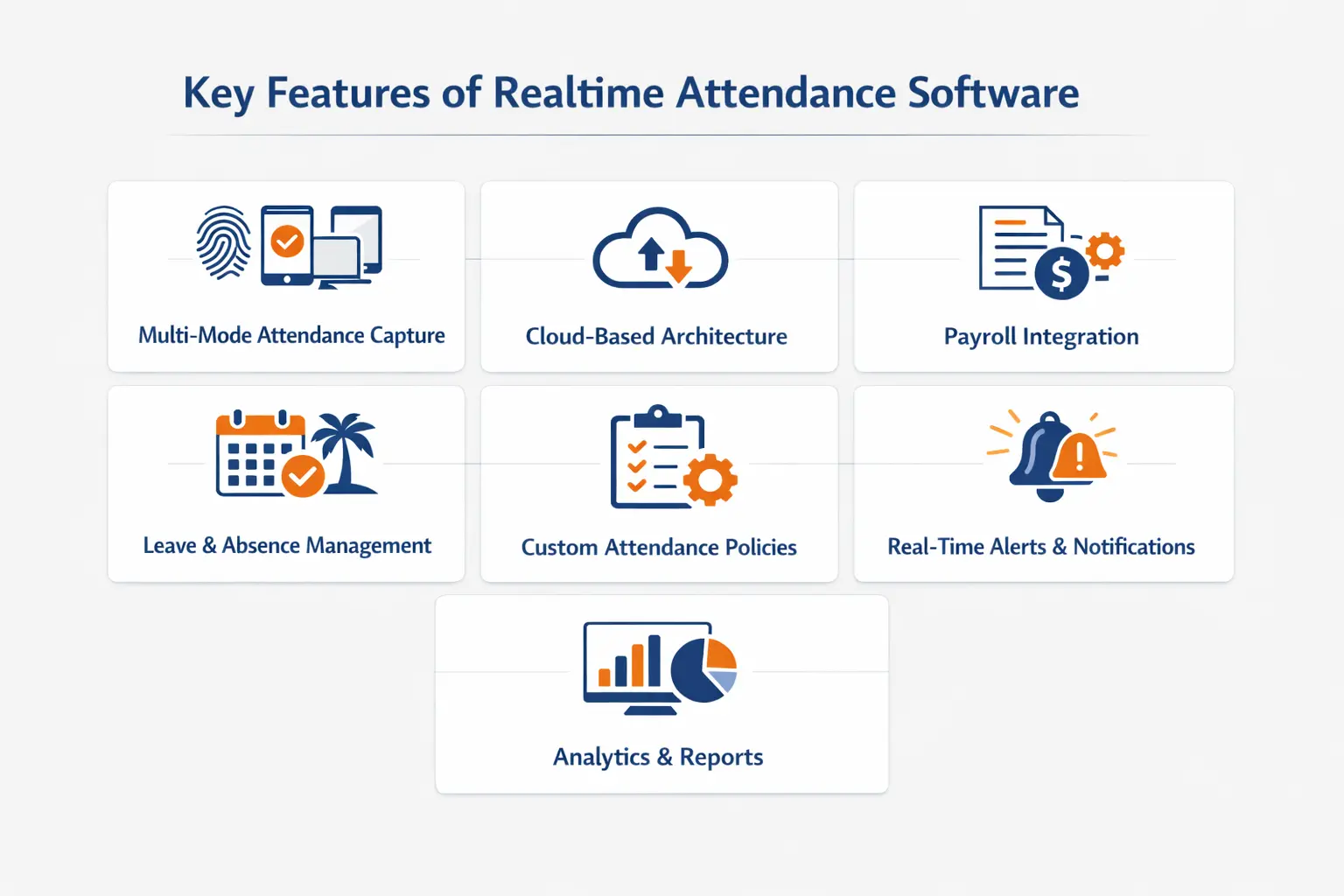
Before you proceed with a realtime attendance software download or vendor evaluation, ensure the platform covers these must-have capabilities:
- Multi-mode attendance capture: The software should support biometric devices, mobile app check-ins and web portals. A system just supporting one mode won't suit every workplace context.
- Cloud-based architecture: On-premise servers are expensive to maintain and difficult to scale. Cloud deployment gives you flexibility, automatic updates, and remote accessibility.
- Payroll integration: Attendance data should sync with your payroll system in real time.
- Leave and absence management: Attendance and leave are inseparable. The software must handle leave types, approval workflows, encashment policies, and holiday calendars.
- Custom attendance policies: Shift-based organisations need the software to support multiple shift configurations, grace periods, late-in/early-out rules, and comp-off policies.
- Real-time alerts and notifications: Managers should receive instant notifications for absenteeism, late arrivals, or unscheduled overtime.
- Analytical dashboards and reports: Historical patterns like who is frequently absent on Mondays, which department has the highest overtime costs, should be visible at a glance.
Features That Make Realtime Attendance Software Ideal for Remote Teams
The Remote Work Attendance Problem
Managing attendance for remote workers is not the same as tracking office workers. You cannot rely on a biometric device installed at a single location. What you need is a software-first approach.
How Modern Platforms Handle It
Geo-fencing
Geo-fencing creates a virtual perimeter around a designated work location. The moment an employee enters that boundary, the system auto-marks their attendance. For field staff and delivery teams, this is a game-changer.
Selfie-based attendance with AI liveness detection
This prevents employees from uploading static photos. The system checks for real-time facial movement before confirming the punch-in, which is especially useful for verifying remote worker identity.
IP-based attendance restrictions
This feature ensures that employees marking attendance from a web portal can only do so from approved IP addresses. Organisations thus can prevent unauthorised logins from non-office networks.
Realtime attendance dashboard
The realtime attendance login dashboard gives HR teams a consolidated view across all these methods, so a hybrid organisation can see office-based and remote employee attendance on the same screen without switching between multiple tools.
Why Realtime Biometric Attendance Software Matters More Than Ever Today?
The market for realtime biometric attendance software in India has grown rapidly. Vendors like Mewurk, HROne and Keka have all deepened their biometric integration capabilities in recent years.
The global time and attendance software market is valued at USD 3.99 billion in 2025 and is projected to reach USD 6.23 billion by 2030 at an 8.23% CAGR, with Asia-Pacific posting the fastest regional growth at 11.3%.
In India specifically, the demand is driven by:
- A large manufacturing sector that requires factory-floor attendance compliance
- Growing BFSI and IT sectors, where audit trails are non-negotiable
- An expanding SMB segment that is digitising HR operations for the first time
Manual vs. Realtime Attendance Software: A Quick Comparison
| Parameter | Manual Attendance | Realtime Attendance Software |
|---|---|---|
| Data accuracy | Prone to human error | Near 100% accurate |
| Payroll processing time | 3–5 days of reconciliation | Automated, instant |
| Buddy punching | Easily possible | Eliminated via biometrics |
| Remote team tracking | Not feasible | Fully supported |
| Labour law audit readiness | Poor | Always ready |
| HR time spent on attendance | 30–40% of work hours | Under 5% |
| Scalability | Limited | Grows with your headcount |
Realtime Attendance Software Download and Deployment Guide
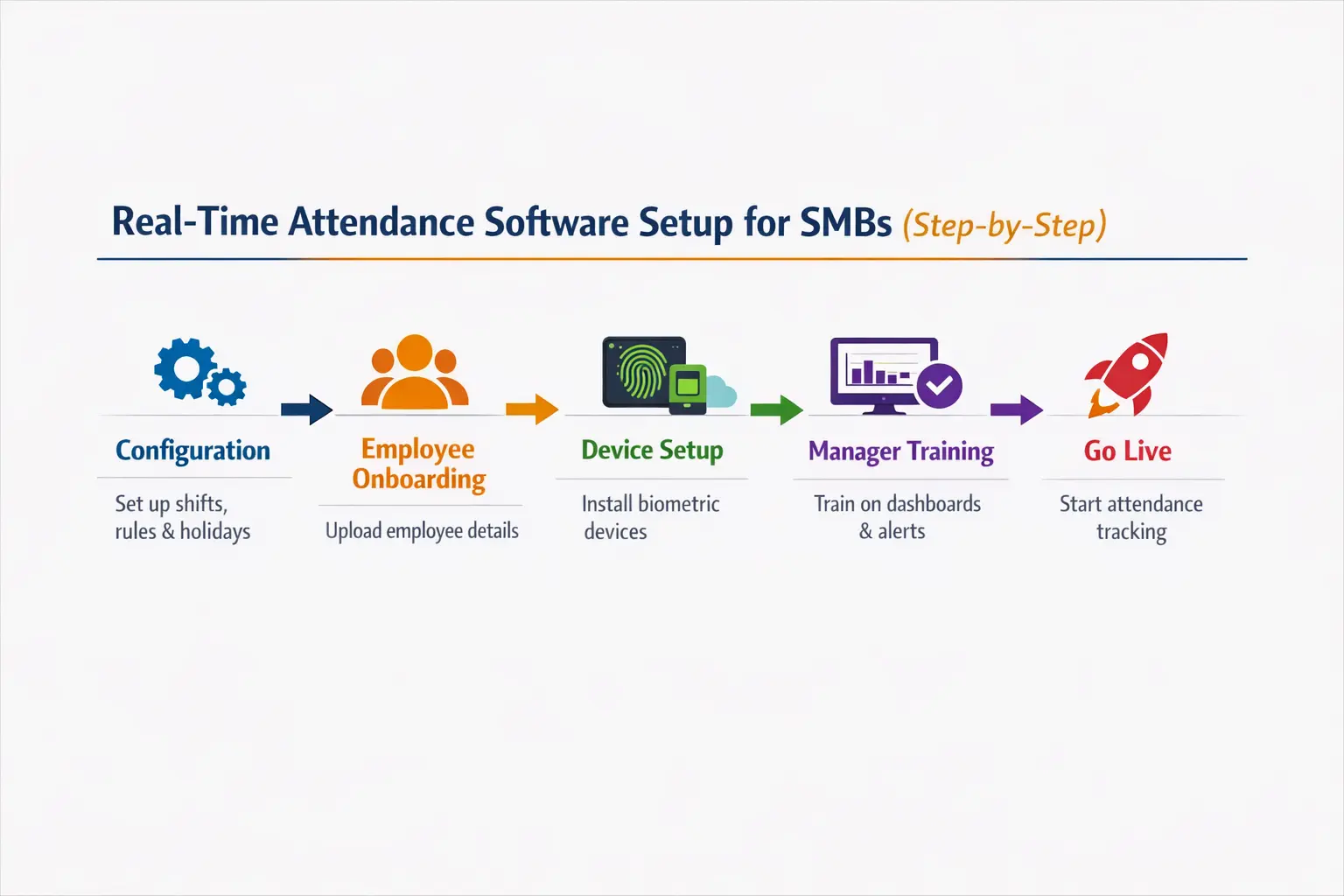
For SMBs considering adoption, the deployment process is far less complex than most assume. Most cloud-based platforms today offer a realtime attendance software download for both Android and iOS, along with a web-based admin portal that requires no local server installation.
A typical deployment for a 50-person SMB looks like this:
- Configuration: Define shifts, attendance policies, leave types, and holiday calendars.
- Employee onboarding: Upload employee data and enrol biometric profiles where applicable.
- Device installation: Mount biometric terminals at office entry points and connect them to the cloud.
- Manager training: Walk managers through the dashboard, approval workflows, and alert settings.
- Go-live: Employees use the system for clock-in/clock-out from Day 1.
Most vendors offer guided onboarding support, and for remote-only teams, even the biometric hardware step is optional since mobile and web-based attendance is sufficient.

Conclusion
For Indian SMBs and organisations managing distributed remote teams, realtime attendance software is the foundation of accurate payroll, legal compliance, and workforce productivity. The operational gains are too significant, the cost savings too tangible, and the compliance readiness too critical to abandon.
If you have not yet evaluated a modern attendance solution for your organisation, now is exactly the right time to start.
Frequently Asked Questions (FAQ)
1. What is realtime attendance software, and how does it differ from traditional systems?
Realtime attendance software captures and processes employee attendance data instantly upon clock-in. Traditional systems require manual data entry or end-of-day batch processing, which introduces delays and errors.
2. Can realtime biometric attendance software work for remote teams?
Yes. Modern platforms combine biometric hardware for offices with mobile geo-fencing and selfie-based check-ins for remote staff. It gives HR managers a unified dashboard across all work locations.
3. Is realtime attendance software compliant with Indian labour laws?
Most reputed platforms maintain tamper-proof, timestamped records that meet requirements under the Factories Act, Shops and Establishments Act, and the Code on Wages. As a result, statutory audits become much easier.
4. How do I choose the right realtime attendance software for my SMB?
Evaluate multiple options available to you based on multi-mode attendance capture, payroll integration depth, mobile app quality, support for Indian statutory compliance, and total cost of ownership, including device and subscription costs.
5. What should I check before a realtime attendance software download or purchase?
Verify cloud-based architecture, data security standards, biometric device compatibility, leave management features, and whether the vendor offers an implementation and support team with Indian market experience.

Most Popular Post

Why Accurate Attendance and Leave Management Matters for Business Growth?
Read More →Why Accurate Attendance and Leave Management Matters for Business Growth?
How To Leverage Attendance Data For Better Workforce Management?
Read More →How To Leverage Attendance Data For Better Workforce Management?