
Summary
The ₹25,000 ceiling is now official and effective from September 17, 2026—no longer a proposal. HR and payroll teams should move from "monitor and prepare" mode into active implementation: updating systems, reviewing employee PF wage data, and rolling out changes per the notified rules.
If you work in HR or payroll, you've probably had this question from staff lately: "Is PF now cut on ₹25,000?"
Short answer: yes, from 17 September 2026.
The Employees' Provident Fund (EPF) is a retirement savings plan for salaried staff in India. The Employees' Provident Fund Organisation (EPFO) runs it. Each month, you and your employer both contribute a portion of your pay to it.
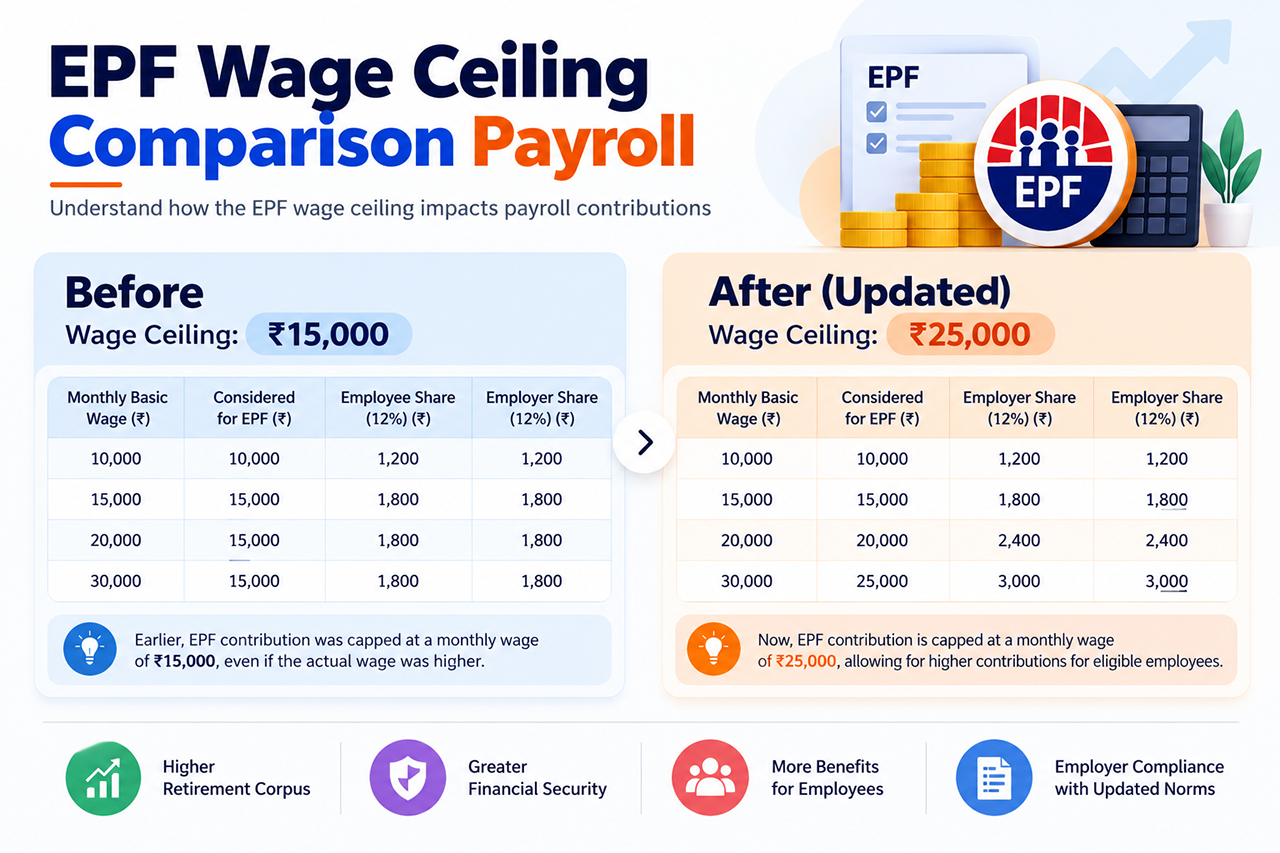
There's a cap on how much of your pay counts. This cap is called the wage ceiling. For almost twelve years it was ₹15,000 a month, unchanged since September 2014. Pay went up a lot in that time, and the limit has now been raised to ₹25,000.
The Union Cabinet approved the change on 16 September 2026, and the Labour Ministry notified it the next day through S.O. 5109(E) under the Code on Social Security, 2020. This guide explains what changed, what it means for employees and employers, and how HR teams can put it into payroll correctly.

What Is the ₹25,000 PF Wage Ceiling?
The PF wage ceiling is the pay limit up to which PF is compulsory. It's based on basic pay plus DA. From 1 September 2014, the limit was ₹15,000 a month. It was raised to ₹25,000 a month with effect from 17 September 2026, through a notification issued by the Labour Ministry.
What Is the PF Wage Ceiling?
Think of the wage ceiling as a line. It decides two things:
- Who must join EPF. A new hire who earns up to the limit has to be enrolled.
- How much PF is compulsory. Your employer only has to pay PF on your wages up to this limit.
Your salary and your PF wage are not the same thing. PF is not worked out on your gross pay or your CTC. It's based on:
- basic pay,
- dearness allowance (DA), and
- retaining allowance, if you get one.
Most other allowances, like HRA, overtime and bonus, are left out. There is a catch, though. In 2019, the Supreme Court ruled in Regional PF Commissioner v. Vivekananda Vidyamandir that an allowance paid to every employee can count as basic pay. The Code on Social Security, 2020 also uses a wider meaning of "wages". So check how your pay structure fits under the rules in force today.
Why have a ceiling at all? It keeps compulsory savings focused on low and middle earners. It also caps what employers must pay. People above the line can still join in some cases.
A quick example. Riya earns ₹40,000 a month. Her basic pay plus DA is ₹18,000.
- Her PF wage is ₹18,000, not ₹40,000.
- Under the old ₹15,000 ceiling, her employer only had to pay PF on ₹15,000. Paying on the full ₹18,000 needed both of them to agree.
- Under the new ₹25,000 ceiling, her full ₹18,000 falls within the limit, so PF is due on all of it.
What Is the Current PF Wage Ceiling?
| Item | Current Position |
|---|---|
| EPF wage ceiling | ₹25,000 a month (basic + DA), from 17 September 2026 |
| Previous ceiling | ₹15,000 a month, from 1 September 2014 to 16 September 2026 |
| Effective date | 17 September 2026 |
| Official notification | S.O. 5109(E), published in the Official Gazette on 17 September 2026, under the Code on Social Security, 2020 |
| Applicability | ₹25,000 now decides who must join and the compulsory PF base |
| Employee impact | Higher PF cuts for those with PF wages above ₹15,000 whose PF was capped |
| Employer impact | Higher employer PF, EPS, EDLI and admin costs for affected staff |
In plain words: the old rule was ₹15,000. The new rule is ₹25,000, and it has applied since 17 September 2026.
Why Was the PF Wage Ceiling Raised?
Here's the problem. The ₹15,000 limit was set more than ten years ago. Prices and pay both went up after that. Many freshers in big cities had a basic pay above ₹15,000, which put them outside compulsory PF. That was never the plan.
People who backed a higher limit usually pointed to four things:
- More people covered. A higher limit brings more workers into compulsory savings.
- More formal jobs. It fits with wider labour reforms, like the Code on Social Security, 2020.
- Better retirement savings. PF capped at ₹15,000 builds only a modest fund and pension.
- Pay growth. The ceiling hadn't kept pace with salaries.
Official notice vs news reports. For months, the ₹25,000 figure (and others, like ₹21,000) appeared only in news reports about discussions in EPFO's Central Board of Trustees (CBT) and the Ministry. That changed with the Cabinet's approval on 16 September 2026 and the Gazette notification on 17 September. The government expects the change to bring more than 51 lakh additional employees under mandatory EPFO coverage.
What Changes Now That the Ceiling Is ₹25,000?
PF rates haven't changed; only the wage base has. Here's what that means.
For Employees
- Higher PF cut. If your PF was capped at ₹15,000, your monthly cut can rise. At most, it goes from ₹1,800 to ₹3,000.
- Lower take-home pay. Your net pay can drop by that extra amount, unless your pay structure changes.
- Bigger savings. More money goes in each month, and it earns interest. Over the years, your PF balance grows faster.
- More from your employer. Your employer's share goes up by the same amount as yours.
- EPS goes up too. The pension ceiling also moved to ₹25,000, so the EPS share can rise from ₹1,250 to up to ₹2,083 a month.
- New joiners. Staff with PF wages between ₹15,000 and ₹25,000 now have to join.
For Employers
- Higher payroll cost. You pay more PF for each affected employee.
- Payroll rules. The ceiling value in your system needs to be updated.
- Employee records. You need to review who is eligible, who is in EPS, and who pays PF on higher wages by choice.
- Compliance. Some staff who were left out before now have to be enrolled.
- Reporting. Your ECR (Electronic Challan cum Return) must show the new wage values.
- Accounts. Budgets, provisions and CTC letters may need to be changed.
PF Contribution Calculation
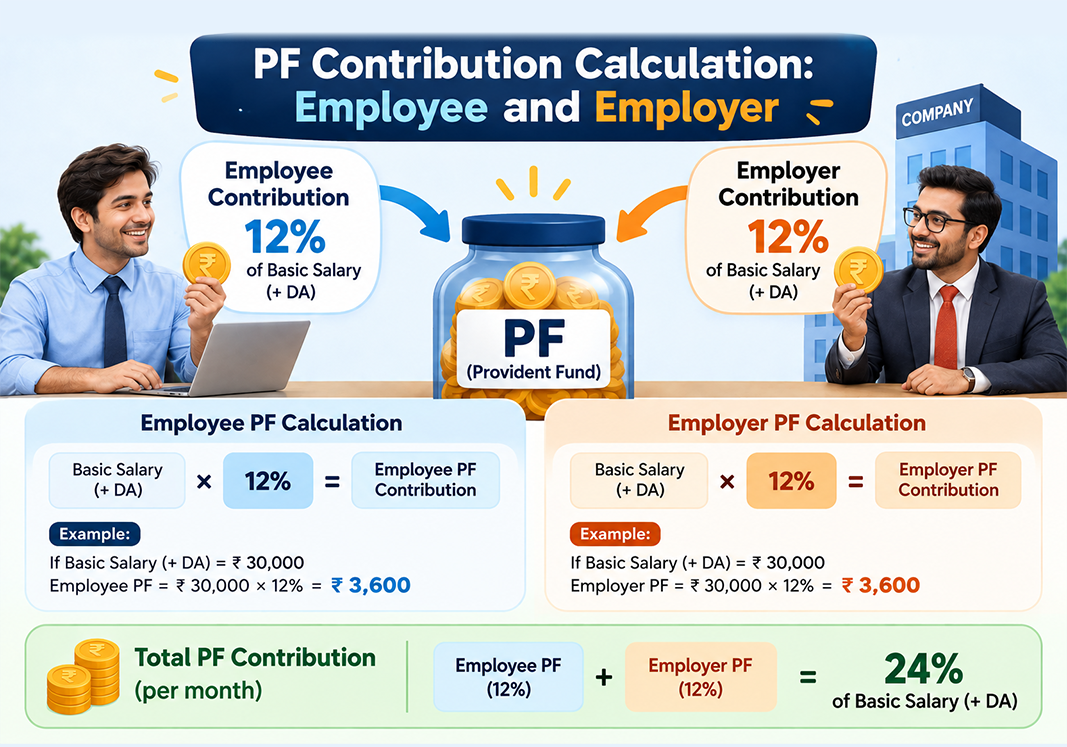
Here's how PF works under the new ceiling:
- Employee share: 12% of PF wages. It's 10% for some notified firms and for firms with fewer than 20 staff.
- Employer share: also 12% of PF wages. But it's split in two:
- 8.33% goes to EPS (Employees' Pension Scheme). This is worked out on wages up to ₹25,000 (it was ₹15,000), so the most it can be is ₹2,083 (it was ₹1,250).
- The rest goes to EPF. That's 3.67%, or more when wages are above the EPS limit.
- Other employer costs:
- EDLI (Employees' Deposit Linked Insurance): 0.5% of wages up to the ceiling.
- EPF admin charges: 0.5%, with a minimum amount.
- Government share: the Centre adds 1.16% to EPS for eligible members. Check EPFO's FAQs on the new ceiling for the wage base this now applies to.
| Component | Example (new rules) |
|---|---|
| Basic pay + DA | ₹25,000 |
| Applicable PF wage | ₹25,000 |
| Employee share (12%) | ₹3,000 |
| Employer: EPS (8.33% up to ₹25,000) | ₹2,083 |
| Employer: EPF balance | ₹917 |
| Effect on net pay | The employee share is cut from net pay |
It helps to keep these terms apart:
- Basic pay: one part of your pay structure.
- PF wage: basic + DA + retaining allowance.
- Gross pay: everything you earn in the month.
- CTC: what you cost the company in total, including the employer's PF.
- Take-home: what lands in your bank after cuts.
Example: PF Calculation at ₹15,000 vs ₹25,000
This is an example only. It assumes:
- basic pay + DA of ₹25,000 a month,
- a 12% PF rate, and
- PF capped at the ceiling.
The EPS limit moved to ₹25,000 along with the PF ceiling, so the EPS share rises too.
| Particular | Old Ceiling (₹15,000) | New Ceiling (₹25,000) |
|---|---|---|
| PF wage considered | ₹15,000 | ₹25,000 |
| Employee share (12%) | ₹1,800 | ₹3,000 |
| Employer: EPS (8.33%) | ₹1,250 | ₹2,083 |
| Employer: EPF (balance) | ₹550 | ₹917 |
| Total employer share | ₹1,800 | ₹3,000 |
| Total PF | ₹3,600 | ₹6,000 |
| Monthly difference | — | +₹2,400 (₹1,200 employee + ₹1,200 employer) |
| Yearly difference | — | +₹28,800 |
EDLI and admin charges also rise, since they're worked out on the same wage base. Rounding follows EPFO's ECR rules.
Who Is Affected?
| Employee Situation | Impact of the ₹25,000 Ceiling |
|---|---|
| PF wage below ₹15,000 | No change. PF stays at 12% of actual PF wages |
| PF wage between ₹15,000 and ₹25,000 | If PF was capped at ₹15,000, it now moves to actual wages. New joiners in this range, who could opt out before, now have to join |
| PF wage above ₹25,000 | If PF is capped, the base rises from ₹15,000 to ₹25,000. Paying on higher wages by choice stays subject to the rules |
| Existing EPF member | Stays a member at any wage. The PF base may change if it was capped |
| New employee | The ₹25,000 limit now decides who must join |
| Employer | Higher PF cost for affected staff, plus payroll and compliance updates |
Does a ₹25,000 Wage Ceiling Mean Everyone Contributes PF on ₹25,000?
No. This is the part people get wrong most often. The ceiling is an upper limit. It is not a fixed amount that everyone pays PF on.
- If you earn less than the limit, you pay PF on what you earn. Someone with a PF wage of ₹12,000 pays 12% of ₹12,000.
- If you're already a member, you stay one. That holds even if your pay later goes above the limit.
- If you're a new joiner above the limit, you may be left out. Under paragraph 2(f) of the EPF Scheme, 1952, a new joiner whose PF wages are above the ceiling, and who has never been an EPF member, is an "excluded employee". They don't have to join.
- If you want to pay more, you can. Under paragraph 26(6), you and your employer can agree to pay PF on your full wages. You can also add extra on your own through VPF (Voluntary Provident Fund).
The same logic now applies at the new ₹25,000 limit.
Impact on Take-Home Salary
An example. Arjun earns ₹50,000 a month. His basic pay plus DA is ₹25,000. Before the change, his employer paid PF only on the ₹15,000 limit.
| Particular | Before (₹15,000) | Now (₹25,000) |
|---|---|---|
| Employee PF cut | ₹1,800 | ₹3,000 |
| Change in take-home (before tax) | — | −₹1,200 a month |
| Employer PF cost | ₹1,800 | ₹3,000 |
| Monthly retirement savings | ₹3,600 | ₹6,000 |
So Arjun now takes home ₹1,200 less each month, before tax. In return, ₹2,400 more goes into his PF each month.
There's one more thing to watch. If the employer's PF is part of his CTC, the company may shrink other parts of his pay to cover it. That could cut his take-home a bit more.
Tax plays a part too. His own PF counts under Section 80C, but only in the old tax regime. In the end, the real effect depends on his pay structure and his tax regime.
Impact on Employers and Payroll Teams
For payroll teams, a change in the ceiling touches a lot of moving parts:
- the ceiling value in your payroll setup,
- PF formulas and rounding rules,
- employee records (PF status, EPS status, paragraph 26(6) choices),
- the EPF, EPS, EDLI and admin charge sums,
- ECR files and monthly challans,
- matching your books with what you've paid EPFO,
- compliance reports,
- pay structures and CTC letters, and
- rules inside your HRMS and payroll software.
What Should HR Do to Implement the Change?
- Check the official notice. Go by the Gazette notification (S.O. 5109(E)), EPFO circulars and FAQs. Don't go by news reports.
- Find who's affected. List everyone with a PF wage above ₹15,000.
- Review PF wage data. Check which pay parts count as PF wages.
- Check your payroll software. Find where the ceiling value is stored.
- Work out the cost. Estimate the extra cost per employee and per team.
- Test payroll. Do dry runs for capped staff, uncapped staff and new joiners.
- Check the sums. Cross-check EPF, EPS, EDLI and admin charges.
- Talk to employees. Explain the new cuts and savings before payday.
- Start on the right date. Apply the change from 17 September 2026, and follow EPFO's guidance on how to treat September's wages, since the change took effect mid-month.
- Keep an eye on it. Review the first few ECRs and fix any gaps.
PF Wage Ceiling vs PF Contribution Limit
| Term | Meaning | Example |
|---|---|---|
| Wage ceiling | The pay limit for compulsory PF | ₹25,000 (from 17 September 2026) |
| PF wage | Basic + DA + retaining allowance | ₹18,000 |
| Contribution amount | PF rate × PF wage used | 12% × ₹18,000 = ₹2,160 |
| Actual salary | Gross pay, with all allowances | ₹40,000 |
PF Wage Ceiling and EPS
Many employees think their employer's full 12% goes into their PF account. It doesn't. A big part goes to the Employees' Pension Scheme, 1995.
- EPS share: 8.33% of wages, on up to ₹25,000 (it was ₹15,000). That's ₹2,083 a month at most.
- EPF share: whatever is left of the employer's 12%.
- Government share: the Centre adds 1.16% to EPS for eligible members.
- Who can join EPS: staff who joined after 1 September 2014 with wages above the ceiling usually can't. That ceiling is now ₹25,000.
- Higher pension: after the Supreme Court's November 2022 ruling, some members could apply for a pension on higher wages. Certain conditions apply.
The notification raised the ceiling for EPS and EDLI too, not just EPF. Check all EPS rates and limits against EPFO's latest guidance.
How HRMS and Payroll Software Can Help
Rule changes are much easier to handle when your PF rules sit in one place. Keeping them spread across spreadsheets makes every change harder. A good payroll and HRMS tool can help with:
- automatic PF sums,
- pay structure setup,
- employee records,
- running payroll,
- statutory cuts and compliance reports,
- audit trails,
- matching PF payments,
- updating rules and settings, and
- payslips.
A payroll and HRMS platform like Mewurk can help HR teams manage employee data, payroll calculations and statutory compliance workflows more efficiently when configured according to applicable rules. Just make sure your setup matches the latest notified PF rules.

Common Mistakes HR Teams Should Avoid
- Still using the old ₹15,000 ceiling in payroll settings
- Mixing up gross pay and PF wages
- Using one rule for every employee
- Forgetting existing members and paragraph 26(6) choices
- Getting the employer share wrong
- Forgetting that the EPS cap also moved to ₹25,000 (up to ₹2,083 a month)
- Getting the effective date wrong for September 2026 payroll
- Skipping test runs
- Not telling staff why their PF cut changed
Employee FAQs
Q1. What is the PF wage ceiling?
It's the monthly pay limit, based on basic pay plus DA, up to which PF is compulsory. Since 17 September 2026 it's ₹25,000 (it was ₹15,000).
Q2. Has the PF wage ceiling been increased to ₹25,000?
Yes. It was notified through S.O. 5109(E) on 17 September 2026. Check EPFO for the latest circulars.
Q3. When did the ₹25,000 PF ceiling become effective?
From 17 September 2026, the date the notification was published in the Official Gazette.
Q4. Will employees earning above ₹25,000 be covered?
Existing members stay covered. New joiners above the new limit are usually left out, unless they choose to join under the rules.
Q5. Will my PF deduction increase?
It may, if your PF wage is above ₹15,000 and your PF was capped at ₹15,000.
Q6. Will my take-home salary decrease?
It may, due to the extra PF you pay. For a PF wage of ₹25,000 or more, that's up to ₹1,200 a month.
Q7. Will employer PF contribution increase?
Yes, for affected staff. The employer matches your 12%.
Q8. Does the change affect EPS?
Yes. The EPS wage ceiling also moved to ₹25,000, so the maximum EPS share rises from ₹1,250 to ₹2,083 a month.
Q9. Is PF calculated on gross salary?
No. It's based on basic pay, DA and retaining allowance, under the current meaning of "wages".
Q10. How is PF contribution calculated?
You pay 12% of your PF wage. Your employer pays 12% too. Of the employer's share, 8.33% goes to EPS, up to the EPS limit.
Q11. Does the ₹25,000 ceiling apply to all employees?
No. It mainly affects staff with PF wages above ₹15,000 and new joiners in that range.
Q12. What should employers change in payroll software?
The ceiling value, eligibility rules, EPS logic and ECR mapping, applied from 17 September 2026.
Q13. Will existing EPF members be affected?
They remain members. Their PF base may change if it was capped.
Q14. What happens to employees earning below ₹25,000?
If your PF wage is below ₹15,000, nothing changes. Between ₹15,000 and ₹25,000, PF now applies to your full PF wage.
Q15. Where can employees verify the latest PF rules?
On epfo.gov.in, labour.gov.in and the Official Gazette (egazette.gov.in).
Key Takeaways
- The PF wage ceiling is now ₹25,000, effective 17 September 2026 (S.O. 5109(E)). It was ₹15,000 from 2014.
- PF is based on basic pay + DA + retaining allowance, not gross pay or CTC.
- Total PF can rise by up to ₹2,400 a month per affected employee.
- The EPS ceiling moved to ₹25,000 too, so the maximum EPS share is now ₹2,083.
- Update payroll settings, ECR mapping and employee records from the effective date.