Summary
Manufacturing HR isn’t like office HR, and the software built for one rarely works for the other. This guide covers what HR software for manufacturing actually does, why shift-heavy, contractor-heavy factories need it more than most industries, which features matter, and how to compare platforms like Mewurk, Keka, greytHR, factoHR, HROne, and Zoho People before you commit to one.
It’s 6:40 AM at a mid-sized auto components plant outside Pune. The morning shift is walking in, the night shift is walking out, and three contract workers who joined last week still haven’t been added to the biometric device. The supervisor is marking their attendance on a paper register that’ll get typed into Excel sometime that afternoon, if someone remembers.
By the time payroll runs, there’s a decent chance those three names get missed, or someone copies last month’s hours by mistake instead. Now multiply that across 400 workers, two rotating shifts, and a handful of contract labourers who cycle in and out every few weeks. That’s basically why manufacturing HR is one of the toughest HR problems out there, and honestly, most generic HR software just wasn’t built to handle it.
This isn’t one factory’s story either. It’s the everyday reality across textile units in Surat, pharma plants in Baddi, and auto ancillaries around Chennai. Shift complexity, contract labour, overtime disputes, and compliance paperwork pile up faster than any HR team can manage on spreadsheets alone. That’s the gap HR software for manufacturing is built to close.
What Is HR Software for Manufacturing and Why Does the Shop Floor Need Its Own Category?
HR software for manufacturing is a cloud-based HRMS designed specifically for factory operations, accommodating multiple shifts, biometric attendance at plant gates, and a mix of permanent and contract workers, while ensuring compliance with the Factories Act, 1948, as well as the newer labour codes.
Generic HR software is built for office teams sitting at a desk from 9 to 6. Manufacturing HR software is built for a supervisor at gate 3 who needs to know right now who clocked in for the night shift, and it has to keep track of which shift a worker is on, which plant they’re at, and whether they’re on the company’s books or a contractor’s.
At its core, it does three things well: automates attendance across shifts and gates, calculates payroll correctly even when overtime and contractor wages follow completely different formulas, and keeps compliance registers ready for the day a labour inspector actually shows up.
Why Are Manufacturing Companies Moving Away From Manual HR and Generic Software?
Ask any HR manager on a factory floor what keeps them up at night, and payroll accuracy usually tops the list. Manufacturing workforces just don’t fit the neat, salaried, Monday-to-Friday model most HR tools were originally designed around. Here’s what’s actually driving the shift toward purpose-built systems:
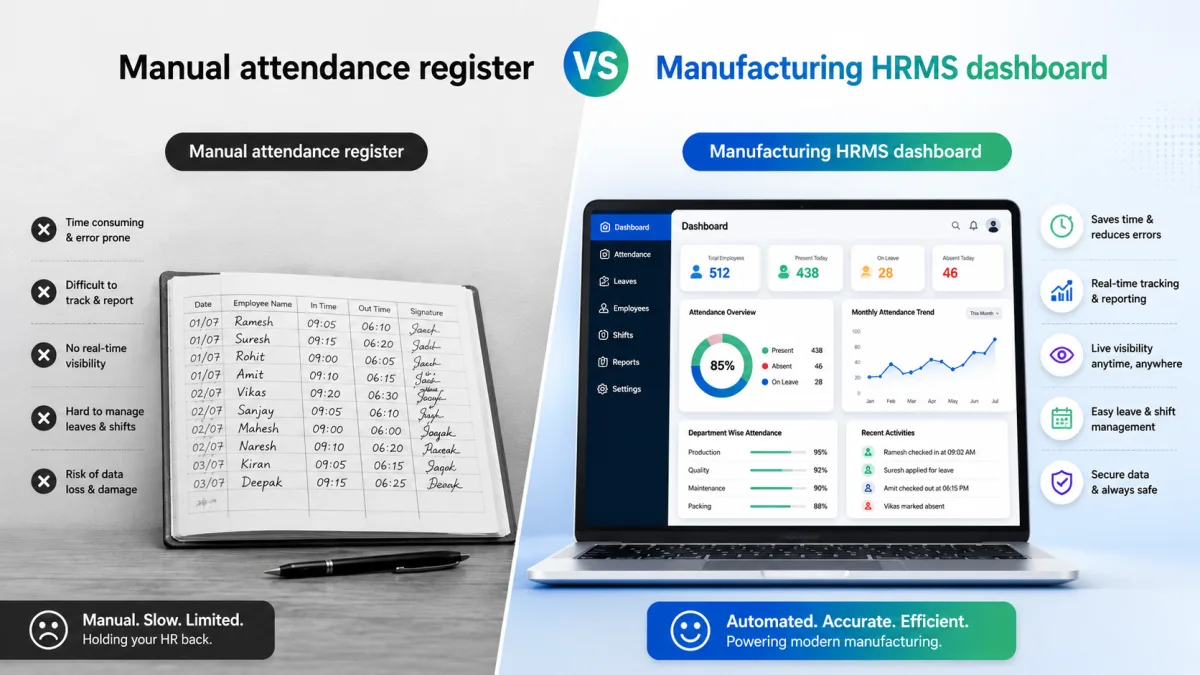
- Shift-based workforces make manual tracking unreliable. The same worker might be on general shift this week and night shift next week, and getting attendance and pay right across rotating patterns by hand is where most errors creep in.
- Multiple plant locations need consolidated visibility. A company running units in Baddi, Rudrapur, and Chennai needs one dashboard, not three Excel trackers someone reconciles at month-end.
- Contract workers often make up 30-50% of shop-floor headcount, especially in textiles and auto components, and their wages, attendance, and compliance documents require separate yet connected tracking.
- Overtime calculations get complicated fast. Weekday overtime, holiday work, and night-shift differentials all carry different rates, and repeatedly getting even one wrong is how labour disputes start.
- Payroll complexity compounds once PF, ESI, professional tax, TDS, and bonus calculations all have to run against hours that genuinely vary week to week.
- Labour law compliance under the Factories Act requires maintained registers and working hour limits, and inspectors can ask for these on short notice.
- Attendance fraud, particularly buddy punching, is a real cost on floors where a supervisor can’t watch every gate at once.
- Manual processes simply stop scaling past a couple hundred workers across shifts. Something breaks, and it’s usually payroll accuracy or compliance readiness.
Top Challenges in Manufacturing HR
| Challenge | Why It’s Hard |
|---|---|
| Shift scheduling | Rotating shifts and sudden absenteeism require constant roster adjustments |
| Attendance tracking | Multiple gates and buddy punching create data gaps |
| Payroll errors | Variable hours and contractor wages multiply the chance of mistakes |
| Labour compliance | Factories Act and state-specific rules apply differently across locations |
| Leave conflicts | Production lines can’t run short-staffed, so approvals need shift-level visibility |
| Worker turnover | High contract labour attrition makes onboarding a near-daily task |
| Contract labour management | Multiple contractors and wage structures add real complexity |
| Multi-location workforce | Consolidating data across plants manually is close to impossible |
Traditional HR vs Manufacturing HR Software
| Aspect | Registers / Excel | Manufacturing HR Software |
|---|---|---|
| Attendance | Manual registers, delayed exports | Real-time biometric or face recognition sync |
| Shift management | Paper rosters | Digital planner with rotation and swap tracking |
| Payroll | Manually calculated overtime | Rule-based automation |
| Compliance | Registers updated in a rush | Auto-generated, always audit-ready |
| Contractor tracking | Separate spreadsheets per contractor | Centralized within one system |
| Visibility across plants | Delayed manual consolidation | Real-time dashboard |
| Self-service | None | Mobile app for payslips and leave |
Top Features to Look For in Manufacturing HR Software
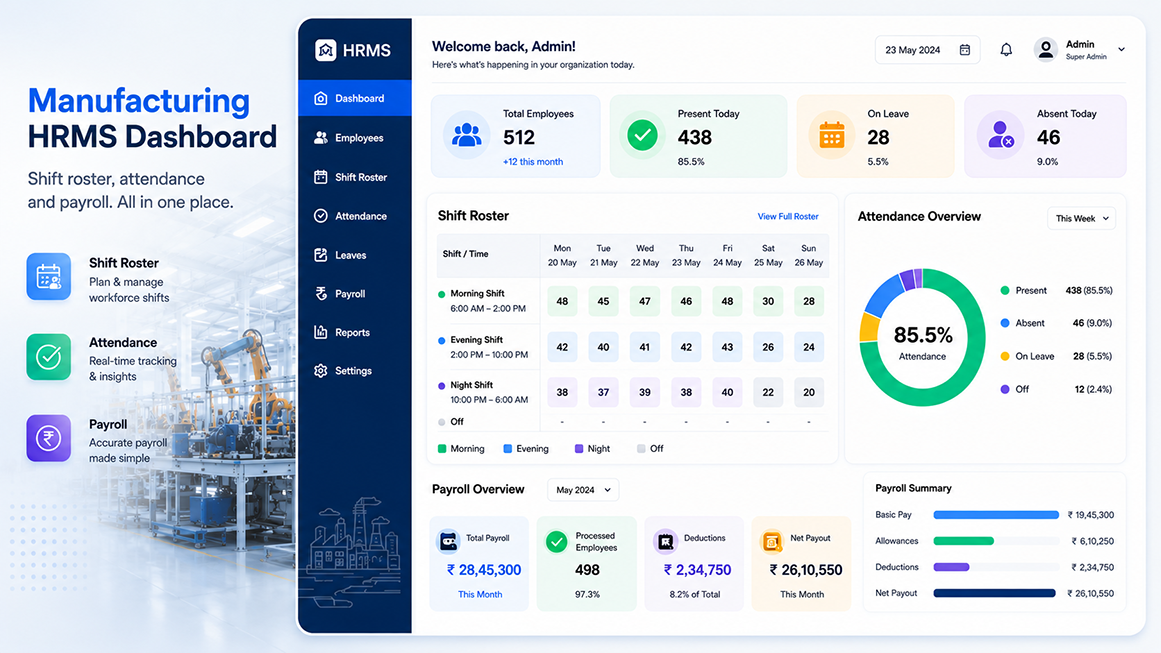
A good manufacturing HRMS isn’t office HR software with a factory label slapped on. Each of these needs to solve an actual shop-floor problem, not just look good in a sales demo.
- Face recognition attendance - cuts buddy punching close to zero, since a worker can’t clock in for an absent colleague when the system verifies a face, not a card.
- Biometric integration - works with the fingerprint devices most Indian factories already have installed, so you’re not forced to replace the hardware.
- Shift scheduling - handles rotating patterns, weekly-off allocation, and the constant reshuffling that comes from sick leave and swap requests.
- Payroll automation - applies PF, ESI, professional tax, TDS, overtime, and night shift allowance automatically, rather than having someone recalculate each one by hand every month.
- Contractor management - tracks each contractor’s workforce, wage rates, and compliance documents separately, while still rolling everything into plant-level reporting.
- Multi-plant dashboards - let a corporate HR head in Ahmedabad view attendance and payroll status for a unit in Vapi without calling the local team.
- Compliance registers - auto-generate muster rolls, wage registers, and overtime registers, so there’s no scramble before an inspection.
- Employee self-service (mobile) - matters more here than almost anywhere else, since most factory workers aren’t sitting at a desk to use a web portal.
- AI-assisted recruitment - speeds up the high-volume, high-turnover hiring that’s typical for contract labour positions.
Benefits Manufacturers Actually See After Implementation
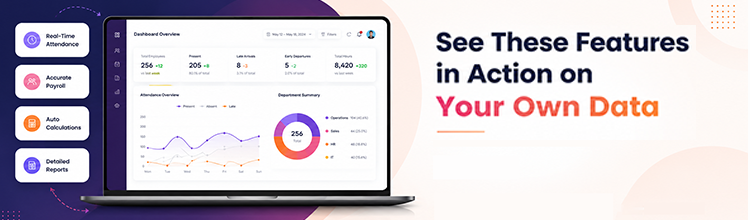
Reduced payroll errors happen almost automatically once overtime and statutory deductions are rule-based instead of manually calculated. Attendance processing drops from days to hours during month-end. Compliance stays consistently ready rather than a pre-inspection scramble. And real-time visibility means a plant manager knows exactly how many workers are present on each shift at any given moment, without having to call around.
There’s a quieter benefit too: workers who can check their own payslip and leave balance on their phone tend to trust the system more, and unplanned absences tied to confusion over leave status tend to drop.
Industry-wise Use Cases
| Industry | How HR Software Gets Used |
|---|---|
| Automobile Manufacturing | Multi-shift attendance across assembly lines with strict overtime tracking for JIT schedules |
| Textile | High contract labour ratio needing separate wage tracking and frequent turnover management |
| Food Processing | Round-the-clock shift rotation with hygiene and safety documentation |
| Pharmaceuticals | GMP-compliant documentation layered on top of standard HR compliance |
| Electronics | High-precision shift scheduling for cleanroom environments |
| Steel | Continuous 24x7 process shifts needing seamless handover attendance |
| FMCG Manufacturing | Seasonal workforce scaling requiring rapid onboarding and offboarding |
Manufacturing HR Software Comparison
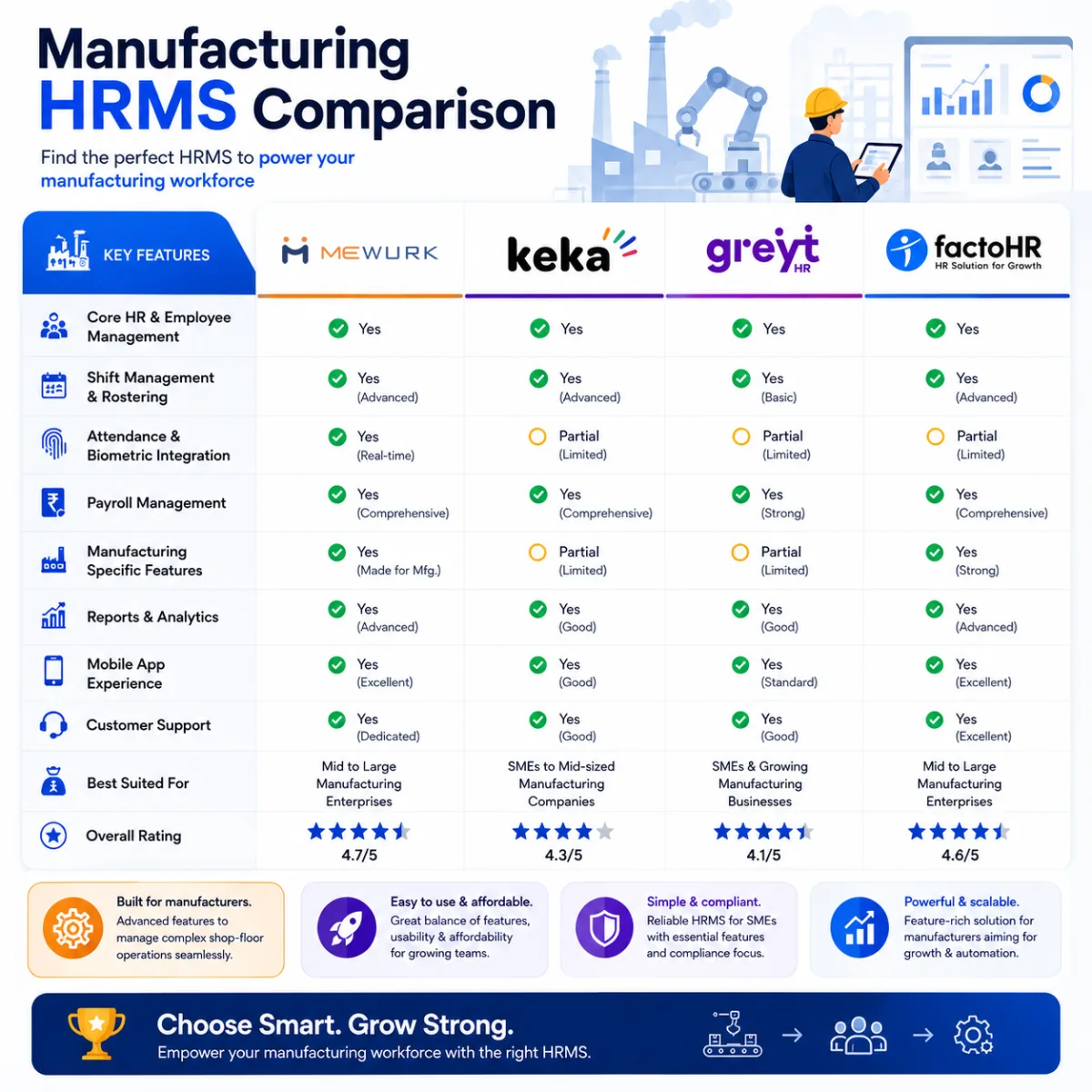
| Platform | Best For | Face Recognition | Contractor Management | Multi-Plant Support | Starting Price |
|---|---|---|---|---|---|
| Mewurk | SMEs to mid-size manufacturers | Yes | Yes | Yes | ₹2/employee/month |
| Keka | Mid-market, UI-focused teams | Limited | Limited | Yes | ₹9,999/month |
| greytHR | SMBs, compliance-first | Limited | Limited | Yes | ₹3,495/month |
| factoHR | Multi-location, compliance-heavy | Yes | Yes | Yes | Custom |
| HROne | Mid-market, 300+ employees | Limited | Limited | Yes | Custom |
| Zoho People | Small, office-first teams | No | No | Limited | ₹48/user/month |
This reflects publicly available feature information as of 2026 and can vary by plan and configuration. Worth requesting a demo focused specifically on your shift and contractor setup before deciding, since a lot of this depends on which tier you’re actually buying.
How to Choose the Right HR Software for Your Factory
The right platform really depends on where your operation is today. Here’s roughly how it breaks down:
Under 100 workers, single plant
You mostly need reliable attendance and payroll automation without a heavy implementation. Mewurk or Zoho People fit well here.
100-500 workers, contract-heavy
Once contract labour becomes a significant share of headcount, contractor management and compliance registers are no longer optional. Mewurk and factoHR both handle this range well.
500+ workers, multiple plants
At this scale, multi-plant dashboards and deeper compliance automation matter more than UI polish. factoHR, HROne, and Mewurk are all built to handle this.
Whatever range you’re in, don’t skip a trial covering one full payroll cycle, and specifically test the biometric integration against the hardware you already have installed at your gates.
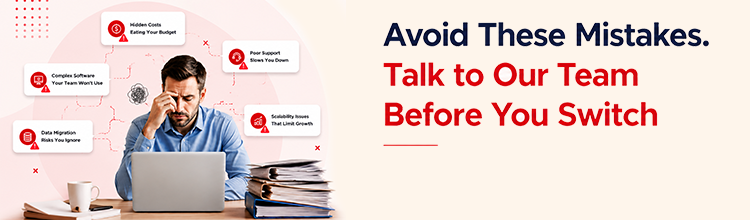
Common Mistakes While Choosing HR Software
- Choosing based on price alone, without checking if it handles shift-based overtime correctly.
- Assuming the permanent employee module will work fine for contract labour too.
- Skipping the trial period and discovering mid-implementation that biometric integration doesn’t work with existing hardware.
- Not checking compliance register formats against what your state’s labour department actually requires.
- Underestimating the mobile app, forgetting most factory workers won’t use a desktop portal.
- Not involving shop-floor supervisors in the evaluation, even though they’ll manage daily attendance issues.
- Overlooking multi-plant needs if expansion is already on the roadmap.
Why Mewurk Is Worth Considering for Manufacturers
Mewurk is built with manufacturing use cases in mind rather than as an office-first product with factory features bolted on later. Face recognition attendance directly addresses buddy punching and works across multiple plant gates without requiring a hardware overhaul if biometric devices are already installed. Attendance data flows straight into payroll, so overtime and night-shift allowances are calculated automatically rather than reworked by hand.
Shift scheduling software supports the rotating patterns common in manufacturing, and the self-service app lets shop-floor workers check payslips and apply for leave without depending entirely on the HR office. Compliance reporting stays continuously updated, which matters when an inspector’s visit isn’t always scheduled in advance. For recruitment-heavy contract labour hiring, the AI interviewer speeds up initial screening during seasonal production peaks.
None of this makes Mewurk the only workable option. factoHR and Keka also serve manufacturing clients reasonably well. Whichever vendor you’re considering, check whether the shift, contractor, and compliance modules are genuinely built for factory operations rather than retrofitted from a generic office HR product.
Conclusion
Manufacturing HR is different from office HR, and treating it that way is where most factories end up with the wrong software. Shift rotations, contract labour, biometric attendance, and compliance registers all need to work together, not as separate spreadsheets someone reconciles at month-end.
Whether you land on Mewurk, factoHR, Keka, or something else, the evaluation stays the same: test it against your real shift patterns, your actual contractor setup, and one full payroll cycle before committing. Found this useful? Share it with an HR manager or plant owner who’s still running payroll off a paper register.
Frequently Asked Questions
1. What is the best HR software for manufacturing companies in India?
It depends on your plant size, shift complexity, and contractor ratio. Mewurk, factoHR, and Keka are commonly used across Indian manufacturing units, each with different strengths in compliance depth and biometric integration.
2. Can manufacturing HR software handle contract labour separately from permanent employees?
Yes. Most manufacturing-focused HRMS platforms track contractor wages, attendance, and compliance documents separately while still rolling the data up into unified plant-level reporting.
3. Is biometric attendance mandatory for factories in India?
It’s not legally mandatory, but most mid- to large-sized factories adopt biometric or face-recognition attendance management systems to reduce buddy punching and improve payroll accuracy.
4. How does HR software calculate overtime for manufacturing workers?
Overtime rules get configured against your factory’s policy, typically different rates for weekday overtime, holiday work, and night shifts, and then applied automatically during payroll.
5. How much does HR software for manufacturing cost in India?
Pricing usually depends on employee count, number of plants, and selected modules, and is typically charged per employee per month, with add-ons for compliance and contractor management.
6. How long does it take to implement HR software in a factory?
Usually a few weeks, largely depending on biometric device integration and how much data needs migrating from existing registers or spreadsheets.