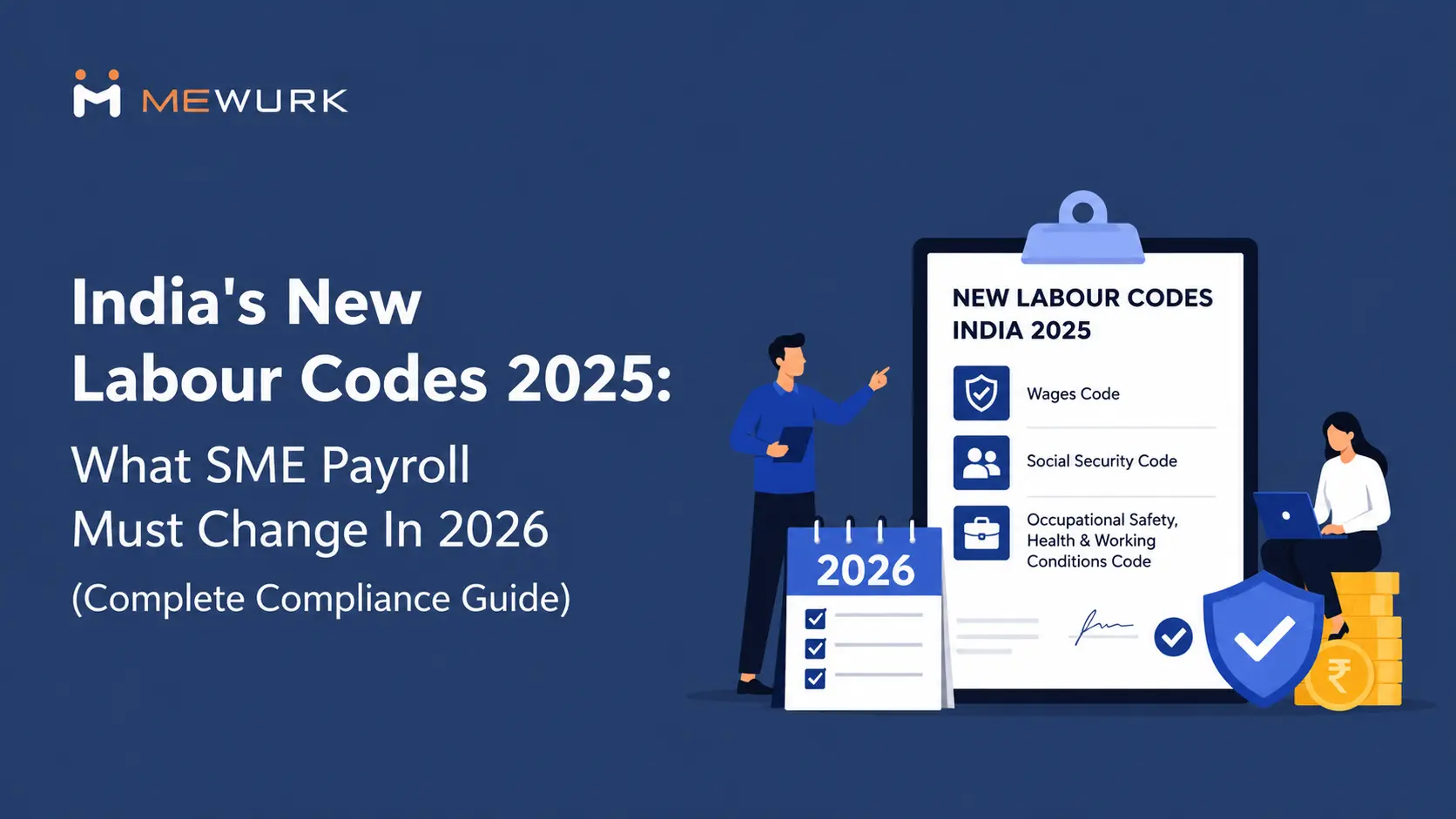
India's New Labour Codes 2025: What SME Payroll Must Change In 2026 (Complete Compliance Guide)
Summary
This is a practical HR guide to India's new labour codes 2025 covering the 4 codes, the 50% wage rule, revised gratuity and overtime provisions, the 2-day full and final settlement rule, and a step-by-step compliance checklist. You will learn exactly what changed on 21 November 2025, what it means for your salary structures and payroll costs, and how SME HR teams can become labour code compliant in 2026.
For decades, Indian HR teams struggled with confusing and complicated 29 separate central labour laws. If one was for wages, another was for bonus, a third for gratuity, and dozens more layered on top of each. That maze is now gone. On 21 November 2025, the Government of India brought the four new labour codes into force.
This is widely and popularly called the new labour codes 2025. They mark the biggest rewrite of Indian employment law since independence.
Notwithstanding this, most SMEs are still running payroll the old way. Salary structures are built around a 35-40% basic pay, manual overtime registers, and FnF settlements take 45 days in most companies. All of these are now compliance risks.
Labour codes kya hain, exactly? What is this 50% wage rule everyone keeps mentioning? And what must your payroll change before the inspector or an employee's lawyer asks? This guide answers all of it.
What Are the 4 New Labour Codes 2025 in India?
The new labour codes 2025 in India consolidate 29 central labour laws into four comprehensive codes. It's similar to bringing together 29 different codes and packing them into four organised sets.
| Labour Code | What It Covers | Key Laws It Replaces |
|---|---|---|
| Code on Wages, 2019 | Minimum wages, payment of wages, bonus, equal remuneration | Payment of Wages Act, Minimum Wages Act, Payment of Bonus Act |
| Industrial Relations Code, 2020 | Trade unions, standing orders, dispute resolution, retrenchment | Industrial Disputes Act, Trade Unions Act |
| Code on Social Security, 2020 | PF, ESI, gratuity, maternity benefit, gig worker social security | EPF Act, ESI Act, Payment of Gratuity Act, Maternity Benefit Act |
| OSH & Working Conditions Code, 2020 | Working hours, leave, safety, welfare, contract labour | Factories Act, Contract Labour Act, Shops & Establishments provisions |
Quick Definition: The new labour codes 2025 India framework is a unified set of four laws, Wages, Industrial Relations, Social Security, and Occupational Safety, that govern how every Indian employer pays, manages, and exits employees from 21 November 2025 onwards.

Labour Code Rules 2026: What Has Changed and From When?
A common confusion we have observed among SME owners in India is the timeline. Here is the clean version of the timeline. Since we are now in the third quarter of 2026, here is a simplified overview of the key milestones:
- 21 November 2025: All four labour codes were notified as effective law. The 50% wage rule, expanded gratuity eligibility, and new settlement timelines apply prospectively from this date.
- 30 December 2025: Draft Central Rules were published for stakeholder consultation.
- April 2026 onwards: Final central rules are being notified, with full enforcement following. State rules vary: some states have notified final rules, others are still in draft.
Important note for HR: Do not wait for your state's final rules to act. The core provisions - including the wage definition that drives PF, gratuity, and bonus - are already in force. "Our state rules aren't final yet" is not a defence in a wage dispute.
Understanding the 50% Wage Rule Under the New Labour Codes 2025
If you remember only one thing from this guide, make it this section. The single most consequential change in the Labour Code Rules 2026 is the new uniform definition of wages.
What Counts as Wages Now?
Under the new definition, wages = basic pay + dearness allowance + retaining allowance. Components like HRA, conveyance, overtime, bonus, and employer PF contribution are excluded, but with a catch:
The 50% test: If the excluded components exceed 50% of total remuneration, the excess is automatically treated as wages. In effect, wages must form at least 50% of an employee's total pay.
Why SME Payroll Teams Should Care About New Labour Codes 2025?
Most Indian SMEs historically kept basic salary at 30-40% of CTC to minimise PF and gratuity outgo. That structure has become non-compliant now. If you follow such a format, it is imperative to restructure it at the earliest.
Let's understand the difference with a practical example below. This shows how the salary is structured for an employee with a monthly CTC of ₹60,000, structured the old way as well as per the new format.
| Component | Old Structure | New Compliant Structure |
|---|---|---|
| Basic + DA (wages) | ₹21,000 (35%) | ₹30,000 (50%) |
| HRA | ₹10,500 | ₹12,000 |
| Special/other allowances | ₹24,300 | ₹13,200 |
| Employer PF (on wages) | ₹2,520 | ₹3,600 |
| Employee take-home impact | Higher today | Slightly lower today, higher retirement corpus |
In this example, the employer's PF cost on this one employee rises by roughly ₹1,080 per month. If you are a business with a 50+ headcount, you will need to multiply by your exact employee headcount number to figure out the actual annual statutory cost.
The increase is significant, which is exactly why salary restructuring under the new labour codes 2025 needs modelling.
New Labour Code Gratuity Rules Explained: Bigger Payouts and Wider Coverage
Two changes brought by the new labour codes 2025 hit gratuity directly:
- Larger calculation base: Gratuity is calculated on last drawn wages. Since wages must now be at least 50% of total remuneration, the gratuity base and therefore the payout increases for employees whose basic was previously lower.
- Fixed-term employees qualify after 1 year: The traditional 5-year rule no longer applies to fixed-term employees, who are now entitled to pro-rata gratuity after just one year of continuous service. Permanent employees still follow the 5-year norm.
The 30-day payment deadline continues, with interest payable on delays. For the full eligibility rules, calculation formula, and tax treatment, read our complete guide to Gratuity in India.
HR action point: Re-run your gratuity provisioning. Your actuarial liability has likely increased on both counts - higher base and more eligible employees.
Overtime Rules and Working Hours Under the New Labour Codes
The OSH (Occupational Safety and Health) Code rewires how working time is regulated:
- 48 hours remains the weekly ceiling - but daily hours can now stretch up to 12 (including breaks). Companies that are willing can open the door to a 4-day work week structure if employees still complete 48 hours.
- Overtime requires employee consent and is payable at twice the ordinary rate of wages.
- Women can work night shifts across establishments, subject to their consent and prescribed safety measures.
- Digital records are the expectation - electronic registers, attendance trails, and wage records that can stand up to an audit.
This is where manual attendance registers can become a liability for the employers. If overtime is paid at double rate, every disputed in-punch and out-punch is now a monetary dispute. Accurate, tamper-proof capture through a biometric attendance system with automated overtime calculation is the practical way to stay clean.
Full and Final Settlement: The New 2-Day Rule

Under the Code on Wages, when an employee is removed, retrenched, or resigns, their final wages must be settled within 2 working days of their last day. Don't mistake it for the next payroll cycle. The deadline is only two working days.
If you're a small business and you're still handling all your employee exits by hand-digging through one spreadsheet for leave balances, another for loan payments, and a third for gratuity calculations-there's just no way you're going to get it all done on the employee's last day.
Labour Code Compliance Checklist for SME HR Teams
Here is your practical, do-this-now checklist:
Salary Structure & Payroll
- Audit every employee's CTC: does basic + DA meet the 50% threshold?
- Restructure non-compliant packages and issue revised compensation letters
- Re-map PF, ESI, bonus, and leave encashment calculations to the new wage base
- Model the cost impact before April increments so budgets absorb the change
Gratuity & Exits
- Identify all fixed-term employees and switch on 1-year pro-rata gratuity eligibility
- Update gratuity provisioning/actuarial valuations on the new wage base
- Rebuild the FnF workflow to settle within 2 working days of exit
Attendance, Overtime & Records
- Move from manual registers to a digital attendance management system and wage records like Mewurk.
- Configure overtime at 2x wages with consent capture
- Issue appointment letters to every employee (now mandatory)
Documentation & Policy
- Update HR policies on working hours, night shifts for women, and leave
- Track your state's rule notifications. State-level variations apply
- Train payroll and HR staff on the new definitions before the next audit
To better understand the risks of non-compliance, read our guide on avoiding labour law penalties with HR software.
How Payroll Software Makes Labour Code Compliance Automatic
You can do all of this manually if you've only got 10 employees. But when you are managing 100 people, that becomes an absolute impossibility. And that's exactly the kind of headache that modern payroll software like Mewurk was built to take off your plate.
- Compliant salary structures by default - the 50% wage rule applied to every new CTC, automatically
- Statutory engine that updates itself - PF, ESI, PT, TDS, bonus, and gratuity computed on the correct wage base
- One-click FnF - leave encashment, recoveries, and gratuity calculated instantly, so the 2-day settlement rule is achievable
- Audit-ready digital records - every attendance punch, wage register, and payslip stored, searchable, and inspector-proof
Mewurk's payroll, attendance, and leave modules work as one system, so any rule change updates can be easily implemented everywhere at once.
Conclusion
The new Labour Codes 2025 framework is quite different from a routine amendment. It has changed everything: what you pay, how you calculate it, how fast you can settle exits, and how you should document all of it.
Did this guide make the new labour codes clearer for you? Share it with the founders, HR peers, and accountants in your network. Many of them could still be structuring salaries the 2019 way.
Frequently Asked Questions (FAQs)
1. When did the new labour codes come into effect in India?
All four labour codes were notified as effective law on 21 November 2025, replacing 29 central labour laws. Final central rules are being notified through 2026, and state rules vary by state.
2. What is the 50% wage rule under the new labour codes?
As per the 50% wage rule under the new labour codes 2025, wages (basic + DA + retaining allowance) must form at least 50% of an employee's total remuneration. If excluded allowances exceed 50%, the excess should be treated as wages for PF, gratuity, and bonus calculations.
3. Will employee take-home salary reduce under the new labour code salary structure?
It may reduce marginally if basic pay was previously below 50% of CTC, because PF deductions rise with the higher wage base. The trade-off is a larger retirement corpus and higher gratuity.
4. What is the new full and final settlement rule?
The new full and final settlement states that final wages must be settled within 2 working days of an employee's removal, retrenchment, or resignation. Earlier, it used to be informal and took 30-45 days of industry practice.
5. Are fixed-term employees eligible for gratuity under the new labour codes?
Yes. Fixed-term employees are entitled to pro-rata gratuity after just 1 year of continuous service, instead of the 5 years required for permanent employees.
6. Can Mewurk automatically apply the 50% wage rule?
Yes. Mewurk's payroll engine can be configured to ensure that salary structures comply with the 50% wage rule. Once configured, it will automatically calculate PF, ESI, gratuity, and other statutory components based on the correct wage definition.

Most Popular Post

Why Accurate Attendance and Leave Management Matters for Business Growth?
Read More →Why Accurate Attendance and Leave Management Matters for Business Growth?
How To Leverage Attendance Data For Better Workforce Management?
Read More →How To Leverage Attendance Data For Better Workforce Management?