Gratuity in India: A Complete HR Guide to Eligibility, Calculation, and Compliance
Summary
This is a practical HR guide to gratuity in India covering eligibility, calculation methods, tax treatment, maximum limits, legal provisions, and compliance requirements. You will learn how gratuity works under Indian law and what HR teams must know to manage gratuity accurately and compliantly.
Every rupee an employee earns tells a story, and gratuity is the final chapter of that story, written by a loyal employer. Nevertheless, in most HR departments across India, gratuity still triggers confusion: Who qualifies? How much is owed? What counts as continuous service? And is it even taxable?
This guide brings together the key information on gratuity in India, including who qualifies, how the amount is calculated, and what employers need to know.
What Is Gratuity in India?
Gratuity kya hota hai? Simply put, gratuity is a statutory lump-sum payment made by an employer to an employee as a financial acknowledgement of their long and loyal service to the organisation.

Gratuity in India or anywhere else, for that matter, is not a monthly salary component. It does not appear in your payslip every month. Instead, it is paid in a single shot when the employee leaves the organisation, provided certain eligibility conditions are met. In simple terms, gratuity is a financial thank-you for long-term service.
In India, gratuity is governed by the Payment of Gratuity Act, 1972, which makes it a legal right for eligible employees. The Act covers workers across factories, mines, oilfields, plantations, ports, railway companies, shops, and any other establishment with 10 or more employees.
Quick Definition: Gratuity in India is a one-time retirement or exit benefit paid by the employer, calculated on the basis of the employee's last drawn salary and years of service.
Gratuity Act India: The Legal Foundation
Payment of Gratuity Act, 1972
The Payment of Gratuity Act, 1972 (Passed under Act 39 of 1972) was enacted by Parliament on 21 August 1972 and came into force on 16 September 1972. It was a landmark piece of labour legislation that formally brought retirement financial security into the workplace. The Act has been amended several times:
- 1984, 1994, 1998, 2009, 2010 - incremental amendments
- 2018 Amendment - doubled the gratuity ceiling from ₹10 lakh to ₹20 lakh and aligned maternity leave provisions
- Code on Social Security, 2020 - technically replaced the 1972 Act; however, the gratuity provisions remain substantively intact
Who Does the Gratuity Act India Apply To?
The Act covers:
- Railway companies, factories, oilfields, mines, plantations and ports.
- Shops and establishments that operate with 10 or more persons on any day during the preceding 12 months
- Central and state government departments, defence establishments, and local governing bodies
Important note for HR: Once an establishment crosses the 10-employee threshold, the Act continues to apply even if the headcount later drops below that number.
Gratuity New Rules 2022 and Beyond
Under the Code on Social Security, 2020, which became effective from 21 November 2025, the following notable changes apply:
- Fixed-term and contract employees are now eligible for pro-rata gratuity after just 1 year of continuous service - a significant shift from the earlier 5-year norm
- The definition of "wages" has been standardised; at least 50% of CTC must be included in basic wages in many interpretations, which can increase the gratuity calculation base
- Permanent employees still require the standard 5 years of continuous service
Payment of Gratuity Rules: What Every HR Must Know
Gratuity Time Period: The 5-Year Rule
Under the payment of gratuity rules, an employee must complete a minimum of 5 years of continuous service with the same employer to become eligible for gratuity.
The gratuity is payable on:
- Superannuation (reaching retirement age)
- Resignation after 5 years of service
- Termination (not on grounds of misconduct)
- In the event of death or incapacitation resulting from illness or an accident (5-year rule is waived in these cases).
Gratuity Eligibility Days: The 240-Day Rule
The gratuity eligibility days rule is one of the most misunderstood aspects. Here is how it works:
| Work Environment | Days Counted as One Year |
|---|---|
| Above-ground employees (offices, factories, shops) | 240 working days |
| Underground workers (mines, etc.) | 190 working days |
The 4 Years + 240 Days Interpretation: Based on a Madras High Court ruling and Section 2A of the Act, if an employee has completed 4 years and has worked for at least 240 days in the 5th year, they are considered to have completed 5 years of continuous service. This is a critical HR compliance point that many organisations still get wrong.
When Is Gratuity in India Not Payable?
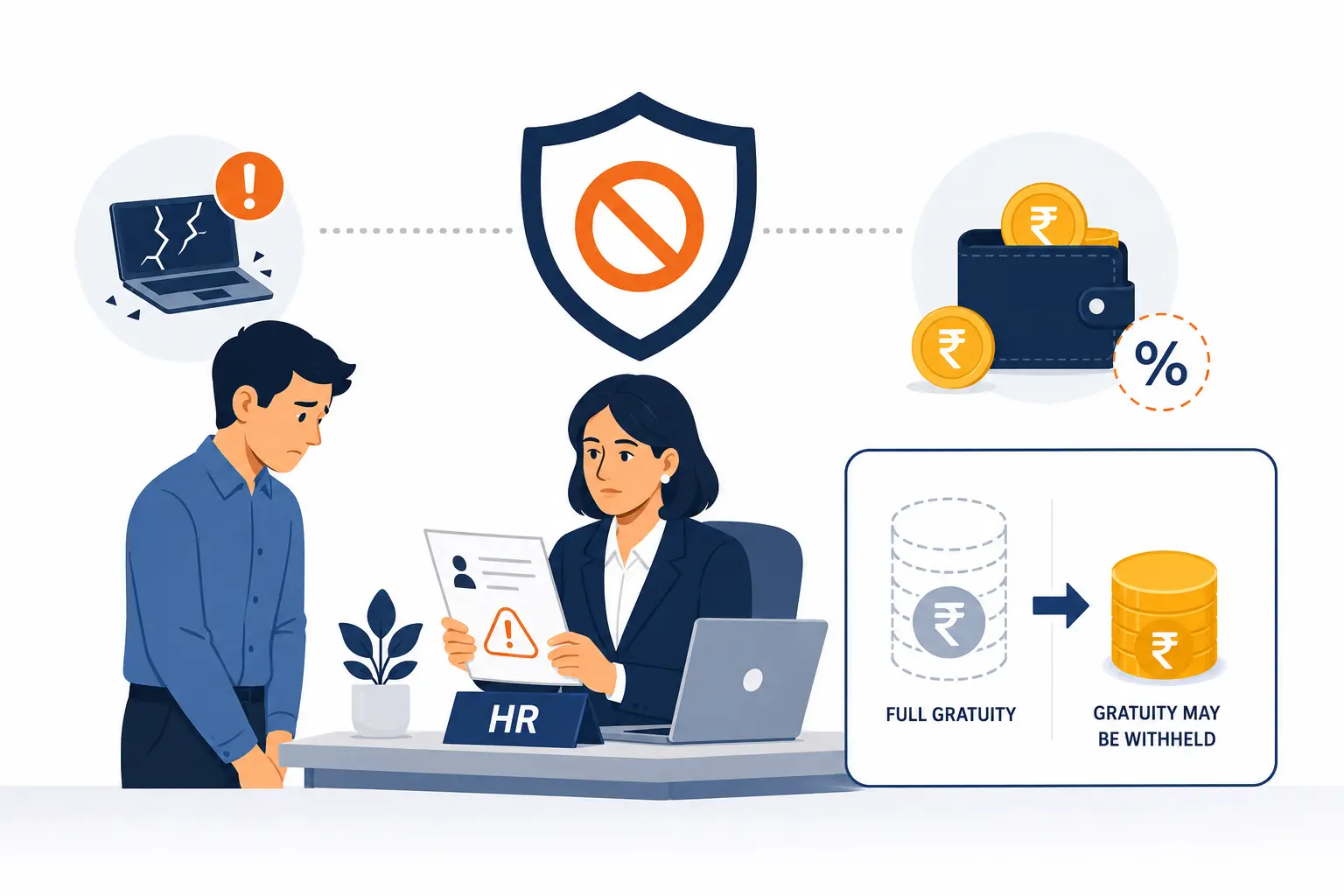
Gratuity can be withheld or forfeited in two situations:
- Deliberate negligence or failure resulting in loss or damage to the employer's property
- Misconduct involving moral turpitude leading to termination
Even in such cases, forfeiture cannot exceed the actual loss caused. The employer cannot forfeit the entire gratuity amount unless the loss is equivalent.
Gratuity Calculation: The Formula for Different Employee Categories
For Employees Covered Under the Gratuity Act
Formula:
Gratuity = (Salary Earned before Separation × 15 × Period (Years) of Service) ÷ 26
Where:
- Last Drawn Salary = Basic Pay + Dearness Allowance (DA) + Retaining Allowance (if any)
- 15 = 15 days' wages for each completed year of service
- 26 = Number of working days in a month (as per the Act)
Practical Example:
An employee retires after 12 years of service with a last drawn basic salary of ₹60,000 per month.
Gratuity = (60,000 × 15 × 12) ÷ 26 = ₹4,15,384
For Employees Not Covered Under the Gratuity Act
Formula:
Gratuity = (Last Received Salary × 15 × Years of Service) ÷ 30
Here, the divisor changes from 26 to 30. The payout is typically lower, and this formula applies to employees in establishments not covered under the Act or those with different service conditions.
What Counts as Years of Service in Gratuity in India Calculation?
- Only completed years are counted
- A fraction of 6 months or more in the last year is rounded up to a full year
- A fraction of less than 6 months is ignored
For example: 7 years and 8 months = 8 years (rounded up). But 7 years and 4 months = 7 years.
Gratuity Limit: Maximum Amount Payable
What Is the Maximum Gratuity Amount Payable in India?
This is one of the most frequently searched questions among HR professionals and employees alike. The table below will give you a much better picture.
| Employee Category | Maximum Gratuity Limit |
|---|---|
| Private sector employees (covered under the Act) | ₹20 lakh |
| Central government employees (as of 2024) | ₹25 lakh |
| State government employees | Varies by state; often ₹20 lakh |
The ₹20 lakh ceiling for private sector employees was set by the Payment of Gratuity (Amendment) Act, 2018, which doubled the earlier cap of ₹10 lakh. The 2018 amendment also gave the Central Government the power to revise this ceiling through notifications, without needing fresh legislation every time.
So if your formula yields ₹28 lakh for a high-salaried senior employee, your statutory obligation is capped at ₹20 lakh. That said, employers can always choose to pay more as an ex gratia measure.
Payment Timeline: Once the gratuity becomes due, employers are required to pay within 30 days. Failure to do so attracts interest on the outstanding amount and possible penalties.
Is Gratuity Taxable or Not?
This is possibly the question that employees ask HR the most at the time of exit. The answer depends on the type of employment.
Gratuity Exemption Section: Section 10(10) of the Income Tax Act
The gratuity exemption section is Section 10(10) of the Income Tax Act, 1961. Here is a clean breakdown:
Government Employees (Central/State Government, Defence, Local Authorities)
The entire gratuity amount is fully exempt from income tax, regardless of how large the amount is.
Private Sector Employees Covered Under the Payment of Gratuity Act
The exemption is the lowest of the following three amounts:
- Actual gratuity received
- ₹20 lakh (revised ceiling as of March 29, 2018)
- 15 days' salary for each completed year of service (calculated as: Last Drawn Salary × 15 ÷ 26 × Years)
Any amount beyond the exempt limit is added to the employee's income and taxed at applicable slab rates.
Private Sector Employees Not Covered Under the Act
The exemption is the lowest of:
- Actual gratuity received
- ₹20 lakh
- Half-month's average salary for each completed year of service
Example for Clarity:
An employee in a private firm receives ₹15 lakh as gratuity after 25 years of service. His last drawn basic was ₹60,000.
- Formula-based exempt amount: (60,000 × 15 ÷ 26) × 25 = ₹8,65,385
- Ceiling: ₹20 lakh
- Actual received: ₹15 lakh
Exempt amount = ₹8,65,385 (the lowest of the three). Taxable portion = ₹15,00,000 − ₹8,65,385 = ₹6,34,615
This is added to income and taxed per the employee's applicable slab.
Note: The lifetime exemption limit on gratuity across all employers is ₹20 lakh. If an employee has already claimed partial exemption from a previous employer, the balance applies for the current employer.
HR Compliance Checklist for Gratuity in India
Managing gratuity in India the right way means staying on top of both legal obligations and internal processes. Here is a practical checklist:
Documentation and Nomination
- Collect Form F (Nomination Form) from every employee within 30 days of completing one year of service
- Update nomination records when an employee gets married or experiences family changes
- Keep records of employment dates, salary history, and nature of exit
On Employee Exit
- Calculate gratuity immediately on the date of exit
- Issue payment within 30 days of the due date
- If there is a dispute, refer it to the Controlling Authority (usually a senior labour officer) under the Act
Accounting and Provisioning
- Many companies fund gratuity through approved gratuity trusts or group gratuity policies from LIC or other insurers
- As per AS 15 (Revised) and Ind AS 19, gratuity must be actuarially valued and disclosed in financial statements
- Annual actuarial valuation is a compliance requirement for listed and larger companies
Forfeiture Protocol
- Document all instances of misconduct that led to termination
- Get legal clearance before forfeiting any portion of gratuity
- Forfeiture in excess of actual loss is not permitted under the Act
Mewurk payroll software maintains a time-stamped employment record for every employee, including joining date, salary revisions, and nature of exit. This helps companies plan and execute gratuity audits in a straightforward and defensible manner.

Conclusion
More than a payable figure on a settlement sheet, gratuity in India is a legal commitment, a financial safeguard for your employees, and a reflection of how your organisation values long-term loyalty.
If you're managing exits across a growing team, Mewurk's HR and payroll platform handles gratuity tracking, eligibility alerts, and settlement calculations automatically, so compliance is built into your process.
Did this guide answer your questions on gratuity in India? If you found it useful, do share it with your HR peers, payroll teams, and finance colleagues who handle exit settlements. They need this as much as you did.
Frequently Asked Questions (FAQs)
Q1. What is the minimum service period required to claim gratuity in India?
An employee must complete a minimum of 5 years of continuous service. However, this condition is waived in cases of death or disablement due to accident or disease.
Q2. How do HR teams manage gratuity calculations for large workforces?
Managing gratuity manually across a large workforce is error-prone and time-consuming. HR payroll platforms like Mewurk can automate this entirely: the system tracks each employee's tenure, flags gratuity eligibility at the time of exit, and calculates the correct amount based on payroll data.
Q3. How is gratuity calculated for employees covered under the Payment of Gratuity Act?
The formula is: (Last Drawn Salary × 15 × Years of Service) ÷ 26. Only basic salary and DA are included; bonuses and HRA are excluded from the calculation.
Q4. What is the maximum gratuity amount payable in India for private sector employees?
The statutory maximum is ₹20 lakh for private sector employees, as revised by the 2018 amendment. Central government employees have a higher ceiling of ₹25 lakh as of 2024.
Q5. Is gratuity taxable in India for private sector employees?
Gratuity is partially exempt under Section 10(10) of the Income Tax Act. The exempt amount is the lowest of actual gratuity, ₹20 lakh, or 15 days' salary per year of service.
Q6. Can an employer forfeit an employee's gratuity in India?
Yes, but only partially. Gratuity can be forfeited if the employee is terminated for wilful negligence or misconduct causing loss, and only to the extent of the actual damage caused.

Most Popular Post

Why Accurate Attendance and Leave Management Matters for Business Growth?
Read More →Why Accurate Attendance and Leave Management Matters for Business Growth?
How To Leverage Attendance Data For Better Workforce Management?
Read More →How To Leverage Attendance Data For Better Workforce Management?