What Is an Employee Leave Policy? Types, Rules & Best Practices
"Show me your leave policy for employees, and I will tell you how much you value your people." That was a line I heard a few years ago in an HR leadership workshop, and it has stayed relevant ever since. It sounds bold, but it is painfully accurate in most workplaces.
A poorly made employee leave policy is the number one driver of avoidable attrition and silent disengagement. Conversely, a transparent, legally sound leave policy for employees acts as a retention magnet.
In this guide, we will give you a clear view of an employee leave policy, why it matters for Indian companies, and how you can design one balancing compliance, culture, and cost.
What is an Employee Leave Policy?
An Employee Leave Policy is the formal governing document of an organisation that defines the conditions under which an employee can be absent from their scheduled duties.
It bridges the gap between the employer's need for operational continuity and the employee's biological, social, and emotional need for rest. Further, it guarantees that the employee does not lose their compensation or face disciplinary action.

In the Indian context, leave policy is a statutory requirement. Depending on the nature of your business, whether you are a manufacturing unit in Mumbai or an IT company in Bengaluru, your leave policy for employees must align with the specific State Shops and Establishments Act or the Factories Act, 1948. The new Labour Codes on Social Security (once fully enforced) further codify these rights.
A robust leave policy for employees serves three purposes:
- Compliance: Avoiding legal penalties and lawsuits.
- Culture: Signalling that the company respects work-life balance.
- Finance: Managing leave liabilities (accruals and encashment).
A valid employee leave policy must bring clarity to the leave year (Calendar vs. Financial), the accrual rate, the maximum accumulation limit, and the procedure for scheduling.
10 Leave Types Leave Policy for Employees In India Should Cover
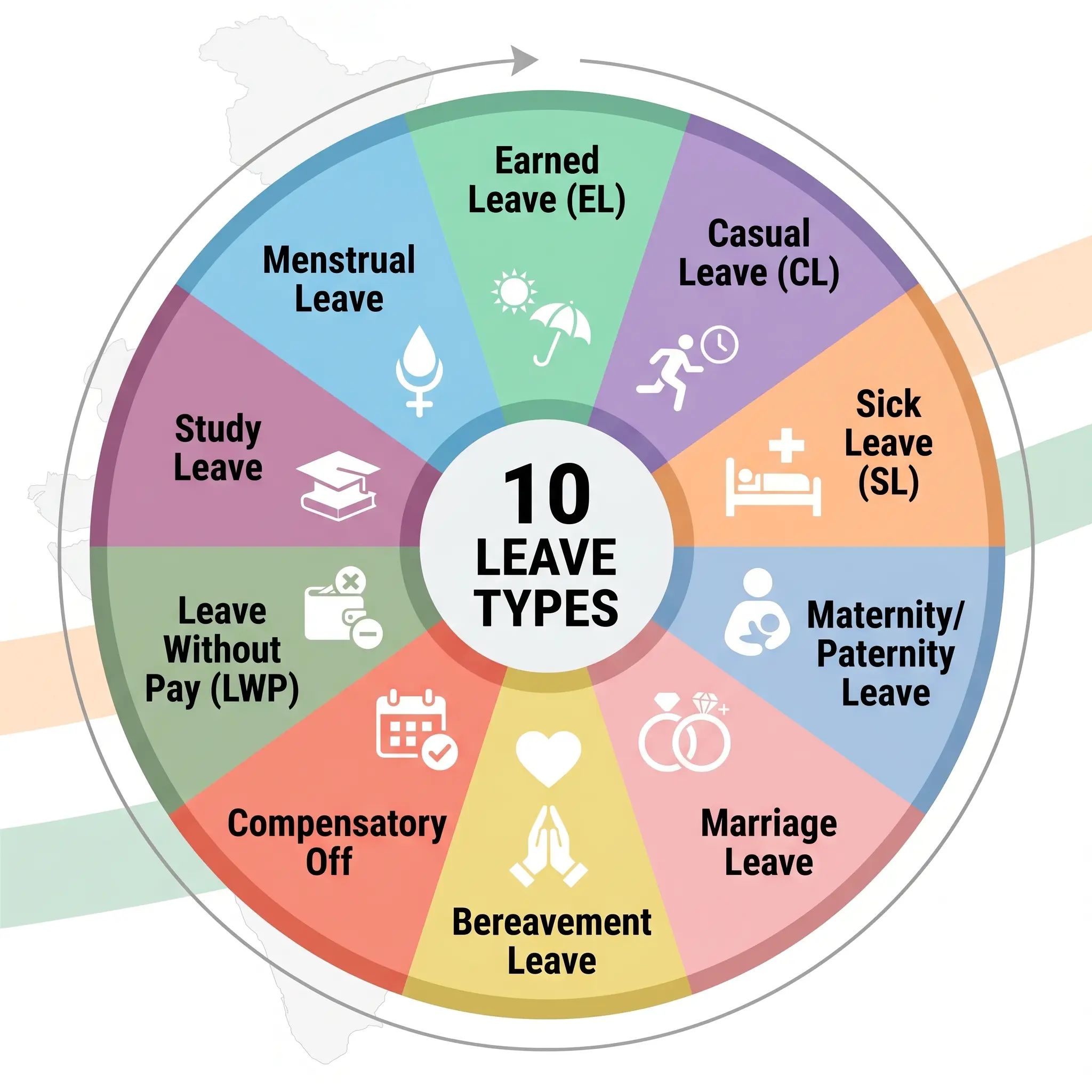
The earlier leave policy for employees in pvt ltd company had only casual and sick leaves. Now it has expanded to accommodate various types of time off. Below are the core leave types expected to be accommodated in a valid and comprehensive employee leave policy India.
1. Earned Leave (EL) / Privilege Leave (PL)
In most companies, this functions as the primary vacation leave bucket. The new Labour Codes have reduced the eligibility threshold. Previously, an employee had to work 240 days to earn leave.
Now, an employee qualifies for annual paid leave after just 180 days of work in a year.
- Accrual: Usually 1 leave for every 20 days worked (approx. 15 days/year).
- Best Practice: Allow encashment of unused EL at the time of exit or at the end of the year.
2. Casual Leave (CL)
Casual leaves are intended for urgent or unforeseen personal matters. It usually has a short notice period.
- Quantity: Usually 6 to 12 days per year.
- Rule: Most leave policy format for employees do not allow clubbing casual leaves with weekly offs or holidays to create a long weekend.
3. Sick Leave (SL) / Medical Leave
Employee sick leave policy in most organisations allows workers to report short sick leave (1-2 days) on their own, but ask for medical proof if the leave continues (3+ days).
Statutory View: Generally, 12-15 days per year, depending on the state.
4. Maternity, Paternity & Adoption Leave
The Supreme Court recently expanded the scope of maternity/paternity and adoption leave policy. Just like the employee marriage leave policy in India, the parental policy remains non-statutory for private-sector employees. The Court urged the government to change this, but it has not yet become law.
- Maternity: 26 weeks for biological mothers. 12 weeks for commissioning/adopting mothers.
- Adoption Update: The Supreme Court has directed that maternity benefits must be granted to adoptive mothers regardless of the adopted child's age (removing the earlier 3-month cap).
- Paternity: While not universally statutory in the private sector, granting 5-15 days is now market standard for a progressive leave policy for employees in pvt ltd company.
5. Marriage Leave
Interestingly, this is often a gift rather than a legal right in most states. Yet, data shows that 45.45% of companies provide 5 days of marriage leave, while 33.33% provide 3 days.
HR Note: Specify if this applies only to the employee's own wedding or to siblings/parents.
6. Bereavement Leave
There is no legal mandate to provide paid leave for a death in the family, but 43.27% of top companies offer 5 days of leave for the loss of an immediate family member. From a cultural sensitivity perspective for Indian audiences, it's the bare minimum expected to show basic respect for a person's culture and family.
7. Compensatory Off
This is for those working on holidays or weekends. It is a good practice to let them enjoy compensatory time off for those holidays they worked. Instruct your employees to use them within 60 days to avoid accrual buildup and make provision for that in the Employee Leave Policy.
8. Leave Without Pay (LWP) / Loss of Pay (LOP)
Leave without Pay (LWP), or Loss of Pay (LOP), is more or less like a backup plan to include in your employee leave policy to let workers have time off without feeling guilty or facing job insecurity when their paid balances are exhausted. Needs approval matrix.
9. Study Leave / Sabbatical
The study leave policy for government employees is defined by DoPT. Private firms can adopt similar models: 6-24 months, often unpaid, with a service bond.
10. Menstrual Leave
Menstrual leave is not statutory yet, but states like Bihar and companies like Zomato have started offering 1 day per month. Kerala proposed a bill to include menstrual leave in the Employee Leave Policy of companies in 2023. In progressive workplaces, such provisions will help bring a big-time impact.
Leave for Contractual Staff
This is a serious headache for the compliance team. A contract employee leave policy differs from a permanent one. For contractual employees in India, they may not accrue EL like permanent staff.
However, under the new codes, they are entitled to paid leave if their contract exceeds a certain duration, and they are entitled to get leave wages loaded into their hourly rates.
How State Rules and Central Labour Codes Shape Employee Leave Policies
India does not have a single leave policy for employees PDF which every HR team throughout the country can download and use for compliance. Instead, we have a mix of state labour laws and central regulations.
The State Shops and Establishments Act Variations Across States
| Feature | Delhi | Karnataka | Maharashtra |
|---|---|---|---|
| Earned Leave | 15 days/year | 1 day per 20 days worked | 21 days/year (after 240 days) |
| Casual Leave | 12 days (often clubbed with Sick) | 12 days | Not specified (varies by establishment) |
| Sick Leave | 12 days (CL & SL combined) | 12 days | Generally, medical leave is included in PL |
How Does the New Labour Code Impact Leave Policy for Employees
The central government is pushing for uniformity and consistency in the leave laws for employees across different states. The New Labour Code has brought renewed focus to standardising labour compliance in this regard.
- Work Hour Flexibility: Companies may adopt 4-day work weeks, which could influence leave calculations and weekly off structures.
- Better Coverage for Fixed Term: Fixed-term staff may receive leave and gratuity benefits similar to permanent employees.
- Health Checks: Mandatory free annual health check-ups for all employees above 40 years of age.
How to Write a Clear and Effective Employee Leave Policy
If you look at the leave policy for employees and feel that certain ones are bad, it would be because they are copied from a competitor or are full of legal jargon. A good Employee Leave Policy will be foolproof.
When you draft your employee leave policy sample, use plain English. It should be equally easy to understand for your entry-level staff and senior-most leaders.
What Should Be Included in an Employee Leave Policy
Your leave policy format for employees should include the following headers:
- Preamble: Why does leave exist? (e.g., to ensure employees rest and return productive.)
- Definitions: Clearly define continuous absence vs intervening holidays.
- The Accrual Table: A simple chart showing how many days are earned per month.
- The Blackout Periods: (Optional) Mention if leave cannot be taken during quarter ends or peak sales season.
- The Handover Clause: Mandate that work must be delegated before leave starts.
How to Communicate the Employee Leave Policy (Email Format)
When you draft a new leave policy or update the existing one, it is good to send a leave policy email to employees in addition to making it available on your HR document management system, accessible to all employees.
Find the sample subject line and content for the leave policy email to employees below.
Subject: Updated Leave Guidelines for the Financial Year
Team,
We have revised our leave structure to align with the new labour codes. Please note that the eligibility for paid leave now kicks in after 180 days.
You can find the complete leave policy for employees PDF attached.
The key takeaway: We have increased our casual leave quota to 12 days. Please plan your leaves in the HRMS portal at least a week in advance.
Best Employee Leave Policy Practices for HR Decision Makers
You have the rules, but how do you make them work without irritating your workforce? Here are the operational hacks that work for HR decision makers.
- Set a leave accumulation cap
- Define separate leave rules for contractors
- Automate leave approval workflows
- Create a clear study leave policy
- Keep leave policies legally compliant
- Use plain and easy-to-understand language
- Standardise leave approval timelines
- Track leave trends through HRMS reports
- Communicate policy updates regularly
- Maintain proper leave records and documentation
Special Leave Policy Situations You Should Address
No leave policy covers 100% of human life. You will have the employee who takes sick leave the day after a long weekend. You will have a manager who rejects every leave request. You should be well prepared for these exceptional situations.
- Define rules for Leave Without Pay (LWP)
- Add guidelines for employee sick leave policy
- Offer floating holidays for cultural and regional festivals
- Clearly mention leave encashment eligibility
- Specify which leave types can be carried forward
- Define leave rules during notice periods
- Handle misuse of sick leave with proper documentation rules
- Create escalation steps for repeated leave conflicts
- Maintain transparency in Full and Final leave settlements
- Set approval authority for exceptional leave requests
Conclusion
So, does your current leave policy for employees reflect how much you value your people?
A well-structured employee leave policy is a retention magnet. It deftly balances culture, cost, and law.
If you found this guide useful, please share it with fellow HR leaders. Wishing you the very best in building a workplace that cares for your employees.
Frequently Asked Questions (FAQ)
1. What is the minimum number of sick leaves an employee must get in India?
Most State Shops and Establishments Acts mandate a minimum of 12 days of sick leave or casual cum sick leave per calendar year, though this varies slightly by state.
2. Can a private company deny marriage leave in India?
Yes. Marriage leave is not a statutory right under most central laws for the private sector. However, many progressive organisations include a flexible employee marriage leave policy in India to support employee well-being and improve workplace satisfaction.
3. Do contractual employees get paid leaves?
Yes, if they are covered under the Contract Labour Act. Leave policy for contractual employees in India is usually handled by giving them a wage premium (in lieu of leave) or providing proportional earned leave based on days worked.
4. How do I request a leave policy for employees PDF from my HR?
Look for the Policies section on your internal HR portal or Intranet. If it is unavailable, simply email HR requesting the Leave Policy Document.
5. Is the leave policy different for a leave policy for employees in pvt ltd company vs a public limited company?
The legal floor (minimum leave) is the same under the state Acts. However, private limited companies offer more generous leave policies to compete for talent, whereas public companies may stick strictly to statutory minimums.

Most Popular Post

Why Accurate Attendance and Leave Management Matters for Business Growth?
Read More →Why Accurate Attendance and Leave Management Matters for Business Growth?
How To Leverage Attendance Data For Better Workforce Management?
Read More →How To Leverage Attendance Data For Better Workforce Management?