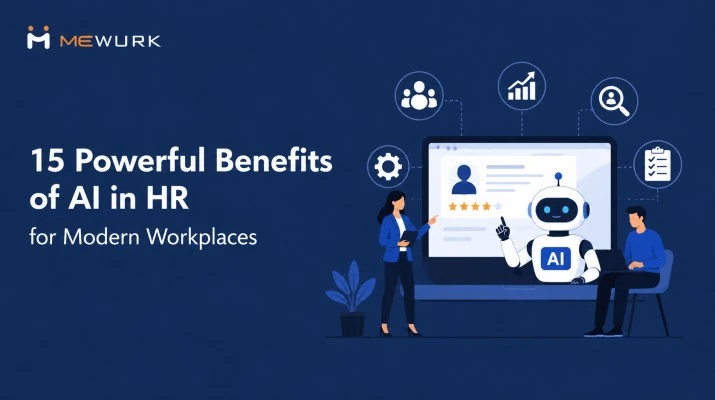
15 Powerful Benefits of AI in HR for Modern Workplaces
Summary
This blog explores 15 major benefits of AI in HR for Indian businesses, including faster hiring, reduced bias, workforce planning, payroll automation, and predictive analytics. Backed by 2026 data and real-world examples, it also examines key AI in HR challenges such as data privacy, transparency, and the growing need for AI skills.
Do you believe that 74% of recruiters in India cannot find qualified candidates? That is not an assumption but a statistic from LinkedIn's 2026 report. Reports show that hiring activity runs 40% above pre-pandemic levels in 2026. It is impossible for an HR to screen candidates by individually perusing resumes. But interestingly, AI has started changing the scenario.
This blog cuts through the hype to deliver 15 verifiable benefits of AI in HR, backed by 2026 data, and specific use cases from Indian enterprises. We will also take a hard look at the challenges of AI in HR.
What Is AI in HR?
AI in HR refers to the use of artificial intelligence to automate HR tasks such as hiring, payroll, employee management, analytics, and workforce planning. Beyond just task automation, how AI is used in HR comprises improving speed, accuracy, and decision-making.

15 Benefits of AI in HR for Business Leaders in India
1. Discovering the Hidden Talent Pool
One of the most celebrated benefits of AI in HR is the ability to look beyond pedigrees. The traditional Indian hiring system filtered candidates based on college names or previous designations. AI changes that.
According to a 2026 LinkedIn hiring report, 71% of Indian recruiters admitted that AI helped them uncover candidates with skills they would have previously missed. This is critical as 47% of recruiters cite shortages in in-demand skills.
How it works: When you use AI in HR recruitment, it could scan for competency and project experience rather than the age of the degree or the brand of the previous employer.
Example: A candidate from a Tier-2 city with a strong GitHub portfolio gets shortlisted based on capability rather than college pedigree.
2. Slashing Time-to-Hire by 70%
In the race for the top tech talent, having speed gives a competitive advantage. AI and automation in HR help compress the hiring cycles to an amazing extent.
The Proof: A major logistics company in Ahmedabad using Mewurk's AI video interviewer managed to reduce hiring turnaround time by 70%. If you are an Indian IT firm, AI could be utilised effectively to handle 70-80% of initial screenings.
Impact: In the above AI in HR examples, we see that HR teams are moving from processing to closing candidates before their competitors could send a rejection email.
3. Reducing Recruitment Bias (Ethical AI)
The role of AI in HR is not limited to being fast. It also helps companies to act more fairly in decisions. As you know, India has quite a diverse socio-economic landscape that requires careful handling of bias.
Algorithmic bias is a real risk, but when it is properly audited, AI could apply the same logic to every applicant, ignoring names, genders, or regional indicators that trigger human subconscious bias.
The real-world example of the impact of AI in HR, specifically in addressing bias, is well documented by Wipro, which used AI to remove subconscious bias at early stages of recruitment, focusing purely on skill-to-role matching.
4. AI Co-Recruiters Are Doing the First Interview
Gone are the days of simple AI chatbots. Examples of benefits of AI in HR now include autonomous agents that act as full recruiters.
Many HRMS platforms now incorporate AI Co-Recruiters as part of their offerings. A perfect example is Mewurk's Maya AI Video Recruiter. This agent lets HRs create jobs, interview kits consisting of interview questions, scoring parameters, etc. and then screen candidates.
Candidates who were screened through this new-age tech reported being interviewed like a real person and expressed that the process made them feel more comfortable and fairly treated.
5. Personalised Learning & Development
One of the biggest and perhaps most impressive AI use cases in HR is how it is being applied in skill-based matching for internal mobility.
Only 48% of organisations currently run structured reskilling programs, but AI allows for dynamic upskilling.
When this is done with proper intent, AI agents could identify a skills gap in your office and automatically recommend a specific nano-course to the employee. Previously, sending online learning management system access was all that many organisations could do in such situations.
6. Predictive Attrition Analytics
Would you like to know who is quitting next month? AI in HR analytics provides leading indicators of disengagement. Researchers highlight that predictive analytics helps identify attrition risks and skill gaps early.
By analysing communication patterns, project load, and engagement survey data, AI could flag attrition risks, and you can intervene with a retention bonus or role change before the resignation lands on your desk.
7. Productivity Growth: Saving 23 Hours a Week
Let's talk about the benefits of AI in HR in reducing the administrative overload. When discussing the use of AI in HR, many pointed out the potential complexity it carries, but the ROI is visible in time saved.
Reliable reports from platforms like Teamlease Digital estimate that AI saves recruiters approximately 23 hours weekly. That is nearly three full working days saved. Examples of AI in HR in this segment cover automating offer letter generation, background verification triggers, and onboarding documentation.
8. Always-On HR Support with GenAI
Generative AI has shifted the expectation of service delivery. HR teams now do not require to answer the same policy question 500 times a month. AI-powered HR Chatbots can handle questions about leave balances, policy queries, and tax declaration filing. Nearly 70% of global respondents report using GenAI in reporting and learning.
9. Enhanced Data Security & Compliance
With great data comes great responsibility. Disadvantages of AI in HR exist, specifically regarding data privacy. However, AI also solves these via governance.
51% of organisations cite data privacy as the greatest barrier to GenAI introduction. How can this risk be addressed? AI applications in HR could be used to monitor access logs and flag unusual activity (e.g., a manager exporting the entire org chart) instantly.
10. Strategic Workforce Planning
CHROs are moving from reporting to predicting. How AI is used for SWP involves modelling what-if scenarios. 45% of organisations in India identify AI and digital skills as their largest workforce constraint. This could be polished as major benefits of AI in HR and help teams model the cost of hiring vs. reskilling to close that gap over time.
11. Payroll Accuracy and Fraud Detection
While not glamorous, payroll is where trust shows its manifestation in employee management. Recent AI trends in HR show the explosion in the category of payroll, with the country being a top global adopter.
34% of Indian organisations are planning near-term AI implementation for payroll. Around 50% are already using it to calculate taxes, benefits, and overtime.
AI detects fraudulent transactions and automates complex tax compliance. This significantly reduces the penalty risk.
12. The End of Manual JD Writing
Writing job descriptions is tedious. Several companies using AI in HR have turned this into a 10-second task.
Platforms like Mewurk's Maya AI enhance the process of job description writing based on job role specifications. Once the JD is created, HRs can edit it to fit their specific role requirement and instantly create interview kits.
According to industry reports, better JDs lead to a higher quality of applicants and a nearly 53% boost in interview success rates.
13. Supporting Global Mobility
For Indian IT and Healthcare sectors, sending talent abroad is lucrative but complex. Recently, TERN Group, an HR AI platform, helped deploy Indian healthcare professionals to Germany and the UAE by integrating credential verification and skills assessment into a single system.
The result was outstanding. The process could reduce the fragmentation of moving talent across borders and ensure thorough compliance with local laws (visa/immigration).
14. Elevating HR to a Strategic Business Partner
When talking about the benefits of AI in HR, the ultimate goal is the elevation of the function. In the current scenario, more than half of the HR leaders struggle to deal with admin load, and it stops them from being strategic players in the organisations.
The solution here is straightforward, though, if you are open to incorporating AI and machine learning in HR. Automation of the admin load, which might take about 23 hours weekly for grunt work, could save HR leaders precisely those hours and encourage them to focus on culture, mergers, and leadership coaching.

15. Future-Proofing with Agentic AI
Looking at AI in HR tech trends for 2026 and beyond, we see Agentic AI. The goal is that AI use in HR shouldn't be limited to just answering questions but taken to the extent of executing multi-step plans.
The current prediction suggests that by 2031, AI agents could handle projects that currently take humans a month.
Benefits of AI in HR: Key Business Impact & Adoption Trends in India
| Benefit Category | Key Impact for Indian Businesses | Adoption Data (India 2026) |
|---|---|---|
| Talent Acquisition | Finds hidden talent, reduces bias, automates interviews | 80% plan to expand AI for hiring goals |
| Operations | Saves 23 hours/week, automates payroll & compliance | 34% implementing AI payroll |
| Workforce Planning | Predicts attrition & skills gaps | 45% cite AI skills as top constraint |
| Strategic Value | Frees CHROs for leadership tasks | 65% view HR as key business enabler |
Understanding the Challenges: What Do AI in HR Statistics Reveal
While the benefits of AI in HR are massive, we cannot take them for granted. A thorough and unbiased study demands treating both advantages and disadvantages of AI in HR at equal measure.
- Data Privacy: 51% of leaders fear compliance breaches.
- The Skills Gap: Ironically, AI in HR certification and upskilling are needed. 45% of firms say a lack of AI skills is their biggest constraint.
- Transparency Pressure: 50% of recruiters are under pressure to explain how AI makes decisions.
If you are an HR professional feeling the heat, consider offering an AI in HR course or AI in HR certification for your team to help them understand the process better. The future of AI in HR depends on humans auditing the algorithms.
Conclusion
We set out to prove that the benefits of AI in HR are not just theoretical. From saving 23 hours a week in admin to reducing bias in hiring, the data is clear.
Did you find the specific use case for your industry useful? If you know a CHRO struggling with attrition or a team bogged down by resume screening, share this blog with them.
Frequently Asked Questions (FAQ)
1. What is the biggest benefit of AI in HR for Indian companies right now?
Recruitment efficiency is by far the biggest benefit of AI in HR. A growing number of recruiters are using AI to find hidden talent. It dramatically cuts the time spent sifting through low-quality applications.
2. What are the risks or disadvantages of AI in HR?
Data privacy concerns are cited by 51% of leaders as among the biggest disadvantages of AI in HR. Another major concern is algorithmic bias, especially when AI systems are not properly audited for India's diverse demographics and hiring patterns.
3. Which are the top companies using AI in HR in India?
Infosys, Wipro, and HCLTech use AI for facial recognition and screening. Mewurk has successfully implemented AI in its biometric attendance systems, HR reports and trends and recently in an AI-based screening/interviewer platform.
4. How does AI affect payroll processing in India?
India is a proactive adopter of AI-powered solutions in HR, especially in payroll. Indian companies that understand the role of AI in HR payroll have started using it now to automate tax calculations, overtime, and fraud detection. A rough estimate shows that about 34% of firms are planning new implementations soon. This will make a huge positive impact on payroll processing in India.
5. Will AI replace HR jobs in the future?
No. AI won't replace HR jobs. What it will do instead is augment them. AI handles automation. It frees the human HR pros for empathy, culture building, and strategy. AI integration has historically grown HR jobs.
6. How AI can be used in HR for workforce planning?
AI can be used in HR for workforce planning by predicting hiring needs, identifying skill gaps and analysing attrition risks. It can also be quite useful in forecasting workforce costs and helping businesses plan future talent requirements more accurately.

Most Popular Post
Why Accurate Attendance and Leave Management Matters for Business Growth?
Read More →Why Accurate Attendance and Leave Management Matters for Business Growth?
How To Leverage Attendance Data For Better Workforce Management?
Read More →How To Leverage Attendance Data For Better Workforce Management?