Summary
HR teams waste a lot of time on repetitive hiring tasks. This guide breaks down 10 practical ways recruitment automation can speed things up, from sorting through resumes to onboarding new hires. Plus, we'll show you how Mewurk AI Video Interviewer takes the headache out of first-round interviews and lets you make smarter decisions, faster.
Can a recruiter evaluate 250 resumes, coordinate six interview panels, and still find time to talk to each candidate in the same week? Most of the time, it is impossible. Time-to-hire across industries now averages somewhere between 36 and 44 days. In some sectors, it stretches well past two months. Ironically, the strongest candidates are off the market within ten days of applying.
The gap between how fast hiring needs to move and how fast hiring teams move is exactly where recruiting automation earns its place. This blog walks you through ten practical ways recruitment automation fixes that, plus where an AI video interviewer like Mewurk fits into the picture.
What Is Recruitment Automation?
Recruitment automation refers to the use of software and AI tools in HR to handle repetitive, rules-based parts of hiring. It covers things like resume screening, interview scheduling, candidate outreach, and status updates. With the help of recruitment automation, recruiters are in a better place to spend their time on judgment calls instead of the repetitive admin.

A recruiting automation platform is usually integrated into an ATS (Application Tracking System) and pulls data from job postings, applications, and calendars. It helps users move candidates through the pipeline with fewer manual touches at each stage.
Some automated recruitment systems handle a single task, like scheduling or resume parsing, while a full recruitment automation software suite might manage the entire journey from job posting to signed offer letter.
Essentially, a recruiting automation tool does not intend to remove human involvement from hiring. It exists to remove the repetitive tasks that keep humans from doing the parts only they can do, which, if you have ever spent an entire day untangling multiple candidates' calendars, is a difference worth caring about.
Why Automating Recruitment Is Necessary Now
Snapshot: Recruiters today average close to 20 interviews per hire, which is much higher than the figure just a few years back. Nearly 40% of their time gets swallowed by interview scheduling.
A large majority of talent acquisition teams already use or plan to use AI agents in the funnel, which tells you where the field is heading, whether individual teams are ready or not. Recruitment automation software has become an essential part of hiring. Without it, reaching hiring goals can be much harder.
10 Ways Recruitment Automation Helps You Hire Better Candidates Faster
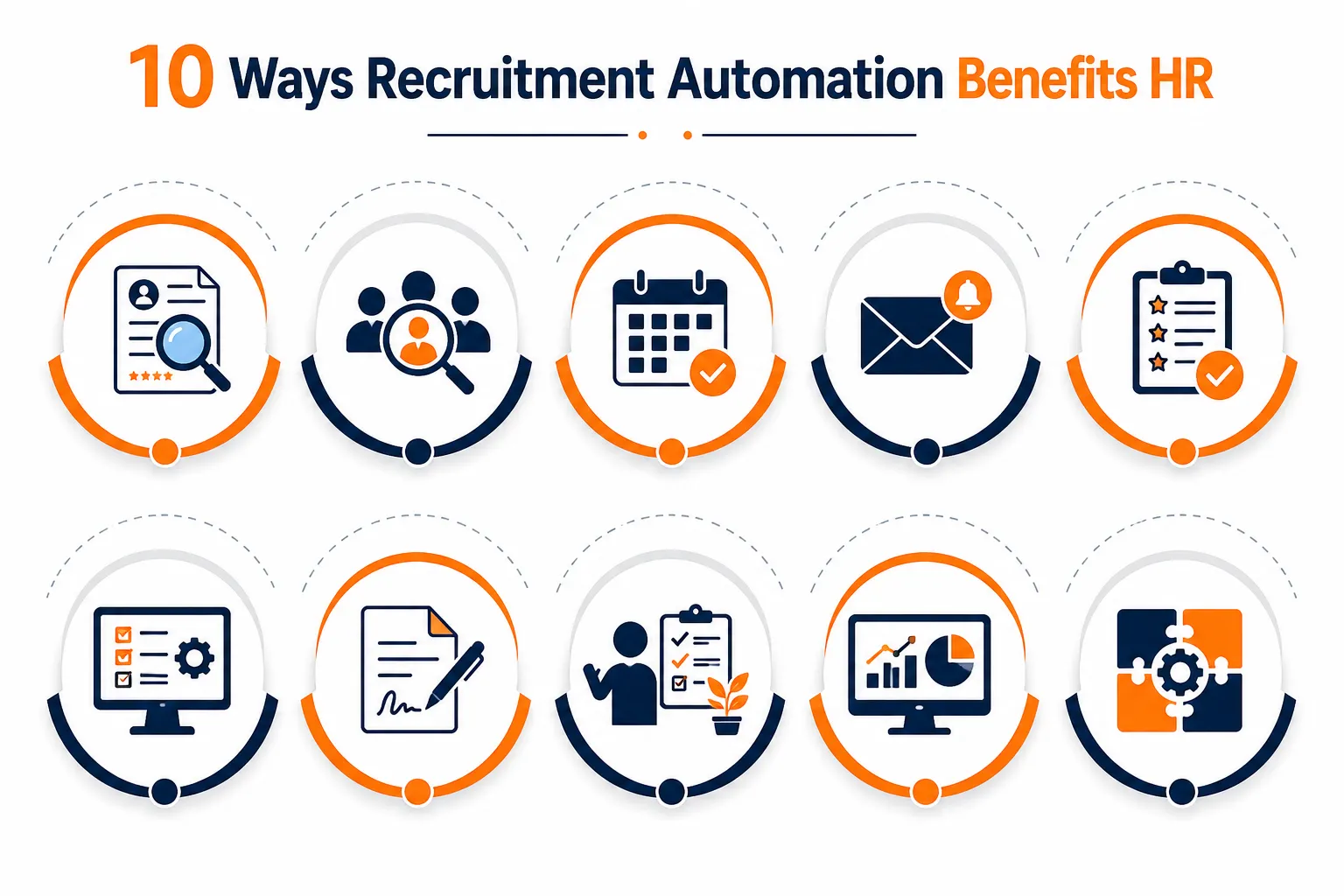
Here are ten places where recruiting automation earns its keep.
1. Non-Stop Resume Screening
If you have to manually read through hundreds of resumes for a single opening, that is a genuine challenge. In fact, it is where most bad hiring decisions begin. When you are tired, your eyes can't skim properly, and you will miss a lot of important things. You would miss out on strong candidates.
Recruitment automation software uses keyword matching, skills parsing, and ranking algorithms to sort candidates. It gives you a perfect shortlist of candidates even before your coffee gets cold.
- Screens resumes 24/7 without recruiter bandwidth limits
- Ranks candidates against role-specific criteria
- Cuts time-to-shortlist by up to 75% in high-volume roles
- Prevents strong candidates from being overlooked.
2. Smarter & Faster Candidate Sourcing
Good candidates would not wait around. The best candidates? They won't even be browsing job boards in the first place. With the help of recruitment automation platforms, you can scan job boards, professional networks, and internal databases to surface passive and active candidates who match your open roles.
For niche or senior roles, recruitment automation helps to maintain proactive sourcing, which can matter more than any job posting ever will.
- Pulls candidates from multiple sources automatically
- Flags close-fit profiles your team might otherwise miss
- Builds talent pools for future openings
- Reduces reliance on expensive job board postings
3. Automated Interview Scheduling
If you ask an HR what eats up most of their time in the hiring funnel, without any second thought, they would say it is scheduling. Some reports put it near 35 to 38% of a recruiter's week.
A recruiting automation system with an automated scheduling option will help you sync calendars, send invites, and handle reschedules. It would bypass your need to send multiple back-and-forth emails. Check the table below to see how it simplifies the job.
| Task | Hands-on Process | Automated Process |
|---|---|---|
| Finding a slot | Multiple emails, days of delay | Instant calendar match |
| Rescheduling | Manual re-coordination | Self-service reschedule link |
| Reminders | Easy to miss | Sent automatically |
4. Personalised Candidate Communication
If you shortlist a candidate but do not communicate any update to them, they will accept offers elsewhere. Who could blame them? Recruitment automation keeps every applicant informed through triggered emails and texts. They won't wonder whether their application was received or not.
Even a short automated note confirming an application was received goes a long way toward keeping candidates engaged through a process they cannot see the inside of. Modern recruitment automation software:
- Sends automatic status updates at each pipeline stage
- Personalises messaging using candidate and role data
- Reduces candidate drop-off caused by silence
- Frees recruiters from writing the same email multiple times a week
5. Data-Driven Candidate Shortlisting
Human judgment is valuable, but it is also inconsistent, especially after reviewing hundreds of resumes for a single role each day. With an automated recruitment system, you can apply the same evaluation criteria to every candidate, which helps surface talent that might get overlooked due to unconscious bias or plain fatigue.
- Applies standardised scoring criteria across all applicants
- Removes some of the variability tied to reviewer mood or fatigue
- Helps support fair and consistent hiring practices
- Works best paired with regular human oversight
6. Faster & Structured Skills Assessments
Instead of guessing whether a candidate can do the job, recruitment automation software can trigger role-specific skills tests automatically once a candidate clears initial screening. The results of this could be instantly synced to ATS for further steps.
- Auto-sends assessments based on role requirements
- Scores objectively without recruiter involvement
- Shortens the gap between application and evaluation
- Gives hiring managers comparable, apples-to-apples data
7. Streamlined Offer Management and E-Signatures
The final stretch of hiring involves sending offer letters, getting approvals, and collecting signatures. Despite many advanced options available today for these steps, they trip up several teams. Through integrated recruiting automation platforms, you can easily generate offer letters from templates and route them for internal approval. You can also send them to candidates for e-signature. You don't need even a single printed page for this.
- Auto-generates offer letters from approved templates
- Routes approvals to the right stakeholders instantly
- Sends and tracks e-signatures in real time
- Reduces delays in signing offer letters
8. Automatic Onboarding before Joining
The hiring process doesn't stop once a candidate accepts a job offer. In the weeks before they start, many new employees might doubt their decision to join the company.
Setting up automated onboarding, which recruitment automation tools these days will help you easily get done, can help avoid this. These systems will manage paperwork, computer setups, and welcome messages before the employee's first day. This makes sure their start date is organised.
- Cuts new-hire paperwork time significantly
- Improves onboarding compliance accuracy
- Reduces first-week friction that drives early attrition
- Frees HR generalists from repetitive admin tasks
9. Real-Time Analytics and Funnel Visibility
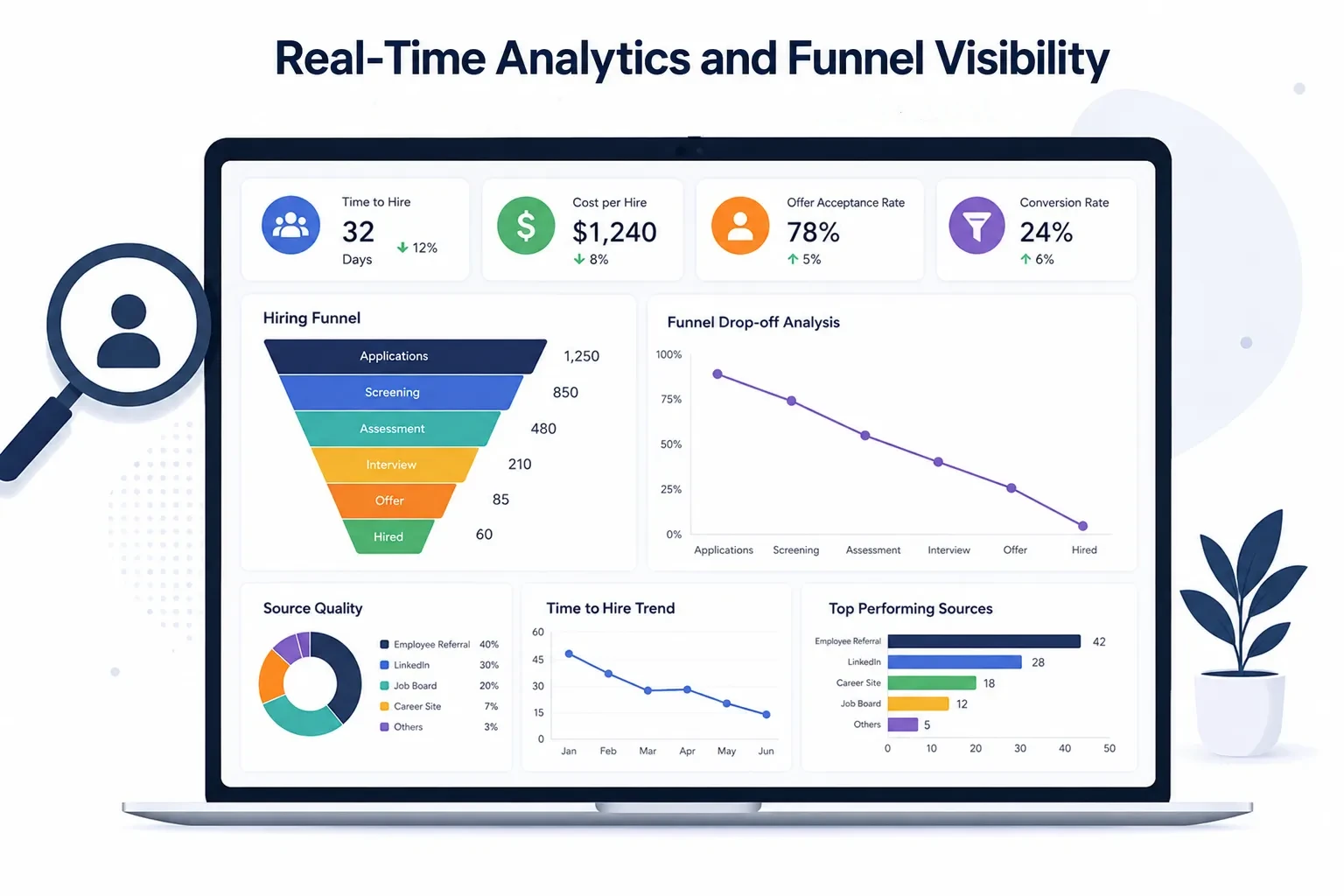
You cannot fix what you cannot see. Recruitment automation dashboards will help you track time-to-hire, source quality, and drop-off points across the funnel. As a team leader or HR, you can use these numbers for better decisions. It will also help you through:
- Surfacing where candidates are stalling in the pipeline
- Tracking cost-per-hire and source ROI automatically
- Helping forecast hiring needs based on historical data
- Turning hiring into a measurable, improvable process
10. Seamless ATS and HR Tech Integration
None of the above matters much if your tools do not integrate with your existing HRMS. Modern recruitment automation platforms integrate with your ATS, HRIS, calendar, and messaging tools. Gone are the days of moving data manually between different tabs.
- Syncs candidate data across your entire HR stack
- Eliminates duplicate data entry between systems
- Keeps hiring managers and recruiters on the same page
- Reduces the errors that come from manual updates
How Mewurk Simplifies Recruitment Automation with AI Video Interviews
One of the slowest, most repetitive parts of hiring is the first screening call: the same fifteen questions asked over and over, usually at whatever hour the candidate happens to be free, and the recruiter happens not to be.
Mewurk's AI video interviewer platform takes that first round off your plate.
Here's how it works. HR or the hiring manager starts by creating an interview kit for the job role. They can either provide a few details about the position or upload the job description, and Mewurk AI generates role-specific interview questions, evaluation criteria, and a scoring framework.
Next, the recruiter uploads a batch of candidate resumes. Mewurk AI automatically analyses them and highlights the candidates who best match the role. This alone saves several hours for the HR team from hands-on screening.
With a few clicks, interview invitations are sent to the shortlisted candidates. Candidates can complete their AI video interview at a time that's convenient for them via the candidate portal, as long as it's within the deadline set by the recruiter.
After each interview, the Mewurk AI Interviewer evaluates the responses and stores the interview recordings, transcripts, and candidate scores in one place. As an HR, you can review the results, compare candidates, and decide who should move to the next stage of the hiring process.

Conclusion
Hiring well and hiring fast do not have to be opposing goals. Recruiting automation closes that gap by handling the repetitive work. We hope this guide has given you practical ideas to improve your hiring process and build a more efficient recruitment workflow. Found it useful? Share it with a fellow HR leader. Wishing you faster, better hires ahead.
FAQ
1. What is recruiting automation in simple terms?
Recruiting automation is a process of using software to handle repetitive hiring tasks like screening, scheduling, and follow-ups. It is to help recruiters spend more time on interviews and decisions rather than the technical procedures behind it.
2. Does recruitment automation replace recruiters?
No. Recruitment automation does not replace human recruiters. It is to handle routine tasks involved in recruitment. The final judgment, relationship building, and culture-fit decisions still need human recruiters and hiring managers involved.
3. How much time can recruitment automation software save?
Depending on the tool and role volume, teams report time-to-hire reductions ranging from 30% to 75%, particularly in resume screening and interview scheduling stages.
4. Is an automated recruitment system expensive to set up?
Costs vary widely, from affordable ATS add-ons to enterprise platforms. Many businesses begin by automating one workflow, such as screening or scheduling, before expanding. To help you get started, Mewurk AI Video Interviewer offers a free trial with up to five AI video interviews.
5. How does Mewurk's AI video interviewer help HR teams?
Mewurk automates first-round screening through structured, on-demand video interviews. It lets recruiters review ranked shortlists instead of conducting repetitive early-stage calls one by one.