Summary
Last-minute absence hits 24×7 teams hardest. This guide covers how structured shift swapping and roster visibility help managers arrange replacement coverage in minutes, the rules that keep swaps safe, and the metrics to track once a swap process is live.
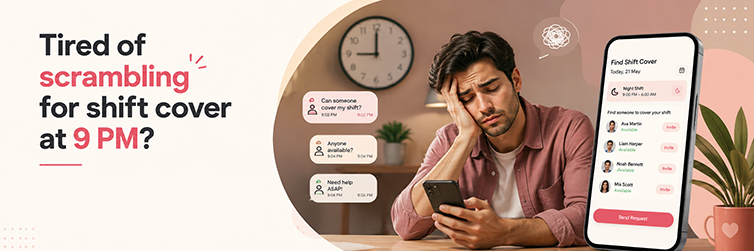
It is 9:40 PM. A supervisor at a packaging plant gets a call: one of the three operators on tonight’s 10 PM-6 AM shift is down with a fever. The line cannot run with two people.
Over the next half hour, the supervisor rings five employees, posts in two WhatsApp groups, checks a printed roster, and finally convinces someone from the evening shift to stay back on overtime.
The night is saved - but the attendance register, the overtime sheet, and next week’s roster all need manual correction now.
Hospitals, factories, security operations, warehouses, support centres - some version of this scene plays out in every 24×7 business. The absence itself is rarely the real problem; people fall sick, emergencies happen.
The problem is that most rosters have no built-in way to recover when someone drops out at short notice. That recovery mechanism is what a structured shift-swap process, backed by a visible roster, provides.
Why Last-Minute Absenteeism Is a Bigger Problem in 24×7 Teams
A typical 9-to-5 office can generally handle any unexpected absences; however, a 24×7 environment simply cannot. Night shifts and weekend work depend on a thin bench - the people who are available are asleep, on leave, or unreachable late on a Saturday evening.
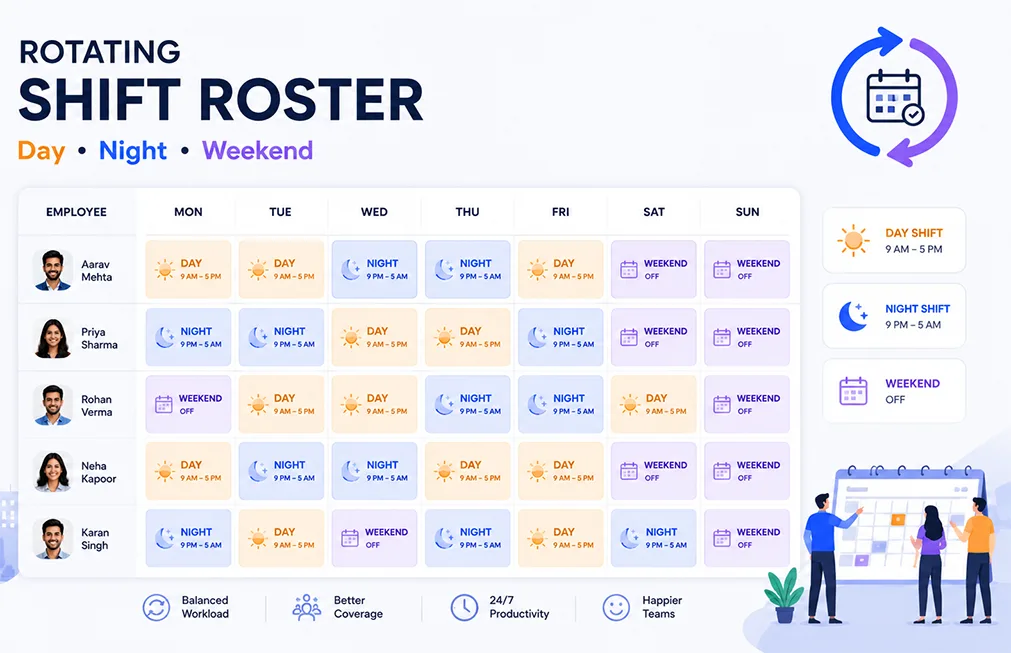
Rotating patterns make it worse; even an experienced supervisor cannot always say who is on a rest day, who just finished a double, and who is due back at 6 AM.
There is also a skill problem. In many 24×7 roles, a warm body is not enough - a boiler needs a certified operator, an ICU needs a trained nurse, a cash van needs a licensed guard. The pool of eligible replacements may be four people, not forty.
And the replacement window is brutally short: when someone calls in at 8 PM for a 10 PM shift, the manager has two hours. The default fallback - asking the outgoing shift to stay on overtime - quietly drives up costs, fatigue, and, ironically, the next round of absenteeism.
What Is Shift Swapping?
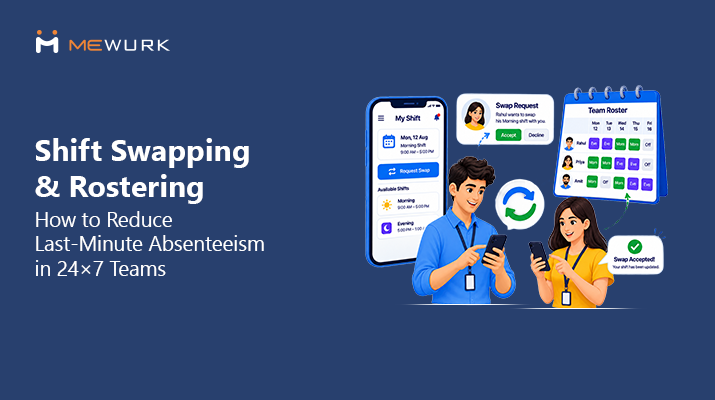
Shift swapping happens when an employee can’t work a shift. They trade it with a colleague who is willing and eligible. A manager reviews and approves the change, and the system records it before the shift begins.
Three factors distinguish a proper shift swap between employees from an informal arrangement like “I’ll cover for you today if you take my Sunday”: there is a set procedure by which the request is made; the other employee’s role qualifications, skills, and working hours are assessed before any agreement; and the official change results in an update to the schedule and attendance records. Without those three, swaps still happen - just invisibly - and HR finds out when payroll or an audit goes wrong.
Shift Swapping vs Shift Replacement vs Shift Scheduling
These terms get mixed up constantly, so it helps to separate them.
| Concept | What it means | Who usually initiates | When it happens |
|---|---|---|---|
| Shift scheduling | Deciding which shifts exist and which roles each shift needs | HR/operations | Before the roster cycle |
| Roster planning | Assigning specific employees to specific shifts, with leave and rest days factored in | Managers/planners | Days or weeks in advance |
| Shift swapping | Two employees exchange assigned shifts with each other | Employees | After the roster is published |
| Shift replacement | One employee covers an absent colleague’s shift without giving one back | Manager (usually) | At short notice |
| Shift change approval | A manager validates any swap or replacement before it takes effect | Manager / HR | Before the affected shift |
Scheduling and rosters generate the schedule, whereas swapping and replacement address discrepancies between plans and reality, and approval ensures that fixes do not lead to problems such as double bookings and hour breaches.
How Employee Shift Swapping Reduces Last-Minute Absenteeism
A swap transforms a gap into a change in coverage: the shift stays vulnerable only until an eligible colleague agrees to take it. It also moves the first effort to the employee, who proposes the swap - and often finds the replacement - instead of the supervisor dialling from zero.
The underrated effect is on silent no-shows. In every 24×7 team, some “sudden sickness” is really a schedule conflict the employee could not resolve - an exam, a wedding, a court date.
When there is a legitimate route to trade a shift, people use it days in advance rather than vanishing on the day; unexpected absence falls because calling in sick stops being the only option.
Speed and accuracy improve together: every eligible colleague sees an open request at once, and because the approved swap flows into attendance, the right person is marked present, and payroll disputes shrink.
How Roster Visibility Helps Managers Find Replacements Faster
Swapping covers the cases employees settle among themselves. When they cannot - or the notice is too short - the manager arranges a shift replacement directly, and speed depends on answering four questions fast.
Who is available, meaning not on leave or a protected rest day? Who is already scheduled - pulling someone off the 6 AM shift only moves the hole forward? Who has the required role or skill? And who can legally take it, within hour caps, rest gaps, and any night-shift rules at the site?
On paper or Excel, answering these takes calls and guesswork. In an employee roster filtered by availability, position, and hours worked, the list shrinks from “everybody in the WhatsApp group” to just three or four eligible names, and then the roster updates automatically as soon as someone accepts.
A Practical Shift-Swap Workflow for 24×7 Teams
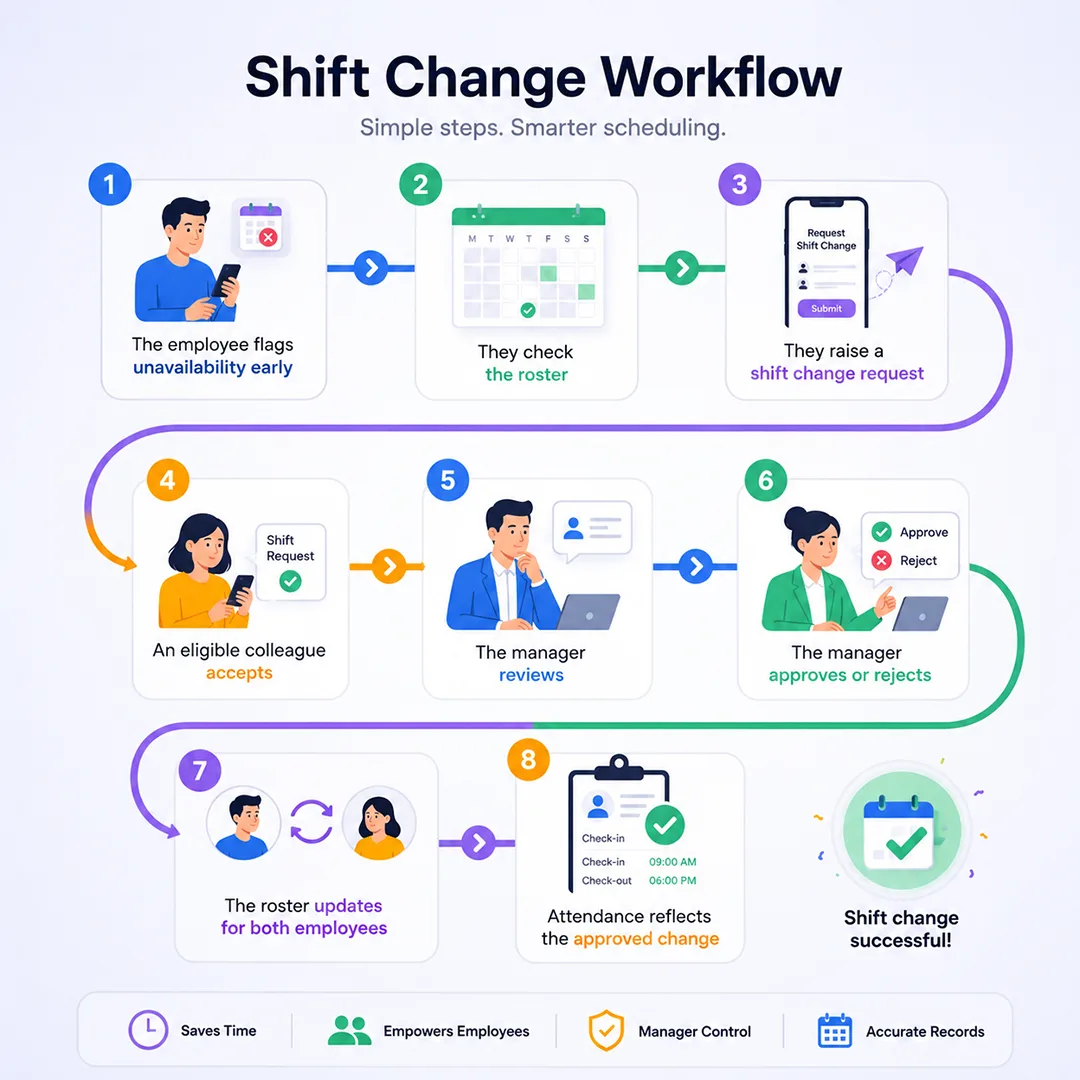
Here is what a workable process looks like end to end:
- The employee flags unavailability early - the moment a conflict appears, not on shift day.
- They check the roster for colleagues on rest days or opposite shifts - the natural candidates.
- They raise a shift change request, naming a specific colleague or opening it to all eligible teammates.
- An eligible colleague accepts - only teammates who match the role and are not already scheduled can pick it up.
- The manager reviews hours, rest gaps, and qualifications for both employees in one view.
- The manager approves or rejects, with a reason so the employee can try another route in time.
- The roster updates for both employees. No manual edits, no version confusion.
- Attendance reflects the approved change, so punch-ins match the roster and payroll inherits correct data.
Define what happens when nobody accepts, too: any request still open at the cut-off - say, four hours before shift start - escalates to the manager.
7 Rules That Keep Shift Swapping Safe
Unstructured swapping trades one problem for another. Keep it under control with:
- Every swap needs approval. Employees propose; managers confirm - no exceptions for “just this once.”
- Match role and skill. A swap is valid only between employees qualified for the shift’s actual work.
- Enforce working-hour limits. Block any swap that pushes someone past daily or weekly caps.
- Protect rest periods. Minimum rest gaps apply to swapped shifts too.
- No double booking. Anyone rostered for an overlapping shift cannot accept the shift.
- Set a cut-off time; after it, open gaps become manager-driven replacements.
- Keep an audit trail - who requested, who accepted, who approved, and when.
Common Shift-Swapping Problems HR Teams Face
Most 24×7 teams already “allow” swaps - informally. Promises in WhatsApp chats are lost among 200 other messages, and no one cares to check whether the volunteer is qualified or already scheduled. Phone trees rely on one person’s memory, Excel lists reside on one laptop, and the notice board copy is obsolete by Tuesday.
When a swap does happen, someone must correct attendance by hand - forget once, and the wrong person gets paid or marked absent for a shift that was fully covered. Unapproved swaps cause the quietest damage: everything looks fine until an audit reveals the person on record was never in the building. Add stale availability data, and manual swap management becomes a slow leak of supervisor hours and trust.
How Technology Can Simplify Shift Swapping and Rosters
This solution emphasises connectivity over functionality, since shift change management fails when the roster, availability, requests, approvals, and attendance records are kept in separate systems. Put everything in the same place, and you eliminate most of the problems.
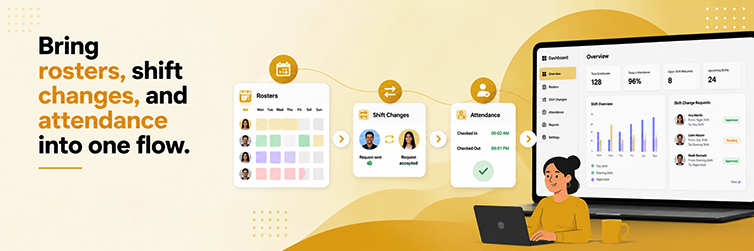
That is the practical case for workforce scheduling software. An HRMS like Mewurk links together shift management and rosters with attendance, time off, and approvals in one system, complete with a mobile app for employees working on the shop floor: rosters visible at any time, shift swap requests sent to the appropriate manager, time off verified before arranging coverage, and approved shift swaps automatically reflected in attendance without manual spreadsheet updates. The aim is not to remove judgement, which managers will continue to exercise, but to let them exercise it with all the information at hand.
Example: Handling a Sudden Night-Shift Absence
Take a logistics warehouse running three shifts, with a structured process in place.
7:50 PM - A loader on the 10 PM-6 AM shift has a family emergency. He opens the app, sees two teammates on rest day, and raises a swap request offering his Thursday in exchange.
8:20 PM - A rest-day colleague accepts: trained on the same dock equipment, rested, within weekly hour limits.
8:35 PM - The supervisor reviews both employees’ hours and eligibility on a single screen and approves.
8:36 PM - The roster updates for both. The night shift is fully staffed before the evening shift ends.
Next morning - Attendance shows the replacement present and the original employee on leave; payroll needs no correction, and nobody made a phone call.
Same absence as the opening scene - forty-six minutes instead of a chaotic evening, and no cleanup afterwards.
8 Metrics to Track After Introducing Shift Swapping
A swap process should prove itself in numbers. Review these monthly, split by shift type and site:
- Last-minute absence rate - absences reported within 24 hours of shift start
- Shift coverage rate - the share of affected shifts that still ran fully staffed
- Time-to-replacement - from absence report to confirmed cover
- Swap approval time - how long requests wait for a decision
- Unplanned overtime hours - the clearest cost signal
- Unfilled shifts - shifts that ran short despite everything
- No-show rate - absences with no advance report at all
- Manager intervention rate - gaps escalated versus resolved by employees
If time-to-replacement and unplanned overtime do not improve within a quarter, adjust the cut-off rule, the eligibility pool, or approval speed.
When Should a Business Consider Shift-Swap Software?
Coordinated manual management is fine for a single team on a repetitive schedule. The signs of its inefficiency are constant: supervisors waste the first hour of every shift fixing the list of workers; payroll issues trace back to attendance that does not match actual work; workers are allocated between sites without any overview of the situation; overtime increases while staffing stays flat; or audits report violations of rest breaks. When two or three of these happen, a spreadsheet stops being cost-effective - it is just an expense.
Conclusion
Absence in a 24×7 operation is not a problem you eliminate; it is one you design for. Fixed rosters answer “who should work.” Shift swapping and live roster visibility answer the harder question - who works now that plans have changed? Teams that build that second answer into their process spend their evenings running operations, not phone trees.
If your managers are still struggling to arrange cover via calls and chats, schedule an online demo with Mewurk to see how a shift swap can be carried out using your actual roster.
Frequently Asked Questions
What is shift swapping?
The formal swapping of shifts between two employees, verified for eligibility and sanctioned by a manager, with the roster adjusted accordingly.
How does shift swapping reduce last-minute absenteeism?
It lets employees resolve scheduling conflicts in advance rather than calling in sick on the day. It also produces a confirmed replacement faster than calls or group chats when a genuine absence occurs.
Can employees swap shifts without manager approval?
They should not. Unapproved swaps risk double booking, working-hour breaches, unqualified cover, and attendance records that no longer reflect reality.
What should a shift-swap policy include?
Who can swap with whom, working-hour and rest-period limits, the cut-off time for requests, the approval chain, what happens when no one accepts, and how the change flows into attendance and payroll.
What is the difference between shift swapping and shift replacement?
In a swap, two employees exchange shifts - both still work their share. In a replacement, one employee covers an absent colleague’s shift without giving one back, usually as extra hours or overtime.
How can businesses manage shift swaps across multiple locations?
Keep one roster system with location- and role-based eligibility rules: a request in one branch reaches only employees who can work there, and each site’s managers approve their own changes.
Can shift changes be connected with attendance records?
Yes, and they should be. When an approved swap updates both the roster and attendance, the employee who works the shift is the one marked present, keeping payroll, overtime, and compliance records accurate.