Roles and Responsibilities of HR Manager in Startups: Complete Guide
Startups are known for their intrinsic nature to move faster. Their priorities don’t stay fixed. You might see their headcounts doubling overnight. The stakeholders of a startup have constant pressure to scale.
Can you imagine the nature of the roles and responsibilities of HR manager in such an environment? Needless to say, they are the backbone for the company’s growth, talent retention and keeping a strong defence against any emerging people-problems.
If your startup doesn't have a structured HR function yet, it's high time you understood why it matters.
What Makes the Roles and Responsibilities of HR Manager Unique in Early-Stage Companies?
In early-stage companies, the HR manager’s roles and responsibilities are much broader. They have so much more on their table than those in mature organisations.
They handle hiring, onboarding, compliance, culture, and performance systems at the same time. Most of the time, it is on their shoulder to build processes from scratch and adapt daily to shifting priorities.
Most challenging of all, they have to work within limited budgets, even if their size is growing at a much faster pace.
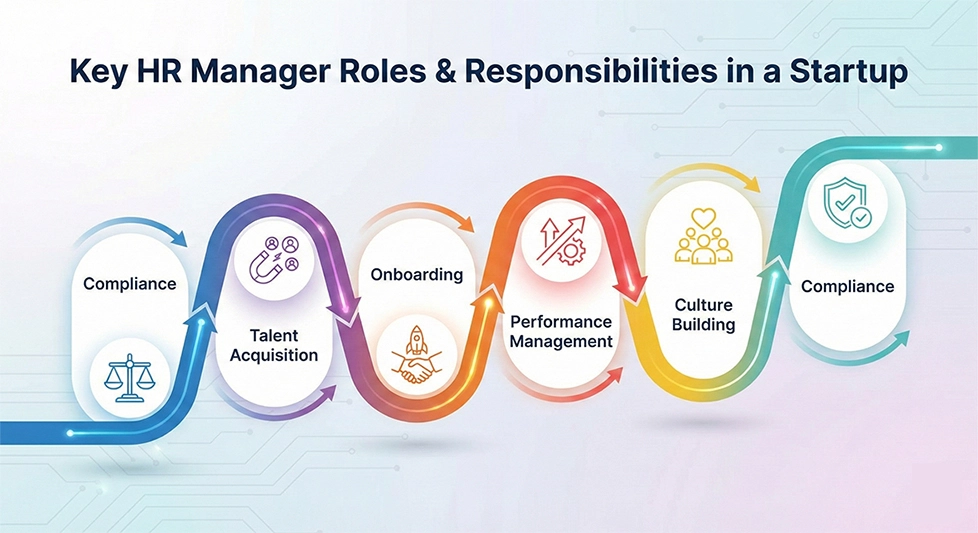
6 Key Roles and Responsibilities of HR Manager in a Startup
With the context clear, let’s get straight to the six key roles and responsibilities of HR manager that define their inevitability in a growing startup team.
1. Talent Acquisition and Strategic Hiring
If you thought recruitment in a startup was anything like hiring at a large enterprise, you are totally mistaken. In a startup, you can’t fill roles just like that because you are at the helm of building a team that will define the company's first chapter.
The roles and responsibilities of HR manager in this area go well beyond posting job descriptions. A capable HR manager in this environment must know how to map workforce planning against business milestones. They must identify skill gaps and keep a talent pipeline ready.
Key hiring responsibilities include:
- Designing structured interview frameworks to reduce unconscious bias
- Writing impactful job descriptions that would attract culture-add candidates rather than just culture-fit ones
- Managing employer branding on platforms like LinkedIn and Glassdoor
- Coordinating with department heads and verifying that hiring timelines match product or sales roadmaps.
- Tracking hiring metrics such as time-to-fill, cost-per-hire, and offer acceptance rates

According to LinkedIn's Global Talent Trends report, companies can minimise their cost-per-hire only by building strong employer brands.
Some companies do exceptionally well by reducing it to the line of 50%. For a cash-constrained startup, that is not a minor detail.
2. Onboarding and Employee Integration
The first 90 days of an employee's journey in an organisation have a significant influence on their retention.
Research by the Brandon Hall Group found that organisations with a strong onboarding process are more likely to have a higher retention rate for their new hire, up to 82%, than those without.
One of the key roles and responsibilities of HR manager here is creating a structured onboarding program.
Unlike the typical templatized style that we see, where setting up the laptop or giving out the welcome kit is all that defines onboarding, here, the focus is different.
Here, the HR themselves must create a strong and effective onboarding experience where the company’s mission and vision are well placed into the employee’s mind.
Such employees would have more clarity about what is expected of them.
What Effective Onboarding Covers
- Week 1: Orientation: Employee is introduced to company values and teams. The HR set up access to tools and established a roadmap for the next 30-60-90 days.
- Week 2-4: Role Immersion: Includes shadowing sessions, product or service deep-dives, and celebrating early wins. These are designed to build confidence in the employee.
- Day 90: Structured Check-In: It is a formal review between the HR manager, the direct manager, and the employee. The former two help the latter identify early frictions they faced at work and recalibrate expectations.
3. Compensation, Benefits, and Total Rewards Design
If you look at today’s talent market, you will notice that two differentiators have become too influential. They are pay transparency and competitive compensation.
The roles and responsibilities of HR manager in this particular context comprise building a compensation philosophy that allows the company to sustain. At the same time, they should keep the company in a competitive enough position to attract senior talent.
Here is how the startup compensation structure differs from a mature company.
| Component | Startup Approach | Mature Company Approach |
|---|---|---|
| Base Salary | Below market, offset by equity | Market-rate or above |
| Equity (ESOPs) | Core component of offer | Rare or symbolic |
| Benefits | Lean, high-impact (health, remote flexibility) | Comprehensive benefits suite |
| Variable Pay | Performance bonuses tied to ARR or milestones | Structured annual bonuses |
| Learning Budget | Often informal or founder-led | Formal L&D programs |
HR managers in startups increasingly use frameworks like Radford or Mercer salary bands to benchmark roles. Even with limited budgets, a well-explained equity offering can win over candidates who believe in the company’s mission.
4. Performance Management and Continuous Feedback
Annual performance reviews are extremely outdated in the context of an an early stage startup organisation. They can’t wait for a year. A lot of things might change for them even in a short span, like 90 days.
In a startup environment, the roles and responsibilities of HR manager regarding performance management involve building a culture of continuous feedback.

Performance Management Frameworks Popular in Startups
- OKRs (Objectives and Key Results): Popularised by Google, OKRs align individual output to company goals on a quarterly basis.
- 360-Degree Feedback: 360-Degree Feedback is a peer review alongside manager assessments. This gives employees a fuller picture of how their work lands across the team.
- Stay Interviews: Proactive conversations with high performers to understand what keeps them engaged before they start thinking about leaving.
The HR managers won’t necessarily have to do all these by themselves or in isolation. They can collaborate with or involve other company stakeholders if necessary. The goal is to equip managers with the tools and frameworks to have honest, growth-oriented conversations on an ongoing basis.
5. Culture Building and Employee Engagement
When we talk about company culture, people often liken it to a ping pong table or a Fun Friday event. These are only some tiny factors contributing to the company culture.
In a broader sense, company culture is the set of behaviours that are appreciated and define a company’s personality.
The roles and responsibilities of HR manager extend into shaping that culture intentionally.
Gallup's State of the Global Workplace report shows that only about 23% of employees worldwide are actively engaged at work. In a startup, low engagement is expensive because every disengaged person's attitude is amplified.
HR managers must proactively work to build a healthy company culture and translate that into policy. They must run engagement surveys, analyse results and bring those findings to the attention of leadership.
6. Compliance, Risk Management, and HR Operations
This is the least glamorous part of the roles and responsibilities of HR manager in early-stage business settings, but it carries the highest legal and financial risk if ignored.
Critical compliance areas for startups:
- Labour Law Adherence: Offer letters, employment contracts, notice periods, and termination procedures must comply with jurisdiction-specific regulations.
- POSH Compliance (in India): The Prevention of Sexual Harassment Act mandates Internal Committees for any organisation with 10 or more employees.
- Payroll Accuracy: Errors in PF, ESI, TDS, or gratuity calculations are potential reasons for penalties and employee trust erosion.
- Data Privacy: Employee data management must align with applicable data protection regulations.
- Exit Management: A structured offboarding process which protects intellectual property, maintains relationships, and generates honest feedback through exit interviews.
To execute the roles and responsibilities of HR manager in this domain, one must stay updated on the regulatory changes and know how to translate that knowledge into solid internal policies.
Why the HR Manager's Role Evolves as the Startup Scales
At a 10-person startup, it may be that just one HR generalist handles everything. At 100 people, an HR generalist can’t handle everything. There should be HR professionals with specialisation in various aspects like talent management, compensation, etc.
Again, at 500, the roles and responsibilities of HR Manager evolve. There, they are more like strategic business partners with dedicated functions in talent acquisition, L&D, and people analytics.
Conclusion
The roles and responsibilities of HR manager in a startup are not limited to human resource management support functions. They handle critical growth functions. An HR manager who can handle these six roles and responsibilities well is one of the highest-leverage people in any startup.
Frequently Asked Questions
1. What are the primary roles and responsibilities of an HR manager in an early-stage startup?
At the early stage, an HR manager should focus on hiring, onboarding, basic compliance, and culture-setting. Once these foundational functions are properly handled, that itself will prevent costly mistakes as the team grows.
2. When should a startup hire its first HR manager?
Most experts recommend bringing in a dedicated HR professional when the team crosses 15 to 20 people. If you are a startup and have the means, it is still better to bring in a dedicated HR manager even before that to avoid structural consequences arising from informal people management.
3. How do the roles and responsibilities of HR manager differ from an HR business partner?
An HR manager’s roles and responsibilities are more centred around an organisation’s HR operations and policy execution.
On the other hand, an HR business partner works more strategically alongside leadership. They have to make sure that the people strategy they design is compatible with their business’s objectives and growth plans.
4. What HR metrics should a startup track from day one?
Mainly, there are four HR metrics to keep track of from day one onwards. Time-to-hire, offer acceptance rate, 90-day retention, and employee engagement scores. By keeping track of these metrics, you can get a clear picture of HR health in a startup environment.
5. Can the roles and responsibilities of an HR manager be outsourced in a startup?
Yes, HR functions like payroll and compliance can be outsourced. However, you need a dedicated internal HR presence who understands the company for more critical tasks like culture-building and strategic hiring.

Most Popular Post

Why Accurate Attendance and Leave Management Matters for Business Growth?
Read More →Why Accurate Attendance and Leave Management Matters for Business Growth?
How To Leverage Attendance Data For Better Workforce Management?
Read More →How To Leverage Attendance Data For Better Workforce Management?