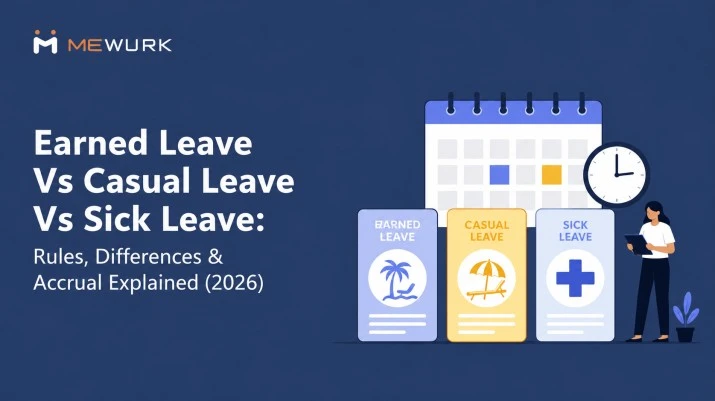
Earned Leave Vs Casual Leave Vs Sick Leave: Rules, Differences & Accrual Explained (2026)
Summary
This is a practical HR guide to the three core leave types in India: earned leave vs casual leave vs sick leave. By reading this blog till the end, you will learn how each leave type works, how they differ, and how you can build a compliant leave policy for your organisation.
At times, HR professionals will find themselves confused when an employee requests them: "I have 4 CL, 6 SL, and 11 EL left. Can I club them all for my Goa trip?" The employee deserves all these leaves, but when questions like whether they can be clubbed arise, it becomes a complex and confusing situation. You need to understand the difference between these three leave types and how they can be applied.
Earned leave vs casual leave vs sick leave is not just trivia. In the event of getting it wrong, you will face payroll errors during leave encashment, disputes during full and final settlement, and compliance gaps under your state's Shops and Establishments Act. If you don't wish to make leave management the most difficult part of your HR operation, you need to have a clear take on earned leave vs casual leave vs sick leave.
SL, EL and CL: The 3 Types of Leave in India Every HR Must Know
Before going into the detailed policy side, let's take a moment to understand the very basics of SL, EL and CL leave through the easy-to-understand table which is given below.
| Abbreviation | Full Form | Also Known As | Core Purpose |
|---|---|---|---|
| CL | Casual Leave | - | Short, unplanned personal needs |
| SL | Sick Leave | Medical Leave | Illness or medical care |
| EL | Earned Leave | Privilege Leave (PL), Annual Leave | Planned vacations and long breaks |
Quick Definition: Casual leave covers sudden personal situations, sick leave covers illness, and earned leave is paid time off that an employee accrues by working. Earned Leave is the only leave type among these three that can be carried forward and encashed.
All three leave types are governed by a mix of laws: the OSH & Working Conditions Code (which replaced the Factories Act provisions), your state's Shops and Establishments Act, and your company's own leave policy.
What Is Casual Leave?
Casual leave, as it is explicit from the term, is leave for life's unplanned moments. An employee can apply for a casual leave when they have situations like a school admission of the child, a plumbing emergency or a family function.
What Are Key Casual Leave Rules in India?
India does not have a uniform central law for casual leave. Instead, casual leave provisions are governed by the respective state Shops and Establishments Acts, which prescribe the entitlement and conditions applicable to employees.
- Entitlement: Usually 6 to 12 days per year, depending on your state's Shops and Establishments Act
- Duration limits: Usually cannot be taken for more than 3 consecutive days. Employees who need longer absences should apply for them through earned leave if the company has a policy for it.
- Carry forward: Carry forward is not allowed for Casual Leave (CL). They lapse at the end of the year
- Encashment: Encashment of Casual Leave is not allowed, even at the time of the employee's exit.
- Clubbing: Generally cannot be combined with other leave types
HR tip: The biggest CL abuse pattern is the Friday-Monday CL. To enjoy an extended weekend, people take casual leave on either side of the weekend, which causes recurring staffing gaps and disrupts team schedules. A solid leave management system like Mewurk, which offers pattern reports, helps catch this in minutes.
What Is Earned Leave? Earned Leave (Privilege Leave) Rules in India
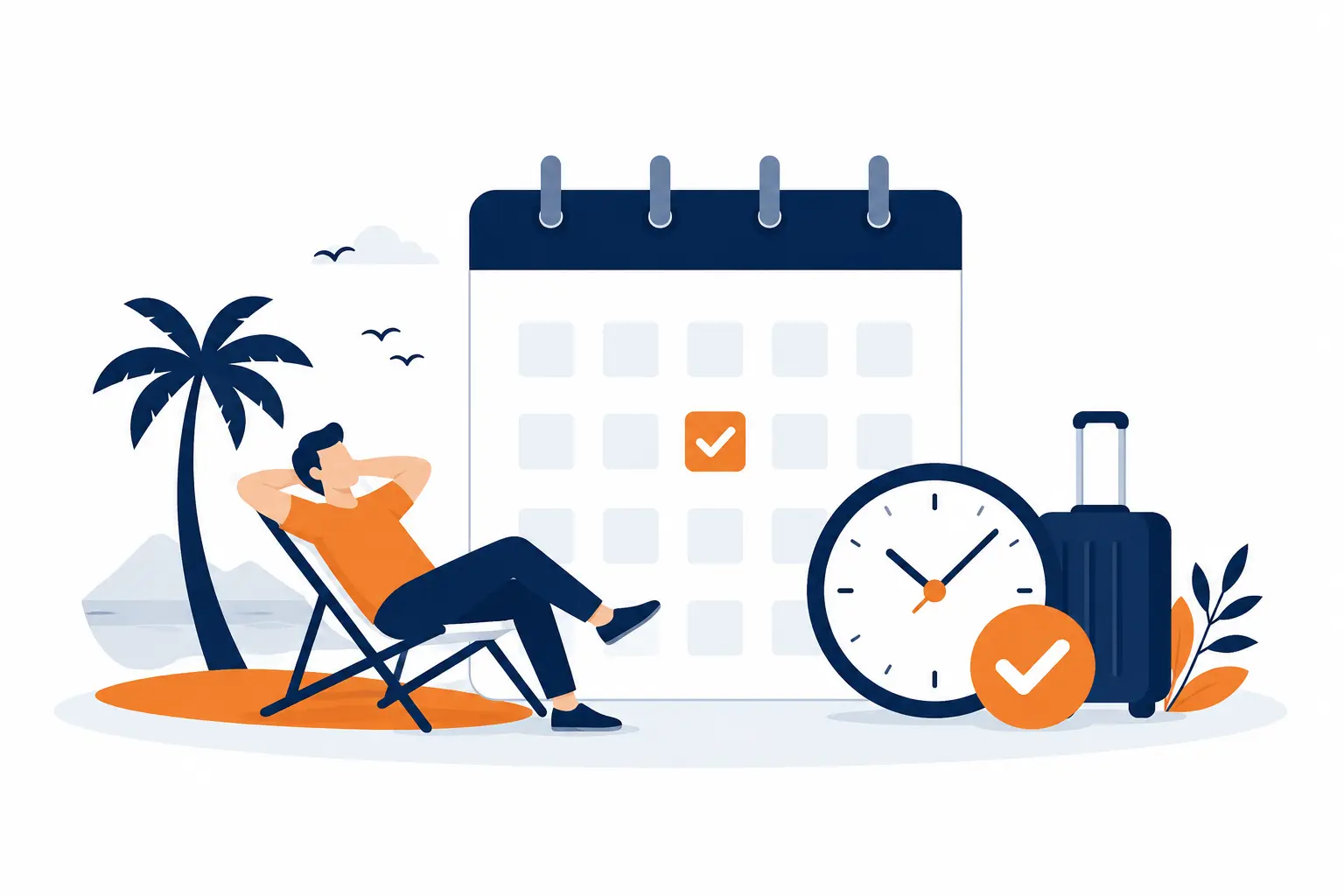
Earned leave, also called privilege leave, is leave an employee earns through their service and the days they work. Among the three: earned leave vs casual leave vs sick leave, this one is the only leave type that accrues, carries forward, and converts to cash.
How Is Earned Leave Calculated?
Under the OSH Code, the accrual rule for earned leave is standardised:
1 day of earned leave for every 20 days worked (For adolescent workers (14-18 years), the accrual rate is 1 day for every 15 days worked).
Here is a practical example to understand the calculation better. Let's assume that an employee works 240 days in a calendar year. Their earned leave is calculated as:
Earned leave accrued = 240 ÷ 20 = 12 days of EL
Most companies offer about 15 days of earned leave per year, which is usually credited monthly (1.25 days per month) or quarterly. Either method is fine, as long as they meet the legal minimum requirement.
Earned Leave Eligibility, Carry Forward and Encashment
Below is a quick breakdown of the key rules on Earned Leave: who is eligible, what the carry-forward limits are, and the encashment provisions you should know.
- Eligibility: An employee becomes entitled to EL after working 180 days in a calendar year under the new labour codes. This is a relaxation of the 240-day requirement under the old Factories Act
- Carry forward: Under the OSH Code, the carry-forward limit is capped at 30 days. Many state S&E Acts allow more (45-60 days in some states)
- Mandatory encashment: EL accumulated beyond the 30-day cap must be encashed. This ensures employees aren't simply losing their excess leave
- Encashment at exit: Any unused Earned Leave is paid out during full and final settlement, based on your basic salary plus dearness allowance (DA).
Please note that the encashment of earned leaves (EL) at retirement or resignation also has tax implications. We have covered the exemption rules in our Leave Encashment guide. For a deeper understanding of the tax treatment of leave encashment and its interplay with gratuity in India, refer to our comprehensive gratuity blog.
What Is Sick Leave? Sick Leave Rules in India
Sick leave (medical leave) is designed to protect an employee's pay when they are struck by illnesses. Key sick leave rules in India include:
- Entitlement: Typically 7 to 12 days per year, as prescribed by the respective state's Shops and Establishments Act and company policies.
- Medical certificate: A doctor's certificate is generally required for sick leave exceeding 2-3 consecutive days, as per both state rules and company policy.
- Carry forward: Usually not allowed, though a few states permit limited carryover.
- Encashment: Not applicable for sick leave.
- ESI angle: Employees covered under ESI are eligible for sickness benefit from ESIC. It is approximately 70% of average daily wages, for up to 91 days in a year and is paid directly by ESIC and not by the employer.
HR Tip: Coordinate your sick leave policy with ESI claims to avoid double payment. Use a reliable leave management system like Mewurk to track ESI-covered employees and flag sickness benefit periods, so you don't end up paying company sick leave for days already covered by ESIC.
Earned Leave Vs Casual Leave Vs Sick Leave: The Key Differences In A Nutshell
Here is the difference between EL and CL leave alongside SL in one view.
| Parameter | Casual Leave (CL) | Sick Leave (SL) | Earned Leave (EL/PL) |
|---|---|---|---|
| Purpose | Unplanned personal needs | Illness / medical care | Planned vacations, long breaks |
| Typical entitlement | 6-12 days/year | 7-12 days/year | ~15 days/year (1 per 20 worked) |
| Accrual | Credited upfront | Credited upfront | Accrued by days worked |
| Eligibility | From joining (per policy) | From joining (per policy) | After 180 days worked |
| Max consecutive days | Usually 3 | Per illness (certificate needed beyond 2-3 days) | No statutory cap; per policy |
| Carry forward | ✗ Lapses | ✗ Mostly lapses | ✓ Up to 30 days (OSH Code) |
| Encashment | ✗ | ✗ | ✓ Beyond cap + at exit |
| Clubbing with other leave | ✗ | Limited | ✓ Generally allowed |
| Notice required | Same day acceptable | Same day acceptable | Advance application |
Leave Carry Forward and Encashment: What Changed Under the Labour Codes (2026)
If you wrote your leave policy before November 2025, there are three updates that require your attention.
- Relaxed Eligibility: EL entitlement now begins after 180 days of work in a year. Earlier, it was 240 days.
- 30-day cap with mandatory encashment: If there is any excess EL, it won't lapse anymore. You must pay it out annually. Which means you should have provision for it in your payroll management software. Having an integrated payroll system like Mewurk is very helpful.
- Encashment during service: Workers can encash accumulated leave during employment if they want. They do not have to wait till their exit.
These rules interact with the new wage definition, too. Encashment is calculated on basic + DA. Under the 50% wage rule, that base has grown for many employees. We've broken down the full impact in our New Labour Codes compliance guide.
5 Common Leave Policy Mistakes Indian SMEs Make
Identifying the five common leave policy mistakes is imperative in a study about earned leave vs casual leave vs sick leave. They are:
- Combining all leave types into one bucket - Merging CL, SL and EL into a single pool without a proper earned leave vs casual leave vs sick leave differentiation can create problems later when you have to calculate encashment or full and final settlement.
- Crediting all earned leave at the start of the year without accrual logic - If you give the full year's earned leave on January 1, an employee leaving in March would have taken more leave than they accrued. You will then have to recover that excess amount from their final payout.
- Ignoring state-specific rules - If you take a policy designed for Gujarat and use it for your Bengaluru office, you are likely missing out on local compliance requirements. State laws differ, and you need to check each location separately.
- Managing leave balances manually - You need to have a proper leave management CL EL SL and ML logic. These numbers do not match for companies relying on outdated methods. To ensure consistency in leave balance management, a digital leave management tool like Mewurk is essential.
- Not defining how weekends are treated when leave is taken around them - If your policy does not state whether weekends get counted as leave when they fall between two leave days, then every long weekend becomes a point of argument. You will end up negotiating each case individually.
Want to avoid these mistakes? Read our detailed blog on building a clear and compliant leave policy for Indian SMEs. Click here to read the full guide.
How a Leave Management System Automates CL, SL and EL
Everything above: three leave types, different accrual speeds, carry forward caps, encashment triggers and state-wise rules is exactly the kind of multi-variable arithmetic humans get wrong, but software doesn't. A modern leave management system, for instance, Mewurk, can help you handle these end-to-end:
- The system credits earned leave monthly at the correct rate, and casual leave and sick leave are credited according to policy, pro-rated for new joiners automatically.
- Rules like carry-forward caps, clubbing restrictions, sandwich rules, and certificate requirements are enforced without anyone having to track them manually.
- Employees can check their real-time balances and apply for leave from the mobile app, so they do not need to email HR every time they want to know what their balance is.
- Approved leave, leave without pay, and encashment all flow directly into payroll, which means balances and payslips always match.
- The system also maintains digital leave registers that are audit-ready, exactly as the OSH Code expects.
Conclusion
The differentiation between earned leave vs casual leave vs sick leave is a HR headache. The core logic is very simple: CL for the unplanned, SL for the unwell, EL for the earned.
Did you find this breakdown and the examples surrounding it useful? We are happy if you did. Feel free to share this guide with your team or fellow founders.
Frequently Asked Questions (FAQs)
1. What is the difference between CL and EL leave?
Casual leave is for short, unplanned personal needs. It is usually max 3 consecutive days and lapses every year. Earned leave is accrued by working (1 day per 20 days worked), can be carried forward up to 30 days, and is encashable.
2. What is EL and CL leave?
EL full form is Earned Leave, while CL full form is Casual Leave. Earned Leave is accumulated through service and is generally used for planned vacations. Casual Leave is meant for short, unplanned personal needs and usually lapses at the end of the year.
3. How many casual leaves and sick leaves are employees entitled to in India?
It depends on your state's Shops and Establishments Act. Usually, it is 6-12 days of casual leave and 7-12 days of sick leave per year. Company policy can offer more.
4. How is earned leave calculated in India?
Under the OSH Code, employees accrue 1 day of earned leave for every 20 days worked, with eligibility after 180 days of work in a calendar year. Most companies credit roughly 15 days annually on a monthly accrual basis.
5. Can casual leave or sick leave be carried forward or encashed?
No. CL and SL generally lapse at year-end and cannot be encashed. Only earned leave can be carried forward (capped at 30 days under the OSH Code) and encashed - including mandatorily for any balance above the cap.
6. Can EL and CL be combined?
Yes, earned leave can usually be combined with other leave types like casual leave for longer planned absences. This gives employees the flexibility to take extended time off without exhausting their earned leave balance entirely. However, please remember that each company has the authority to have specific guidelines on clubbing leaves.
7. Can CL and EL be combined?
Generally no. Most state laws and company policies prohibit clubbing casual leave with other leave types.

Most Popular Post
Why Accurate Attendance and Leave Management Matters for Business Growth?
Read More →Why Accurate Attendance and Leave Management Matters for Business Growth?
How To Leverage Attendance Data For Better Workforce Management?
Read More →How To Leverage Attendance Data For Better Workforce Management?