Why Choose Sustainable, Cloud HR Software Solutions for ESG Compliance?
Every few years, corporate priorities shift. Once, it was all about efficiency. Then came digital transformation. Now, it’s sustainability. It is not merely there as a checkbox to be ticked but as a principle shaping how work itself happens.
And HR, often seen as administrative or people-first, is at the very centre of this change. The HR software solutions and systems HR teams choose, from payroll to attendance tracking, can either amplify an organisation’s environmental footprint or reduce it.
This is where the conversation turns from what software does to how it’s built and powered. The focus of cloud-native HR software solutions has shifted beyond mere automation and compliance to broader strategic value, such as aligning everyday operations with ESG commitments.
Sustainable HR: The Role of HR Software Solutions in Achieving ESG Targets
Most companies discuss ESG (Environmental, Social, and Governance) as if it were an external responsibility. Something that exists more in reports than in everyday decisions. A report to investors. A sustainability page on their website. But ESG starts with operations. And operations start with people.
Unsurprisingly, what often goes unnoticed is that HR operations require large volumes of energy and resources, from paper-heavy onboarding to on-premise servers that run all day regardless of activity. It’s hard not to notice the irony that departments built to manage human potential rely on infrastructure that undermines environmental goals.
Cloud HR software solutions challenge this traditional logic. By moving HR operations to the cloud, they reduce the dependence on physical servers, and thereby cut the paper use to near zero. It has also been noted for creating transparency that supports social and governance goals.
Why Moving to Cloud-Native HR Software Solutions Is a Greener Choice?
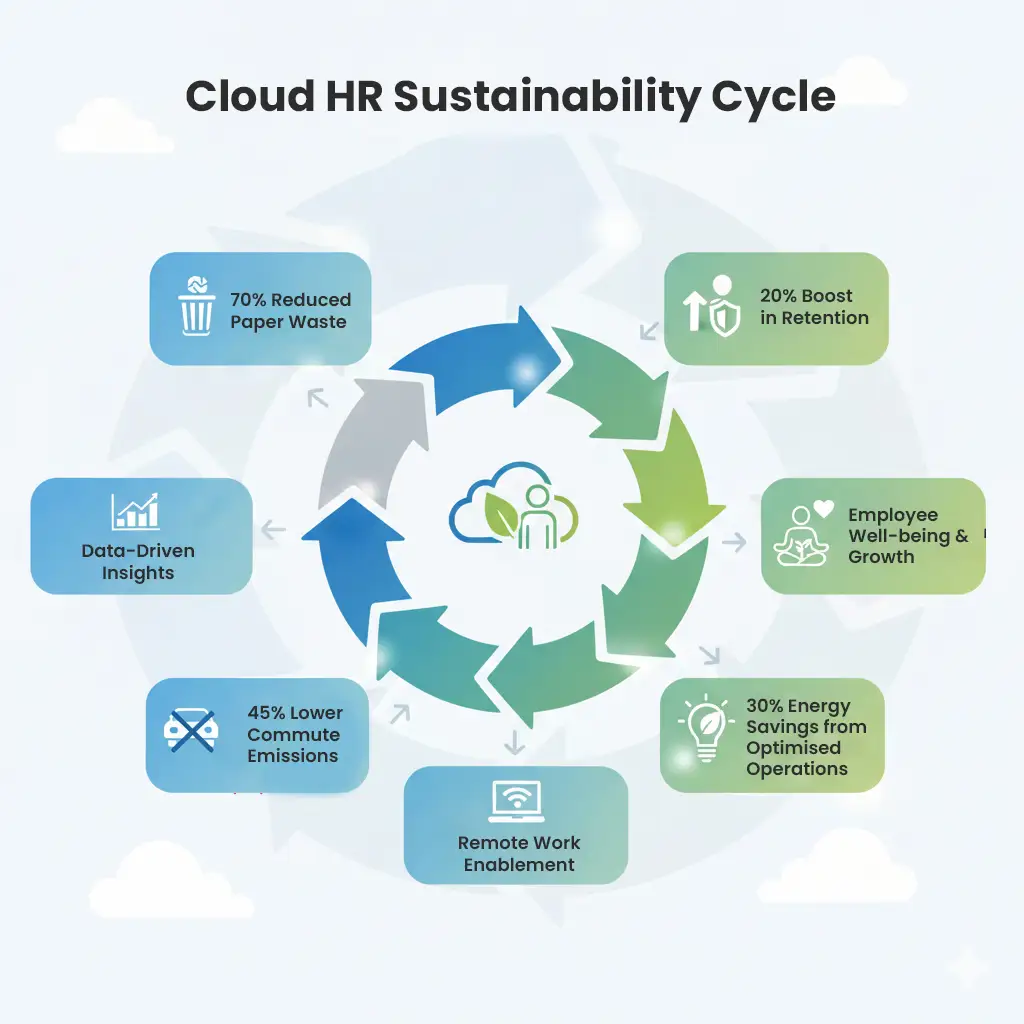
When you decide to shift to cloud-based HR software solutions, you are making an environmental decision because these systems are designed to cause less carbon footprint. Let’s explore the various ways in which digital HR management systems contribute to sustainability and reduce the environmental impact of everyday HR operations.
1. Lower Energy Footprint
On-premise HR systems demand dedicated servers, maintenance teams, and cooling systems. All of these are significant sources of energy waste. Cloud providers, by contrast, use shared infrastructure optimised for efficiency. A single data centre can serve thousands of businesses with less energy per transaction.

2. Zero Paper Dependency
When you use a cloud HR system, everything is stored digitally, meaning you literally don’t require any paper files and physical storage spaces like cabinets. Employees can make their leave request digitally and view the performance report digitally. Earlier, you had to depend on reams of paper for these. Even a medium-sized company can save thousands of sheets every year, and with them, the environmental impact that comes from paper production and disposal.
3. Continuous Optimisation
Traditional workforce management systems, like in-house software, are known for their weakness of ageing quickly. When you scale, you will have to update these systems, which would mean a complete hardware replacement or full reinstallation. Cloud HR software solutions, however, are updated remotely. They reduce the e-waste cycle and extend the system’s life. So when we look beyond the obvious, there is the ESG advantage that comes from reducing electronic waste and energy use.
ESG Compliance: What Does It Mean for HR?
For HR teams, ESG compliance doesn’t stop at environmental stewardship but rather extends to data governance, diversity metrics, employee well-being, and ethical workforce management.
Environmental
Cloud-based HR solutions align directly with environmental goals by minimising energy use and reducing carbon-intensive physical processes.
Social
From remote work policies to employee engagement analytics, HR platforms help measure and improve social responsibility. Tracking gender pay gaps, diversity ratios, or volunteer hours becomes easier when data lives in a unified digital ecosystem.
Governance
Transparent digital records reinforce governance principles. Being traceable, auditable, and tamper-proof is core to responsible management. Cloud employee management platforms automatically capture every attendance log, leave approval, and compliance record, and thereby create a transparent trail of actions.
In this sense, sustainable HR software solutions weave ESG accountability into the fabric of work itself.
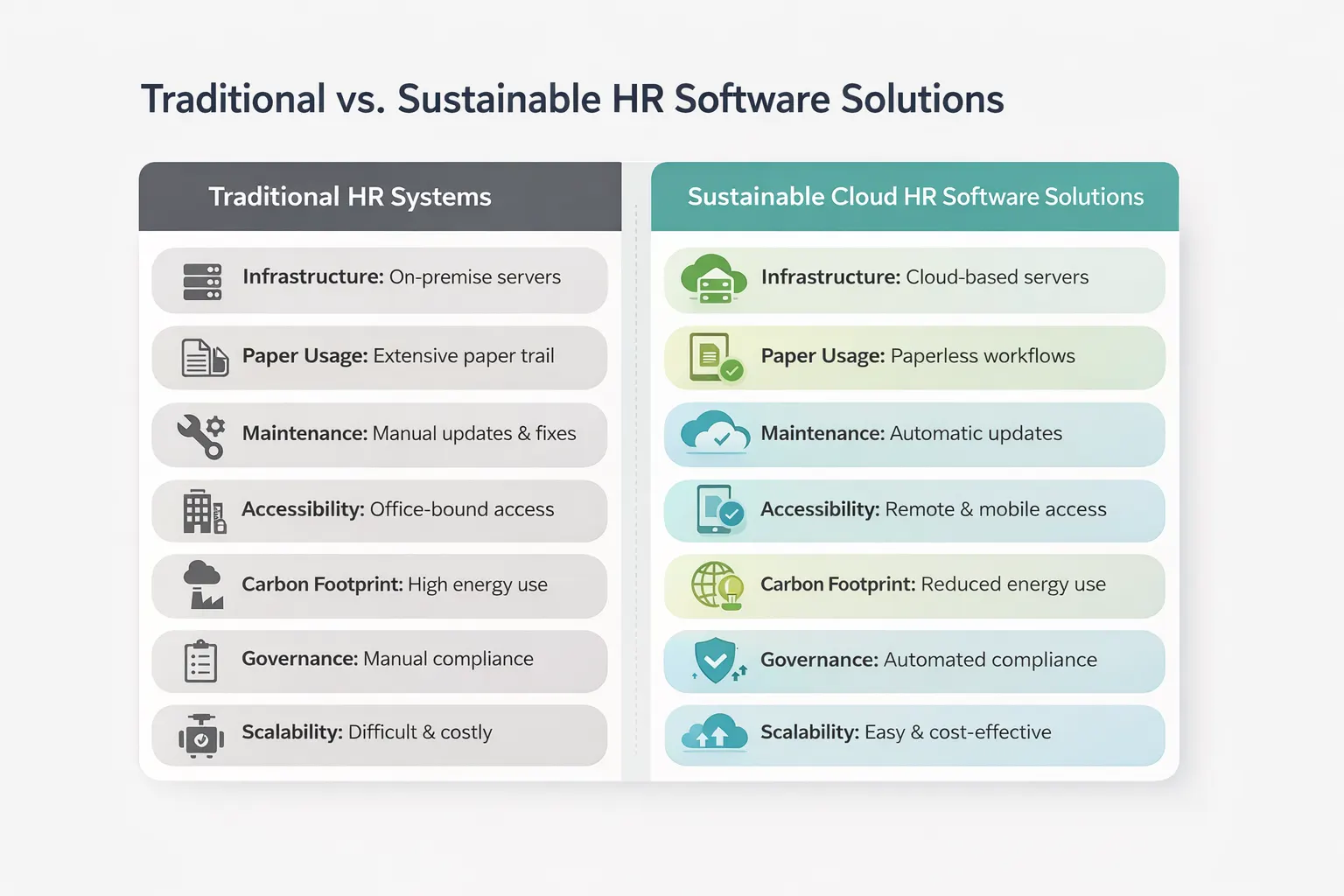
Comparing Traditional vs. Sustainable HR Software Solutions
| Aspect | Traditional HR Systems | Sustainable Cloud HR Software Solutions |
|---|---|---|
| Infrastructure | On-premise servers | Cloud-native, energy-efficient data centers |
| Paper Usage | High (manual forms, records) | Minimal (digital-first documentation) |
| Maintenance | Hardware-heavy, frequent upgrades | Software updates via cloud |
| Accessibility | Limited to office network | Anywhere access, remote-friendly |
| Carbon Footprint | High operational emissions | Shared, optimized computing resources |
| Governance | Manual tracking, higher audit risk | Automated compliance logs, digital trails |
| Scalability | Requires new infrastructure | Instant, subscription-based scaling |
Cloud HR and the ESG Reporting Revolution
The ESG reporting landscape is shifting fast. Investors and regulators no longer accept vague claims of going green. They want measurable data. Cloud HR systems provide that data, although often unintentionally, through patterns they capture.
For example, automated time logs can show the impact of remote work policies on office occupancy and energy use. Attendance analytics can correlate with transportation data to calculate reduced commuting emissions. Even payroll analytics can support social indicators like fair pay and gender equality.
These metrics, when centralised and cloud-managed, turn HR data into ESG evidence. For many organisations, it bridges the gap between what they promise and what they can prove.
HR Software Solutions India: The Local ESG Imperative
In India, the ESG conversation is maturing quickly. Regulatory frameworks from SEBI and the Ministry of Corporate Affairs are pushing listed companies to disclose sustainability practices. But compliance can’t be limited to factories and supply chains. HR operations are part of the same ecosystem.
Cloud-based HR software solutions in India are gaining traction because they bridge this compliance gap without inflating costs. For small businesses, especially, HR software solutions for small businesses offer entry-level sustainability in the form of paperless onboarding, cloud payroll, digital attendance, and e-document storage.
Unlike enterprise ERP systems, which demand heavy infrastructure, these SaaS models democratize ESG readiness. A startup in Bengaluru and a manufacturing firm in Ahmedabad can both adopt low-footprint HR systems without the weight of capital expenditure.
And this, in itself, is a social impact story of technology levelling the field for responsible business.

Mewurk and the Culture of Conscious Technology
Among emerging HR platforms, Mewurk stands out for designing systems that mirror real human workflows while reducing waste. It offers digital timesheets that replace registers, cloud payroll that cuts storage needs, and analytics that visualise workforce patterns for better decision-making.
Its cloud-native model inherently reduces energy overhead, while its scalable subscription format ensures smaller firms can adopt sustainable HR practices without cost barriers.
In ESG terms, Mewurk’s approach sits at the intersection of environmental efficiency, social transparency, and governance clarity, a rare alignment for HR technology.
What’s the Real ROI of Investing in Sustainable HR Systems?
The sustainability case often struggles because it sounds moral, not financial. But cloud-native HR technology bridges that gap.
- Reduced hardware costs: No physical servers to maintain.
- Lower maintenance overhead: Automatic updates from providers.
- Scalable pricing: Pay-as-you-grow models minimize wasteful spending.
- Improved productivity: Employees spend less time on administrative friction.
These efficiencies compound into a form of green profitability. A system that saves time, resources, and energy simultaneously creates environmental and financial ROI.
How Can HR Teams Put the ‘Go Green’ Philosophy into Practice?
Sustainability starts when we stop shopping for it and start rethinking how we work.
HR sits at a rare confluence: where people, processes, and data meet. Every decision HR leaders make, like how employees must log time, how payroll should be processed or how documents are supposed to be stored, contributes to the organisation’s carbon ledger.
Sustainability, therefore, is a mindset that must run through every line of code and every policy written. And cloud HR software solutions are the infrastructure that allows that mindset to function.
Choosing workforce management tools rooted in that idea is a shift in how ethics show up in everyday operations rather than a sheer software upgrade.
Key Takeaways
- Sustainable HR software reduces environmental impact through cloud efficiency and paperless workflows.
- ESG compliance for HR covers environmental, social, and governance dimensions in addition to carbon reduction.
- Cloud-based HR systems enable real-time ESG reporting and measurable sustainability outcomes.
- In India, SaaS-based HR software democratizes access to ESG readiness for small and mid-sized firms.
- Mewurk represents a conscious, cloud-first approach that aligns HR operations with ESG responsibility.
Conclusion
At some point, going green will stop being an initiative and start being the default in the same way digital once did.
Organisations that treat sustainability as an optional project are already behind. ESG-aligned HR software solutions lead with integrity but win with resilience, because they’re wired for openness today and evolution tomorrow.
FAQs
1. What are HR software solutions?
HR software solutions are digital platforms that automate HR processes such as payroll, attendance, leave, and document management. Modern cloud-based systems also help businesses align with ESG goals through reduced energy use and transparent governance.
2. How do HR software solutions support ESG compliance?
They support ESG by minimising paper dependency, reducing on-premise infrastructure energy consumption, and creating auditable digital records that strengthen governance and social accountability.
3. What are the benefits of cloud-native HR software solutions in India?
In India, cloud-native HR systems allow companies, including small businesses, to go paperless, cut costs, and meet regulatory sustainability standards without heavy investment in hardware.
4. Can small businesses use HR software solutions for ESG compliance?
Yes. Many cloud HR platforms offer scalable models tailored for small businesses. These allow affordable access to sustainable, compliant HR operations.
5. Why is Mewurk considered a sustainable HR solution?
Mewurk’s HR software is built on cloud infrastructure, reducing physical resource use. Its design prioritises efficient workflows, transparent analytics, and digital documentation, features that echo key ESG principles.

Most Popular Post
Why Accurate Attendance and Leave Management Matters for Business Growth?
Read More →Why Accurate Attendance and Leave Management Matters for Business Growth?
How To Leverage Attendance Data For Better Workforce Management?
Read More →How To Leverage Attendance Data For Better Workforce Management?