Minimum Wage in India 2026: State-Wise Rates, Labour Code Impact + HR Checklist
Summary
Minimum wage in India is changing faster. This guide explains the latest 2026 state-wise wage rates, the impact of the Code on Wages, the 26-day wage rule, and key HR compliance checks. It also covers VDA revisions, penalties, payroll risks, and practical steps to stay legally compliant across states.
₹178 per day is the current national floor wage. It was set in 2019. Now, can your payroll team afford to rely on a figure which was last revised before the pandemic?
To be honest, no. With the new Labour Codes now active and state unrest triggering major wage revisions across the country, businesses are discovering gaps in their salary structures.
In this guide, you will get the updated minimum wage in India structure for 2026 across key states. We will break down how the Minimum Wages Act 1948 has evolved into the Code on Wages, and provide a practical HR checklist to keep your organisation out of legal trouble.
What Is Minimum Wage in India?
Minimum wage in India is the legally mandated lowest remuneration that any employer must pay a worker. It is set by the state government (or central government for central sphere establishments), and revised periodically based on the Consumer Price Index (CPI) for Industrial Workers.
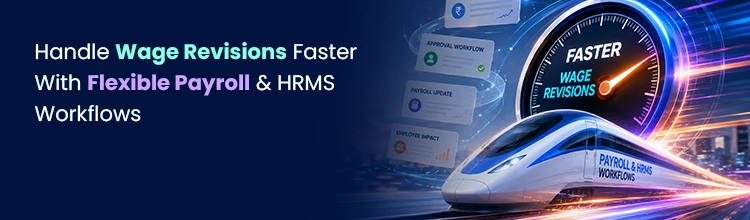
India does not follow a single national wage standard. The wage system in the country operates on two tiers:
- National Floor Wage: As you can see, it is set by the Central Government. As of 2026, it is ₹178 per day (approximately ₹4,628 per month using the 26-day minimum wage calculation rule).
- State Minimum Wages: Each state government sets rates above the national floor wage. It could vary by industry, skill level, and geographic zone.
The Minimum Wages Act 1948 originally governed this framework. Since November 21, 2025, the Code on Wages 2019 has replaced it by consolidating four older statutes into a unified law with far stronger enforcement powers.
How Minimum Wage in India Is Calculated?
Most states in India calculate minimum wages by fixing a basic rate plus Variable Dearness Allowance (VDA). VDA links to the Consumer Price Index and is revised every 6 months, usually in April and October. That is why minimum wages in India change twice a year without a fresh notification.
If you want to ensure a smooth flow from revision to compliance during VDA rates change, it is recommended to use payroll software like Mewurk, which helps you automatically apply the updated wages across your locations.
State-Wise Minimum Wages in India 2026: Major States at a Glance
The table below shows approximate monthly minimum wage rates for unskilled workers across key states. The figures are based on the most recently notified rates as of early 2026. Skilled and highly skilled rates are higher across states.
| State | Unskilled (Monthly) | Skilled (Monthly) | Last Revised | Zone Structure |
|---|---|---|---|---|
| Delhi | ₹18,456 | ₹22,411 | April 2025 | Single zone |
| Maharashtra (Zone I) | ₹14,956 | ₹17,000+ | July 2025 | 3 Zones |
| Karnataka | ₹14,000+ | ₹17,000+ | April 2025 | Zone-based |
| Gujarat | ₹13,013 | ₹13,585 | October 2025 | 2 Zones |
| Haryana | ₹11,275 | ₹13,052 | July 2025 | Skill-class based |
| Rajasthan | ₹10,000+ | ₹12,000+ | Semi-annual | Zone-based |
| Madhya Pradesh | ₹11,700+ | ₹13,500+ | Semi-annual | Zone-based |
| Uttar Pradesh | ₹13,224 | ₹15,500+ | March 2026 | Zone-based |
NB: Please note that the rates mentioned in the table are based on publicly available government notifications. Verify them with your respective state labour department gazette for payroll application. Monthly figures use the standard 26-day convention.
How the 26 Days Minimum Wage Rule Works
What Is the 26 Days Rule?
The most common payroll convention in India is to calculate the daily minimum wage by dividing the monthly rate by 26 working days instead of 30. The logic behind this is that a standard workweek in India includes one weekly off. As a result, the working days in a four-week month become 26.
Formula:
Daily Minimum Wage = Monthly Minimum Wage / 26
Practical Example: If the minimum wages in UP for unskilled workers stand at ₹13,224 per month, the daily rate equals ₹508.62. If the workers are paid on a daily or piece-rate basis, you must use this figure as the floor wage.
Why Does This Matter in Minimum Wage Calculation?
- Workers on contract or casual engagement must receive at least the per-day equivalent of their monthly salary.
- Overtime calculations are based on the daily minimum wage rate.
- The 26 days minimum wage rules apply even when the actual calendar month has more working days.
- If there are any non-compliance instances, they will accumulate as backdated liability, plus a 10x underpayment compensation under the Code on Wages.
How the Code on Wages 2019 Impacts HR Policies in 2026
The Old Framework vs. The New
The Minimum Wages Act 1948 governed wage compliance for over seven decades. It applied only to scheduled employment categories, which meant large sections of the workforce, including white-collar IT and BPO employees, fell outside its scope. The Code on Wages 2019 changed all of that.
Five Critical Changes to Take into Consideration
1. Universal Coverage
Every worker in India, organised or unorganised, IT or manufacturing, is now covered under minimum wage protection. There are no more exclusions based on industry type.
2. Mandatory National Floor Wage Compliance
As per the national floor wage compliance framework, states cannot set minimum wages below the National Floor Wage of ₹178 per day. Earlier, this was only advisory.
3. The 50% Basic Pay Rule
Basic Wage plus Dearness Allowance must constitute at least 50% of total CTC. This has a direct impact on PF contributions, gratuity calculations, and overall employer cost.
You can use a reliable payroll platform like Mewurk to redesign your salary structures and keep them in line with changing wage definitions under the Code on Wages, 2019.
4. Payment Timelines Are Mandatory
Companies should disburse salaries by the 7th of every month. 48 hours after the employee's last working day is the deadline to clear full and final settlement.
5. Steeper Penalties
Non-compliance might attract fines up to ₹1,00,000, up to three months of imprisonment for repeat offences, and up to 10x the underpayment amount as compensation to the affected worker.
Minimum Wages Notification Central Labour Commissioner: Key Rules
If your business operates in railways, mines, oil fields, major ports, or central public sector undertakings, the minimum wages notification central labour commissioner applies to you directly.
The Central Government sets separate minimum wages for workers in central sphere establishments. These rates are higher than the national floor and are revised on the same April-October schedule.
The April 2026 VDA revision applied an increase of 11.28 CPI points. In effect, it takes Area A (metro) unskilled wages in central sphere employment to approximately ₹21,346 per month and highly skilled wages to ₹28,444 per month.
If you are a contractor providing workforce to central government establishments, both state and central minimum wages may apply simultaneously depending on the nature of the contract. You are responsible for tracking both.
State-Specific Minimum Wage Rules: What You Need to Know
Minimum Wages in Delhi
Delhi minimum wages are revised every April. The April 2025 revision, which continues into 2026 unless updated, sets monthly minimums at ₹18,456 for unskilled, ₹20,371 for semi-skilled, and ₹22,411 for skilled workers.
Graduate and clerical workers are entitled to ₹24,356 per month. Delhi's Variable Dearness Allowance for skilled workers was ₹5,411 monthly as of October 2025.
Minimum Wages in Maharashtra
Maharashtra uses a three-zone structure. Zone I covers Greater Mumbai, Thane, Navi Mumbai, and Pune Municipal Corporation. Zone II includes Nagpur, Nashik, Aurangabad, and other municipal corporations. Zone III covers rural and remaining areas.
As per the July 2025 notification, unskilled monthly wages were placed at ₹14,956 in Zone I. The next revision is due in July 2026.
Minimum Wages in Karnataka
Karnataka applies zone-based rates, but it is different from how Maharashtra applies it. Here, the distinctions are between metro Bengaluru and other areas. The April 2025 revision brought sizable increases, with further April 2026 notifications pending at the time of writing.
Minimum Wages in Gujarat
Gujarat revised its minimum wages in October 2025. For Zone I, unskilled monthly wages stand at ₹13,013 while semi-skilled and skilled at ₹13,273 and ₹13,585 respectively. The rates applicable in Zone II are slightly lower. Both zones were updated simultaneously.
Minimum Wages in Haryana
Haryana's April 2026 revision was one of the largest in the country, at approximately 35%, taking unskilled rates to around ₹15,220 per month. The October 2025 notification (effective July 2025) had set unskilled wages at ₹11,275.
Minimum Wages in Rajasthan and MP
Minimum wages in Rajasthan and minimum wages in MP are revised on the semi-annual cycle. Always track revision dates in the state labour gazette before running monthly payroll.
HR Compliance Checklist for Minimum Wages in India 2026
Use this checklist quarterly to maintain wage compliance across your operations.
Pre-Payroll Checks
- Confirm the applicable minimum wage notification for each state where you operate
- Verify whether the April or October revision has taken effect for each state
- Check if your Basic Wage + DA equals at least 50% of total CTC for all employees
- Ensure daily-rate and contract workers are paid at or above the per-day equivalent (monthly / 26)
- Confirm the correct skill category classification for each worker: unskilled, semi-skilled, skilled, or highly skilled
Payroll Processing Checks
- Ensure that wages are disbursed by the 7th of each month
- Confirm that the VDA component is updated to reflect the April or October revision
- Check if overtime rates are calculated on the revised minimum wage base
- Verify that contract worker wages are at the principal employer level (you are jointly liable)
- Ensure full and final settlements are processed within 48 hours of the last working day
Documentation and Record-Keeping
- Maintain wage registers as prescribed under the Code on Wages
- Display minimum wage notices in the local language at every workplace
- Keep minimum wages notifications for each state on file for at least three years
- Record and retain payroll disbursement acknowledgements per employee
Multi-State Operations
- Create a revision calendar for all states where you have active payroll
- Assign a compliance owner for each state's notification tracking
- Verify whether your contractors and vendors serving your facilities are themselves compliant (you may be jointly liable)
- Run an internal audit before April 1 and October 1 every year
How Minimum Wages Affect Your Total Employer Cost
Minimum wage in India requirement could directly influence your PF, gratuity, bonus, ESI contributions, and your company's overall employment cost structure.
- Impact on PF: With the 50% rule under the Code on Wages, a higher Basic Wage means higher PF employer contributions (12% of Basic + DA).
- Impact on Gratuity: Gratuity is calculated on Basic + DA. Higher minimum wages in India could push gratuity liability upward for long-tenure employees.
- Impact on Bonus: Under the Payment of Bonus Act (now within the Code on Wages), the bonus calculation ceiling and threshold are tied to wage definitions.
- Impact on ESI: Workers earning up to ₹21,000 per month fall within ESI coverage. Any wage revision taking an employee above this threshold changes your ESI liability.
For a deeper look at PF and ESI compliance rules, check out our detailed guide.
Conclusion
Minimum wages in India in 2026 sit at the centre of your payroll framework, cost planning, and legal risk management. The blog showed you state-wise rates, how the Code on Wages resets salary design, and gave a checklist you can use to audit your compliance.
Did you find this useful? If yes, please share it with your HR colleagues, payroll managers, and business owners who need clear, reliable guidance on minimum wages in India.
Disclaimer: This blog is intended for informational purposes. Verify all wage rates with the relevant state labour department gazette and consult a qualified labour law practitioner for jurisdiction-specific compliance advice.
Frequently Asked Questions (FAQs)
1. What is the current national floor wage for minimum wages in India?
As of 2026, the Central Government has set the national floor wage at ₹178 per day, which translates to approximately ₹4,628 per month as per the 26-day minimum wage calculation convention.
2. How often do minimum wages in India change?
Basic rates change by notification. VDA is revised every April and October in most states, so effective wage changes twice yearly.
3. Which state has the highest minimum wages in India in 2026?
Delhi minimum wages are the highest in India. Unskilled workers in Delhi are entitled to approximately ₹18,456 per month, while skilled workers are entitled to ₹22,411 per month, effective April 2025.
4. What happens if an employer pays below the minimum wage?
Under the Code on Wages 2019, paying below the minimum wage could attract fines up to ₹1,00,000, up to three months' imprisonment for repeat offences, and up to 10 times the underpayment amount as compensation directly to the affected worker.
5. Does the Minimum Wages Act apply to IT and white-collar employees?
Yes. The Code on Wages 2019, fully operational since April 2026, extends minimum wage protection universally to all employees across all industries, including IT, ITES, BPO, and other white-collar sectors previously excluded.
6. Can an employer pay different minimum wages for the same role in different cities?
Yes, if the state has zoning classifications. For example, minimum wages in Maharashtra are higher in Mumbai (Zone I) compared to other districts. This is legal as it accounts for cost-of-living differences.
7: How can payroll teams keep up with minimum wage revisions?
Minimum wage notifications and VDA revisions vary by state and are updated periodically. These days, it is common for organisations to use payroll software like Mewurk to simplify payroll compliance across locations and through various confusing requirements.

Most Popular Post

Why Accurate Attendance and Leave Management Matters for Business Growth?
Read More →Why Accurate Attendance and Leave Management Matters for Business Growth?
How To Leverage Attendance Data For Better Workforce Management?
Read More →How To Leverage Attendance Data For Better Workforce Management?