Summary
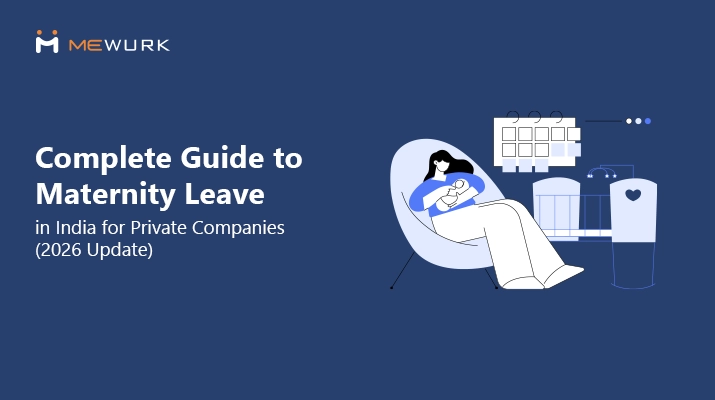
This comprehensive 2026 guide outlines the rules and regulations of maternity leave in India for private companies. It covers eligibility, a critical 2026 Supreme Court update on adoption leave, salary calculations under ESI and non-ESI models, creche mandates, and compliant HR templates.
How many of your women employees returned to the office after childbirth last year, and how many dropped out? If you're an HR leader in a private company, that number will have a direct impact on your employees' retention as well as your brand reputation.
This guide gives you a 2026-ready handbook on maternity leave in India. You'll learn maternity leave meaning under the law, exact maternity leave rules, eligibility, pay calculations, ESI vs non-ESI coverage, creche and work-from-home obligations, documentation, and more.
Use this guide to audit your maternity leave policy in India as well as handle maternity leave applications in a humane way.
What Is Maternity Leave in India And Who Does The Law Cover?
Maternity leave is paid leave granted to a woman employee for pregnancy, childbirth, and postnatal care. Maternity leave in India is a statutory right of the employee, not a company perk.
Under the Maternity Benefit Act, 1961, as amended by the Maternity Benefit (Amendment) Act, 2017, the law applies to establishments employing 10 or more people. Women employees, including permanent, fixed-term, temporary, and contractual employees, may be eligible for maternity benefits if they have worked for at least 80 days in the 12 months preceding their expected date of delivery.
Establishments Covered Under Maternity Leave Rules In India
- Factories
- Mines
- Plantations
- Shops and commercial establishments
- Any other establishment notified by the government.
Employees covered under ESIC get benefits through ESI instead of direct employer payout.
Maternity Leave Rules in India for Private Companies: Duration & Eligibility As Of 2026
Many people still search for 'maternity leave rules in India for private companies 2020' to understand the current law. Under the Maternity Benefit (Amendment) Act, 2017, whose provisions continue to apply as of May 2026, the duration and eligibility criteria are as follows:
| Child Count | Total Paid Leave | Pre-delivery Max | Post-delivery Min | Source |
|---|---|---|---|---|
| First & second surviving child | 26 weeks | 8 weeks | 18 weeks | MBA, 2017 |
| Third child or more | 12 weeks | 6 weeks | 6 weeks | MBA, 2017 |
| Adoptive mother | 12 weeks from handover | NA | NA | MBA, 2017 + 2026 SC Update |
| Commissioning/surrogate mother | 12 weeks from handover | NA | NA | MBA, 2017 |
Modern leave management systems like Mewurk assist organisations in implementing these policies with tighter consistency even if their teams and locations are multiple.
Eligibility: A woman must have worked at least 80 days in the 12 months immediately preceding her expected date of delivery.
On March 17, 2026, the Supreme Court struck down the 'below three months of age' restriction for adoptive mothers. Adoptive mothers are now entitled to 12 weeks of paid maternity leave irrespective of the child's age, effective from the date of handover. Update your maternity leave policy in India for private companies to reflect this.
Maternity Leave Salary Rules: Who Pays And How Much?
For non-ESI employees, the employer is supposed to pay 100% of average daily wages for the entire leave period. Average daily wage here means the average of wages for the 3 calendar months before the leave starts.
In the case of ESI maternity leave / ESIC maternity leave, if the woman's wages are up to ₹21,000 per month and she's covered under ESIC, ESIC pays the benefit at 100% of average daily wages. The employer does not pay wages during leave but must facilitate claim filing with Forms 17-21.
Medical bonus: ₹3,500 if the employer provides no free prenatal/postnatal care.
Continue all allowances that form part of wages during leave. There should be no deduction in bonus, increment, or seniority due to leave. Termination during pregnancy or maternity leave is unlawful.
Other Leave Provisions HR Must Track
Here are the additional leave and workplace benefits that HR needs to track for employees under Indian labour laws:
- Miscarriage or medical termination: 6 weeks' paid leave immediately following the date. Under ESI, 6 weeks or 42 days.
- Tubectomy operation: 2 weeks' paid leave.
- Illness from pregnancy/delivery/premature birth: Up to 1 month of additional paid leave.
- Nursing breaks under Indian law: Two breaks per day until the child is 15 months old, in addition to rest intervals.
- Creche policy: Mandatory if you have 50+ employees. Creche within prescribed distance; 4 visits per day allowed.
- Work from home after maternity leave: After 26 weeks, WFH can be allowed based on the nature of work and mutual agreement.
Maternity Leave Application: Process & Documents
A maternity leave application should be in writing, state the expected delivery date, and attach a medical certificate. Submit it at least 8 weeks before delivery if taking pre-delivery leave.

Application Process
- Notice requirements for maternity leave: Employee gives written notice with proof of pregnancy. There is no statutory timeline, but 6-8 weeks before the Expected Date of Delivery (EDD) is standard practice.
- Forms: Employer files Form 10 with ESIC for ESIC maternity leave cases. For non-ESI, maintain an internal leave register.
- Approval: Issue a written sanction stating the start date, end date, and pay details.
- Rejoining letter after maternity leave: Employee submits a simple rejoining letter with a fitness certificate if the company policy requires. Keep it short with date, intent to resume and signature.
A lot of companies these days use a leave automation tool like Mewurk to handle maternity leave requests automatically. It takes care of things like approvals, leave balances, reminders, and employee records. The good part is that you wouldn’t need to mess around with Excel sheets and confusing email threads.
Employee: Priya Sharma, EID: 2045
Leave: 26 weeks, 15 Jul 2026 to 12 Jan 2027
Pre-delivery: 8 weeks from 15 Jul 2026
Wages: Full average daily wage of ₹2,100 per day
Approved by: HR Head
Maternity Leave Policy in India for Private Companies: Must-Have Clauses
Use this as a policy comparison format when you benchmark.
| Clause | Statutory Minimum | Best Practice Add-on |
|---|---|---|
| Leave duration | 26/12 weeks | Paid transition week before full-time return |
| Eligibility | 80 days in 12 months | Waive for critical talent; cover from Day 1 |
| Intimation | Written notice | Self-service HRMS with auto alerts |
| Salary | 100% avg daily wage | Continue variable pay & incentives |
| Creche | 50+ employees | Tie-up within 1 km or creche allowance |
| WFH | Post-26 weeks if mutually agreed | Hybrid option for 6 months post-return |
| Non-discrimination | No termination | Promotion deferral protection clause |
Maternity leave rules in India for private companies were already updated by the 2017 Amendment, and the Code on Social Security, 2020, subsumed the Act with effect from 21 Nov 2025. As of 2026, follow the Code + 2026 SC ruling.
Practical HR Examples & Employee Scenarios
Scenario 1: Contractual employee, 7 months' tenure
Riya joined as a fixed-term employee 7 months ago. She's 3 months pregnant. Is she eligible? Yes. She'll cross 80 days before delivery. Fixed-term employees get the same maternity benefits as permanent staff.
Scenario 2: Third child, ESI covered
Wage: ₹19,000. Covered under ESI. She gets 12 weeks paid by ESIC at 100% of average daily wage. HR must file a claim and shouldn't pay from payroll.
Scenario 3: Adoption of a 2-year-old child, April 2026
Post the March 17, 2026 SC judgment, a female employee adopting a child gets 12 weeks from the handover date. The earlier limit of below 3 months does not apply any more. Update your maternity leave application letter template to reflect the changes.
Scenario 4: Wants phased return
After 26 weeks, offer WFH or part-time for 4 weeks if the nature of the work allows. If there is any mutual agreement, document it to limit any scenarios of disputes.
Compliance Checklist for Payroll & Operations Leaders
Does your establishment have 10+ employees? Then the provisions of the MBA become applicable. Use this quick checklist to verify that your payroll, HR, and other processes are in compliance with the maternity benefit requirements.
Simple Maternity Leave Letter & Rejoining Letter Formats
If you've been searching for a maternity leave letter, maternity leave request letter, or simple maternity leave letter, use the sample format below to prepare your application.
Date: __
To,
HR Manager
Subject: Maternity Leave Application
I am expecting delivery on [EDD].
As per company policy and MBA, 1961, I request 26 weeks' maternity leave from [start date]. Medical certificate attached.
Thank you,
[Name, Emp ID, Sign]
Rejoining letter after maternity leave:
Date: __
To,
HR Manager
Subject: Rejoining After Maternity Leave
I, [Name], resumed duty on [date] after availing maternity leave till [end date].
Kindly update records.
[Sign]
Common Gaps Private Companies Miss
Many employers comply with maternity leave rules but overlook important details. Below are common mistakes which are frequently creating compliance issues.
- Assuming contractual employees aren't covered.
- Denying second leave within 2 years. Allahabad HC held there's no bar.
- Not updating the adoptive mother clause post March 2026. The age cap is gone.
- Forgetting the creche for 50+ headcount. It is not 50+ women. It's total employees.
- Stopping variable pay during leave. Full wages include all remuneration.
Conclusion
We can't limit the scope of maternity leave in India to compliance alone. Every step you take to retain your skilled women, particularly during their most important life transitions, is a step towards protecting your brand.
Did this guide help you spot a gap in your current maternity leave policy? Share it with your HR and payroll teams, and with any founder who's scaling headcount this year.
Frequently Asked Questions about Maternity Leave In India
1. What is the maternity leave entitlement for private companies in 2026?
Employees working in private companies are entitled to 26 weeks paid leave for the first two children, 12 weeks for the third or more. Adoptive and commissioning mothers get 12 weeks from handover. There is no child-age limit after March 2026.
2. Are contractual or temporary staff eligible for maternity leave in India?
Yes. The Maternity Benefit Act (MBA) covers women employed directly or through a contractor/consultant if the establishment has 10+ employees.
3. How is salary paid during ESI maternity leave?
ESIC pays 100% of average daily wages for 26 or 12 weeks if wages is less than ₹21,000 and the employee is insured. Employer facilitates claim but doesn't pay wages.
4. Is a creche mandatory for private companies?
Yes, creche is mandatory in private companies if the facility employ 50 or more employees. You must provide a creche within a prescribed distance and allow 4 visits per day.
5. Can a company refuse maternity leave application for a third child?
No. For third and subsequent children, 12 weeks of paid leave is mandatory. Refusal of a maternity leave application letter by an employee is a violation of Section 12 of the Act.
6. How can companies manage maternity leave requests efficiently?
As organisations grow, maternity leave management becomes complicated. Leave automation tools have become an essential need today. With modern, sophisticated leave management platforms like Mewurk, HR teams can manage maternity leave alongside paternity leave, sick leave, casual leave, and earned leave from a single dashboard.
This article is for HR-compliance information only and not legal advice. Refer to the Maternity Benefit Act, 1961, the Code on Social Security, 2020, and the latest notifications for case-specific decisions.