HR Salary in India by Role, City, and Industry (2026 Updated Data)
Every year, salary conversations in HR come back with the same mix of curiosity and confusion: What are companies paying right now? 2026 has made that question even more interesting. HR roles have now stretched into analytics, compliance planning, and people strategy, and the pay doesn’t look anymore like the old admin-era numbers.
If you want a clear, grounded view of HR salary in India rather than a broad 4–7 LPA style wild guess listings, this guide will walk you through the current landscape in a way that matches how people navigate the market.
What’s Shaping HR Salary in India in 2026?
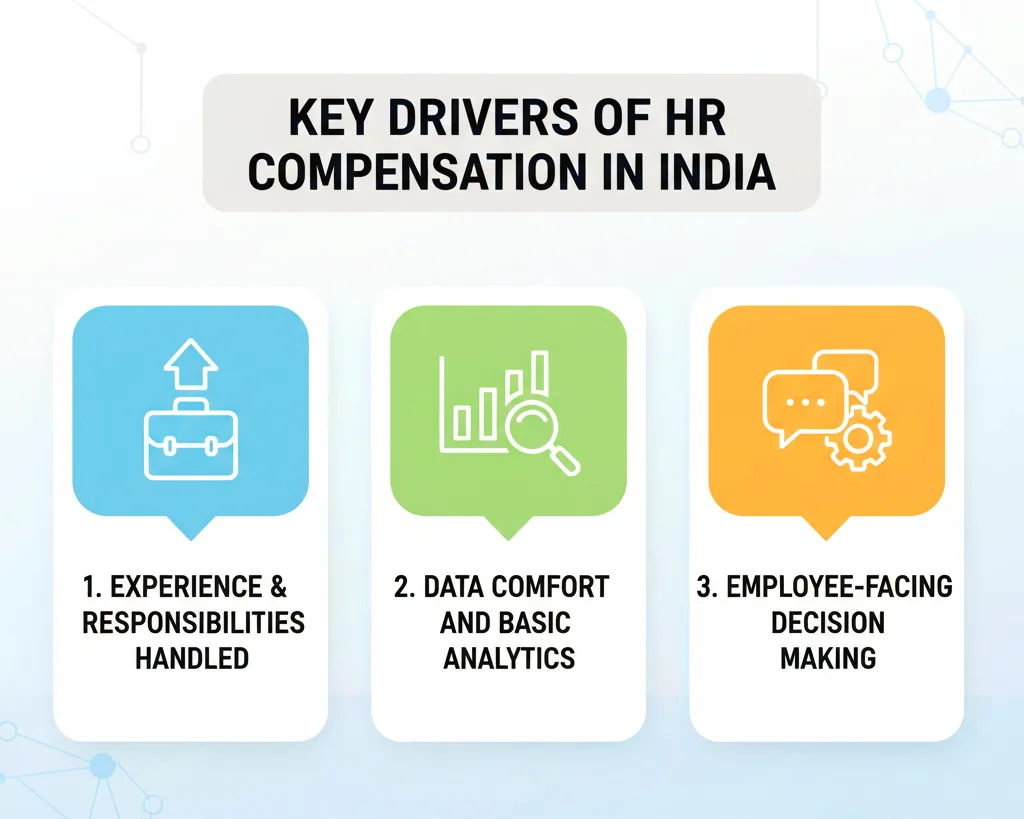
When you look at HR salaries, the pattern that you might see would reflect how the job profile has changed, particularly in mid-sized and fast-growing companies. Contrary to what many of us might have assumed till now, experience isn’t entirely the only force driving the salary decisions any more. What is then shaping HR salary in India now? It has become a mix of:
- What you’ve handled,
- How comfortable you are with data,
- And whether you can manage employee-facing situations without escalating every small issue.
Company Size Still Matters in HR Compensation
A small manufacturing unit in Pune and a Bengaluru SaaS company won’t use the same salary logic. It is not because there is unfairness in it, but because it is simply a different kind of workload and expectation.
Salary Shift Triggered by Compliance
With the new labour codes coming in, companies are realising that HR work isn’t just attendance, payroll, and paperwork anymore. There’s a lot more scrutiny, tighter rules, and higher consequences for mistakes. Because of this, organisations are now willing to pay more for HR professionals who are confident with regulations, know how to interpret compliance updates, and can keep the company out of trouble.
Digital Confidence Is Becoming a Pay Factor
Digital confidence here doesn’t mean deeper coding knowledge. HR roles are increasingly becoming complemented by automation. HRs who stay up to date with the knowledge of sophisticated workforce management solutions like attendance systems, leave management software, shift scheduling tools, HR dashboards, payroll tools, and reporting systems tend to handle daily work with more ease.
Companies lean toward these profiles because they bring a sense of reliability to the role.

HR Salary in India by Role (2026)
Here are the actual, practical salaries for HR roles in India. These are the genuine numbers companies are offering in most urban markets.
Role-Wise Salary Table (2026)
| HR Role | Typical Salary Range (Annual) | What the Role Involves |
|---|---|---|
| HR Intern / Trainee | ₹1.4 – ₹2.6 LPA | Supports documentation, coordinates onboarding, and handles basic admin. |
| HR Executive | ₹2.5 – ₹4.5 LPA | Manages day-to-day admin, tracks attendance, and screens recruitment candidates. |
| HR Generalist | ₹3.8 – ₹6.8 LPA | Manages a broad scope from onboarding to compliance and handling grievances. |
| HR Recruiter / TA Executive | ₹3.0 – ₹7.5 LPA | Sources, screens, and manages candidate pipelines; upper range for tech hiring. |
| Senior HR Executive | ₹5.5 – ₹9.0 LPA | Handles complex employee relations, assists with audits, and supports policy work. |
| HRBP | ₹9.0 – ₹18.0 LPA | Focuses on strategic alignment with business units and supports management objectives. |
| Talent Acquisition Manager | ₹10 – ₹20 LPA | Leads recruiting teams, develops sourcing strategy, critical for bulk/tech hiring. |
| L&D Manager | ₹8 – ₹18 LPA | Designs and implements training programs, conducts skill gap analysis and development. |
| HR Manager | ₹7.5 – ₹16 LPA | Manages complete HR operations, oversees compensation cycles, and performs audits. |
| Payroll Manager | ₹8.5 – ₹18 LPA | Oversees end-to-end payroll processing, manages statutory deductions, reviews audits, resolves salary discrepancies, and maintains error-free compliance across monthly cycles. |
| Senior HR Manager | ₹14 – ₹25 LPA | Strategic workforce planning, managing complex ER cases, and influencing budgeting. |
| Head of HR (Mid-size) | ₹30 – ₹55 LPA | Oversees entire HR function, drives company-wide people strategy, reports to CEO. |
| CHRO (Large Enterprise) | ₹60 LPA – ₹1 Cr+ | Compensation often includes bonuses and ESOPs. Sets strategy, leads C-suite discussions, drives culture, and manages large budgets. |
A Few Role Notes You Don’t Hear Often
- Recruiters today earn almost as much as generalists because companies feel hiring pain more than anything else.
- HRBPs today are paid more for their judgment than for running processes.
- Senior HR folks who can properly analyse the workforce data and share insights, even basic trends, land better offers.
- Payroll-specific HR specialists are still underpaid despite being essential, but this is slowly shifting.
HR Salary in India by City
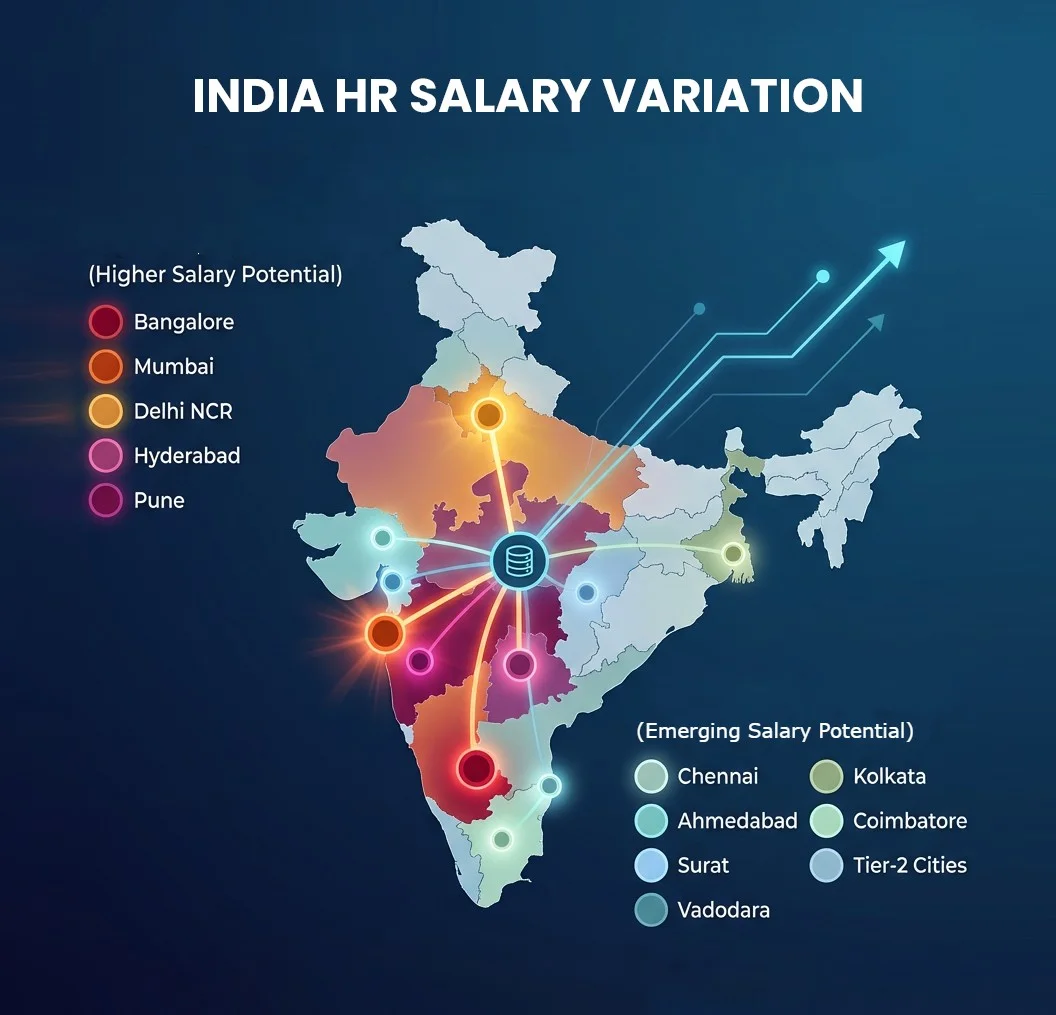
Most often, we assume city-wise differences in HR salary in India are influenced by the cost of living. While that is a factor, there are other factors too that contribute to the variations, like the maturity of local industries, hiring volumes, and how urgently companies scale their teams.
City-Wise HR Salary Table (2026)
| City | Salary Positioning (vs National Median) | Why It’s Higher or Lower |
|---|---|---|
| Bangalore | +10–22% | Tech-heavy, hiring never stops. |
| Mumbai | +8–20% | BFSI + large enterprises. |
| Delhi NCR | +5–18% | Mix of IT + consulting + manufacturing. |
| Hyderabad | +8–15% | Pharma + biotech + IT expansion. |
| Chennai | +4–12% | Auto + manufacturing + IT services. |
| Pune | +5–12% | Engineering + SaaS + product dev. |
| Ahmedabad | +3–10% | Manufacturing + pharma + textiles. |
| Surat | +2–8% | Exports, textiles, and large workforce operations. |
| Vadodara | +3–9% | Heavy industrial hubs. |
| Kolkata | +0–5% | Growing slowly; stability over scale. |
| Coimbatore | +0–6% | SME-driven, manufacturing-led. |
| Tier-2 Cities | Median or slightly lower | Predictable, but conservative salary bands. |
A Quick Read on City Dynamics
Bengaluru pushes HR salaries upward because hiring speed is everything there.
Mumbai is less frantic but pays well due to BFSI (Banking, Financial Services, and Insurance).
In cities like Ahmedabad, Surat, Rajkot, and Vadodara, HR salaries aren't very high, but the jobs are steady, and people get regular, consistent raises.
Kolkata's salaries are stable, but they don't increase very quickly.
If you look at these cities side by side, the pattern becomes obvious: salaries grow where the hiring volume is unpredictable or where compliance is high-stakes.
HR Salary in India by Industry
Just like HR salaries in India vary by cities and role, the industries too come with their own salary logic. In some industries, the HR role is mostly seen as admin support, but in others, it's considered the difference between predictable operations and high performance/strategic success.
IT & Technology
- Salary Position: Higher.
- Reason: Tech companies reward speed, retention, and hiring stability, which are the three essential areas where HR has direct control and influence.
BFSI (Banking, Financial Services, and Insurance)
- Salary Position: High.
- Reason: The BFSI sector is compliance-heavy and often has a multi-location workforce which heavily relies on HR processes.
Pharma & Healthcare
- Salary Position: High.
- Reason: The environment is highly regulated and requires managing a large volume of specialised roles. HR pay reflects this urgency and complexity.
Manufacturing
- Salary Position: Moderate to high
- Reason: HR's work on labour codes, factory staffing, and safety trainingdirectly affects operational continuity and legal compliance.
Retail & Hospitality
- Salary Position: Moderate
- Reason: Large workforces but tighter margins. HR salaries stay stable rather than being high.
Professional Services & Consulting
- Salary Position: High.
- Reason: Roles like HRBP, L&D, and Talent are highly valued because the success of the business depends entirely on securing and developing skilled people.
Startups
- Salary Position: Low Base, High Potential
- Reason: HR manages rapid organisational change and intense growth. Pay is highly variable, often including stock options.
Top Skills and Certifications That Can Push HR Salaries Up
The HR skills that pay well in 2026 are different from the ones that were considered premium a decade ago.
Skills Employers Pay More for
- Workforce analytics (even basic Excel + interpretation)
- Statutory compliance understanding
- Hiring strategy, especially tech hiring
- Compensation benchmarking
- Conflict-handling and employee relations
- HR audit readiness
- HR tech fluency (reports, dashboards, workflows)
- L&D program design
- Org development exposure
You don’t need all of these. Even three solid skills can move your salary bracket to a more comfortable range.

Certifications That Make a Noticeable Difference in HR Take-Home
- SHRM (CP / SCP)
- HRCI (PHR / SPHR)
- XLRI programs
- Labour law certificates
- HR analytics certifications
- Total rewards/compensation programs
Although having mere certifications doesn’t guarantee a salary jump, it can certainly change how companies evaluate your potential.
What’s Currently Changing in the HR Pay Scale in India?
If you zoom out a little, the direction is easy to see. HR salaries in India are rising because:
- HR is becoming a decision-support function in almost all organisations
- Workforce planning is being taken seriously as every role has a financial consequence.
- Companies have realised that bad hires and poor retention cost more than competitive pay.
- The power of data analytics shifts HR from reactive problem-solving to predictive planning.
Interestingly, even companies that never cared about structured HR earlier, for instance, mid-sized manufacturing, regional logistics, family-led businesses, etc., are now opening up HR roles with better pay because they have experienced what poor people management costs.
Conclusion
If you want to know about HR salary in India for 2026, look at the big picture. The numbers are pulled in different ways by your role, your city, and your industry. Only when you look at them together does the picture make sense. Luckily, HR salaries are much better today, and the growth options are clearer.

FAQ
1. If I want a faster salary jump, which three skills should I build first?
Focus on: (1) workforce analytics (interpret basic reports and tell a story from data), (2) statutory compliance (read and apply labour rules to day-to-day operations), and (3) hiring strategy for critical roles (tech/volume hiring). Even solid competence in these three can raise your bargaining power better than a stack of generic certifications.
2. How do companies view HR candidates with modern software experience?
Candidates who know how to use digital systems for attendance, payroll, and reports are seen as more reliable and accurate. Companies prefer people who can manage a tech-enabled workflow from day one, which cuts down on errors and supervision. This is why having experience with an integrated HRMS, like Mewurk, is now a huge advantage on a resume.
3. Why is tech experience now so important for an HR career?
The advancement of technology in the people management domain has shifted HR's role from a back-office admin role to a strategic, profit-protecting function. Companies today greatly value HR professionals who can:
- Reduce Penalties: Handle payroll and compliance automatically.
- Generate Insights: Use dashboards to predict turnover or skill gaps.
- Save Time: Automate time-off requests, onboarding, and appraisals.
4. How do HR salaries differ between startups and large enterprises?
Startups offer lower base pay but higher upside (stock/ESOPs) and faster role-stretching. You will gain broad ownership. Large enterprises, on the other hand, pay higher base packages and benefits, particularly for specialist roles (payroll, compliance, L&D), and tend to reward depth and process ownership. Choose based on whether you want rapid learning + upside (startup) or stability + higher base (enterprise).

Most Popular Post

Why Accurate Attendance and Leave Management Matters for Business Growth?
Read More →Why Accurate Attendance and Leave Management Matters for Business Growth?
How To Leverage Attendance Data For Better Workforce Management?
Read More →How To Leverage Attendance Data For Better Workforce Management?