HR Roles and Responsibilities: A Practical Guide to Modern HR Positions
HR stands for Human Resources. We frequently use the term HR to refer to any professional working in the Human Resource Management (HRM) department of a company. Small companies have one or two HR professionals, while bigger companies can have more than a dozen.
Each HR professional has quite different duties and responsibilities to perform. Whether you are an HR candidate, a regular employee or a student seeking an entry-level career in HR, knowing specific HR roles and responsibilities is vital. And this guide is there to walk you through each.
Why Multiple HR Roles Exist and Why One Role Can’t Do It All?
Human resource management is a vast process which is spread across various aspects of an employee lifecycle. Certain HR roles that handle processes like talent acquisition come to the picture even before the employee lifecycle begins. Hence, one HR role can’t handle these diverse responsibilities.
Many early-stage companies manage to handle most HR responsibilities with the help of a single professional. It is practical for them since the headcount is low and the organisational structure is relatively simple.
But as the company grows and requires accommodating multiple employees, the tasks of HR professionals begin to expand and become increasingly complex, ranging from compliance and payroll to culture building and conflict resolution. As a result, the risk of a one-person HR doing everything will become very high, often leading to burnout, administrative errors, and a decline in employee engagement.
Specialised HR roles and responsibilities give organisations the agility to scale effectively while ensuring that every stage of the employee journey receives expert attention.
How Do HR Roles Evolve as Your Company Grows?
In a small company with a headcount of 10, managing them is just a personal task for an HR professional. When the company grows, the one-size-fits-all approach to HR will begin to strain. Managing 50 or more headcount demands a structural endeavour.
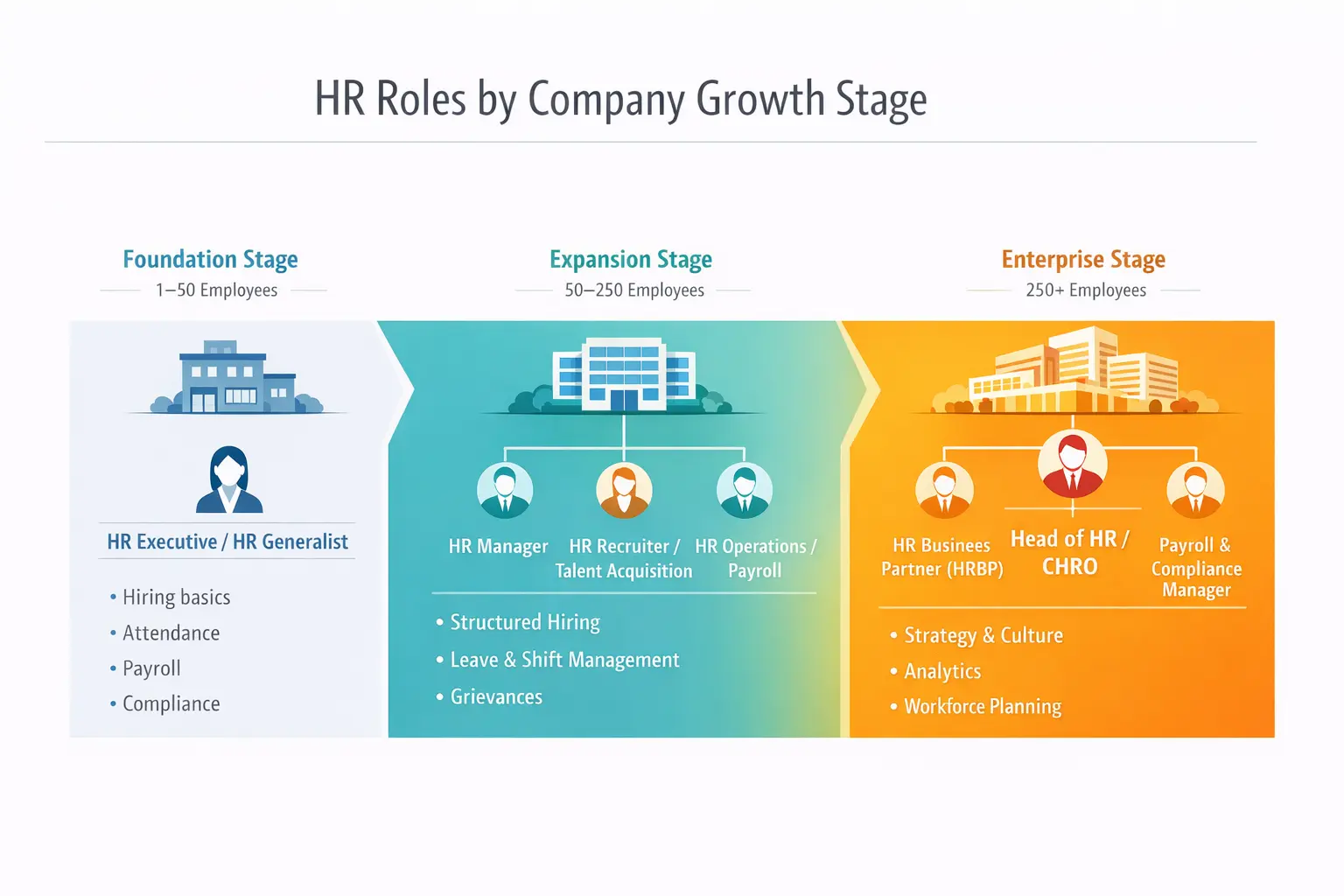
The following phases of company growth illustrate how HR roles and responsibilities evolve as the organisation scales.
Phase 1: The Foundation Stage (1–50 Employees)
At this stage, HR can be a one-person army. An HR Executive or Generalist could handle the entire lifecycle of an employee. Their day might start with screening resumes and end with calculating monthly attendance and coordinating basic payroll. Hiring happens at required intervals, people get paid on time, and all compliance boxes are ticked.
Phase 2: The Expansion Stage (50–250 Employees)
Once you cross the 50-employee mark, the complexity of managing their leaves, shifts, and grievances becomes too much for one person. This is where the roles and responsibilities of HR manager who acts as a one-man-army should be split and delegated to multiple people and roles.
You will require a dedicated HR Recruiter focused solely on talent acquisition, as well as an HR Operations specialist to oversee payroll and statutory compliance.
Phase 3: Enterprise Stage (250+ Employees)
In large organisations, HR department roles and responsibilities shift from the back office to the boardroom. Leadership roles like HR Business Partners (HRBPs) work alongside department heads to oversee whether people's goals align with business revenue. Also, there are specialised wings for Learning & Development (L&D) and HR Analytics to focus on long-term talent retention goals.
At this scale, you cannot rely on any manual method to track data, as it becomes too slow and prone to human error. The best alternative is to use integrated HRMS systems as the central nervous system of your workforce management processes and hold together all HR job roles and responsibilities.
Core HR Roles & Responsibilities
Regardless of the industry, every growing company relies on a core set of HR roles and responsibilities to support their employees and keep their business compliant. Let’s understand what those foundational roles are and how they form the backbone of a professional workplace.
1. HR Executive / HR Officer
An HR executive’s roles and responsibilities consist of managing day-to-day employee management operations within an organization such as cross-checking basic compliance, document filing, etc. They are the first point of contact for employees with the company.
2. HR Generalist
HR generalist is a position you might not see very often in small companies or big companies, but in mid-sized ones. They handle multiple HR functions together. In a medium-sized firm of 50 or more employees, you might find multiple HR generalists tasked with handling the full employee lifecycle. If there are specialised roles for admin and people management, an HR generalist would be the bridge between the two.
3. HR Manager
HR Manager is a superior role within the human resource management department. They are the ones who own the entire HR processes and their team's execution. They directly oversee workplace policy implementation and people issues. In organisations where there is no dedicated HRBP, they also act as a connector between leadership and employees to ensure everyone is on the same page, so as to maintain a healthy work environment.
4. Talent Acquisition Executive /HR Recruiter
In mid to large-sized organisations, there will be a dedicated talent acquisition executive to take care of the entire hiring lifecycle. They are not just limited to sourcing candidates, but their ownership and responsibilities extend towards improving the overall candidate experience in the hiring process.
For instance, they coordinate smooth interview schedules and brief candidates beforehand so they feel prepared and welcomed by the company. HR recruiters work closely with hiring managers and department heads to clearly define the job requirements and identify the ideal candidate profile for each open role.
5. Talent Acquisition Manager
A Talent Acquisition Manager designs the company’s overall recruitment strategy. They are responsible for choosing the right hiring tools, managing recruitment budgets, and building a strong employer brand that makes the company attractive to top-tier candidates in the talent market.
In medium-sized companies, this role is often combined with an HR Manager's duties, but as an organisation scales toward the enterprise level, a dedicated TA Manager becomes essential to lead the recruitment team, set performance targets like time-to-hire and oversee the efficiency and cost-effectiveness of the hiring process and business growth targets.
6. HR Business Partner (HRBP)
An HR Business Partner (HRBP) is the strategic bridge between the HR department and the organisation’s senior leadership. While traditional HR roles and responsibilities focus on administration, the HRBP collaborate closely with department heads. It is on their shoulder to ensure that the people-related initiatives being taken by the HR department directly support business revenue and growth.
They are also tasked with the responsibilities of guiding organisational structure, succession planning, and performance management. To build a high-performing team whose efforts contribute to the company’s broader commercial goal, there must be someone who is fully dedicated to driving a long-term strategy beyond the daily operations, and an HRBP is the one who fills this vital gap.
7. Learning & Development (L&D) Manager
Learning and Development (L&D) Managers are responsible for helping employees improve their skills so that their current capabilities match the company's evolving needs.
Since organisations prefer hiring candidates for the long term rather than short stints, continuous upskilling is essential. It ensures that employees meet widening expectations while staying competitive and relevant in their positions. Today, this constant growth is vital for both the individual's career and the organisation's success.
8. HR Operations / HRIS Manager
The HR Operations or HRIS Manager oversees the technology and data infrastructure. They manage the Human Resource Management System (HRMS). They are making sure employee records are accurate and accessible. They pave the way to automating repetitive tasks like attendance tracking, leave management, document handling and storage. Their contributions reduce manual errors and improve efficiency in HR administration.
The top leadership of an organisation can make informed, people-related decisions only if they have the luxury of clean data and reliable reporting, which are directly under the purview of this role.
9. Employee Relations Manager
The Employee Relations Manager is dedicated to maintaining a healthy and professional bond between the organisation and its people. Their role focuses on maintaining a workplace that is built on fairness and trust. For that, they contribute towards designing the company’s policies and ensuring their consistent application.
When any conflicts or grievances arise, the employee relations managersteps in as a neutral party to resolve issues and protect both the employee's rights and the company's integrity.
10. Payroll & Compliance Manager
Payroll roles and responsibilities are among the most impactful functions in any organisation. Whether you are a small business or a mid-sized to large business, there is no escaping statutory compliance and the salary process.
If salary is not credited on time, it will create frustration for the employees and their families. As a role that is very much dependent on accuracy, timeliness, and legal alignment, a payroll and compliance manager is absolutely critical for business stability.
11. Head of HR
The Head of HR leads the HR function across all departments within an organisation. Major areas like policy ownership and leadership advisory fall under their responsibility.
Although hitting growth targets is the primary focus of a company, it cannot ignore the well-being of its employees. The head of HR has the final word on major decisions regarding the workforce.
While managers handle their specific teams, the Head of HR ensures that every department follows the same standards and values.
12. CHRO (Chief Human Resources Officer)
A Chief Human Resources Officer (CHRO) is a C-suite leader who is responsible for shaping the company’s people strategy at the highest level. They collaborate closely with the CEO and board and contribute to building long-term leadership, culture, and workforce direction.
The CHRO role is more common in large or global organisations than in small or mid-sized enterprises. Nevertheless, fast-scaling startups and people-centric industries such as hospitality or healthcare, where the product is the people, even mid-sized companies may appoint a CHRO to prioritise the workforce at the executive level.
Conclusion
HR roles and responsibilities are the backbone of a healthy workplace. Having the right people in the right HR roles is essential to support your growth at every stage. How has your HR structure changed as your company grew? And which of these roles do you think is the most critical for your success today?
FAQ
1. Is it possible to transition from an HR Generalist role to an HR Specialist role?
Yes. In fact, many start as Generalists to learn all functions, then pivot into a Specialist role like Comp & Ben or L&D once they discover which area they enjoy most.
2. What are the soft skills most needed to succeed as an HR professional?
HR roles and responsibilities have become increasingly soft skills-focused as automated HR tools can handle most administrative and process-driven tasks. Skills like Conflict Resolution, Emotional Intelligence, and Ethical Judgment can significantly influence an HR professional’s growth and long-term success in the role.
3. Are HRBPs paid more than HR Managers?
Yes. HRBPs are often higher-paid because they act as consultants to the business leaders and contribute to the making of revenue-linked strategies. The HR roles and responsibilities of an HR manager, on the other hand, are limited to the internal administration of the HR team and thus lower pay.
4. What does a career path in HR look like?
Most HR professionals start in junior administrative roles and grow into generalist or specialist positions. After gaining sufficient experience in HR roles and responsibilities, they can progress into managerial and leadership roles such as HR Manager, Head of HR, or CHRO.

Most Popular Post

Why Accurate Attendance and Leave Management Matters for Business Growth?
Read More →Why Accurate Attendance and Leave Management Matters for Business Growth?
How To Leverage Attendance Data For Better Workforce Management?
Read More →How To Leverage Attendance Data For Better Workforce Management?