CTC Vs In Hand Salary: An Easy Guide for Employees and Employers in India
Ever accepted a job offer that looked great on paper and then felt confused when your first salary got credited in the bank account? You’re not alone.
While the gross salary is common worldwide, India’s CTC structure might confuse you due to the gap between the offer figure and what you receive or take home.
Whether you are an employee budgeting your income or an employer trying to explain the compensation package clearly to the new hires, this guide will help close that gap.
What Is Meant by CTC in Salary?
Cost to the Company is the full form of CTC in salary. It refers to the total cost an employer spends on an employee in a year. In India, this is the figure that most job offers mention.
How Does the Indian CTC Model Differ from the Rest of the World?
In most Western countries, like the US or UK, employers offer a ‘Gross Salary’ or a straightforward figure from which taxes are deducted. If they say $100,000, that is the amount you earn.
Deductions like social security or health insurance are taken out of that number.

In the Middle Eastern countries like the UAE and Qatar, they usually offer a Monthly Net Salary. Since there is no income tax, what they promise is almost exactly what gets credited in your bank account.
India, however, uses the Cost to Company (CTC) model, which is an all-inclusive calculation. Beyond an employee’s earnings, it totals every penny the employer spends to have the employee on the team.
This includes hidden costs like the company’s share of your retirement fund (PF), gratuity, and even insurance premiums. Because of this, most employees get confused about CTC vs in hand salary; the gap between the higher figure on the contract and the actual cash that hits their bank account, which the salary slip generated through payroll software later shows.
What Are the Key Components of CTC?
CTC includes both cash and non-cash components. To understand what is ctc in salary, you must break it down into its individual parts and see what goes into it.
Basic Salary
This is the very first component you see when you look at a CTC breakdown. It is the fixed core pay you are offered. Many allowances and statutory deductions are calculated as a percentage of the basic.
In other words, the figure here decides several other components.
House Rent Allowance (HRA)
HRA or House Rent Allowance is an amount paid to employees to support their rental housing costs. How much of it is tax-free depends on your city, the rent you pay, and your basic salary.
Also, it is worth noting that many companies set higher HRA for high-rent cities (like Bengaluru, Mumbai, Delhi) and lower HRA for smaller cities (like Kochi).
Other Allowances
In addition to HRA, there are a few other allowances which are added to an employee's salary structure.
When understanding the difference between CTC vs in hand salary, these small components like conveyance, special allowance, medical allowance, or similar heads matter.
Additionally, educational allowance (reimbursement for the expenses employees spend on their children’s education) and Leave Travel Allowances (Refund travel expenses for approved holidays) are offered by some employers.
These carry fewer tax benefits than HRA.
Bonus / Performance Pay
Bonuses, performance-based pay and incentives are forms of variable pay, which are decided based on one’s performance and grouped together in a salary structure.
It is not guaranteed to the employee every month. Usually, companies pay them quarterly or annually. Nonetheless, they still count toward what is mean by ctc in salary.
Employer PF Contribution
This is the company’s statutory contribution to your Provident Fund (PF). While it is part of one’s CTC package, it is not part of their take-home salary. The employee also contributes a portion of their salary to the PF.
Gratuity
Gratuity refers to the long-term benefit paid to an employee when they complete five years or more with the same employer. Although it accumulates yearly, it is not paid monthly.
Benefits (Insurance, Meal Vouchers, Wellness)
Employees are offered various benefits, depending on the employer’s policy. These non-cash benefits add value to your CTC package but do not increase your monthly bank credit.
Stock Options (ESOPs)
Some companies, especially startups, include stock options as part of the CTC to attract or retain employees. Making use of this, employees can buy company shares at a fixed price in the future.
ESOPs are shown as part of CTC, but don’t reflect as cash in one’s bank account each month unless they decide to sell them.

Perquisites (Perks)
Perquisites (perks) are extra benefits provided by the employer, such as a company car, phone reimbursement, housing support, or interest-free loans. Some perquisites are taxable, which can slightly affect how much salary you receive after deductions.
How CTC Breaks Down (Example)
To understand what is CTC in salary package, let’s take the example of an employee with a ₹10,00,000 annual CTC and see how it converts to in-hand salary.
Estimated CTC Split (per annum)
| Component | Amount (₹) | % of CTC |
|---|---|---|
| Basic Salary | 5,00,000 | 50% |
| HRA | 2,00,000 | 20% |
| Special AllowSpecial Allowanceance | 1,80,000 | 18% |
| Bonus | 50,000 | 5% |
| Employer PF | 48,000 | 4.8% |
| Gratuity | 22,000 | 2.2% |
| Total CTC | 10,00,000 | 100% |
How to Calculate CTC the Right Way?
CTC is the total cost your employer incurs each year to have you as an employee. To calculate it the right way, you need to add up the three broad components that go into it.
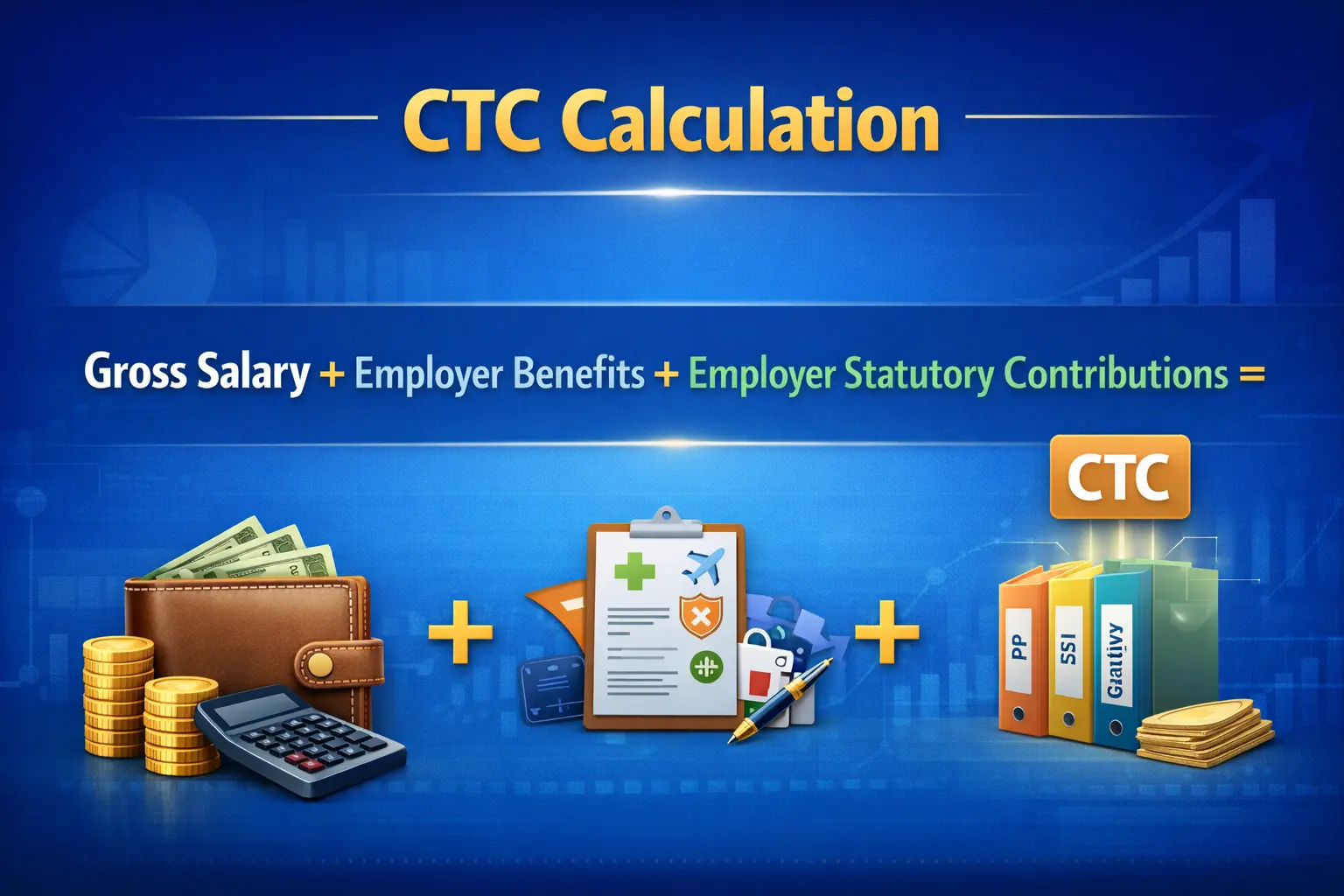
Here, Employer Benefits means the additional perks and non-salary costs your company provides to support you beyond your direct pay.
What Is the Difference Between CTC and In Hand Salary?
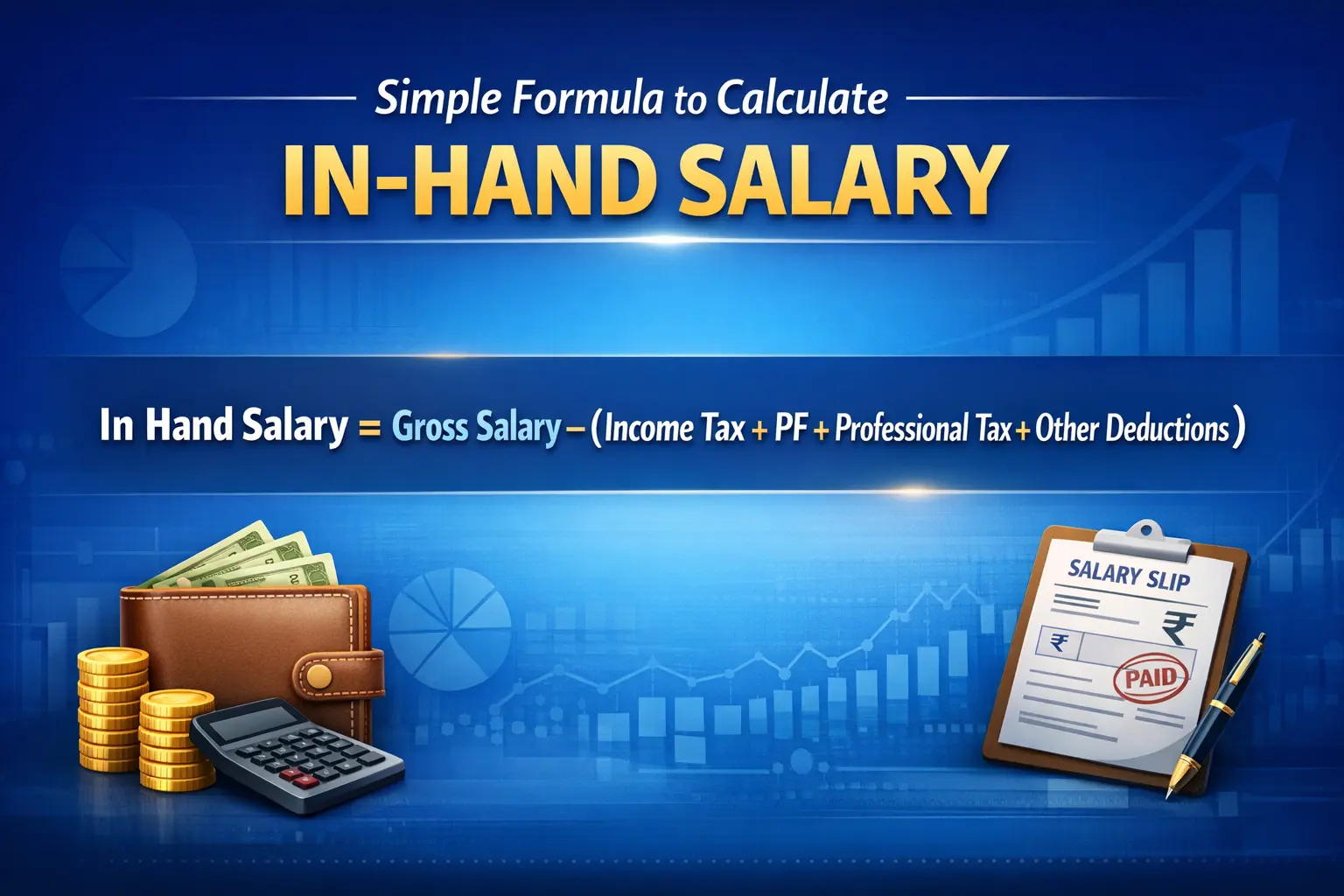
In-hand salary, also called net take-home pay, is the amount deposited into the employee’s bank account after all deductions. The difference comes from components like employer contributions, benefits, and statutory deductions that are counted in CTC but don’t reach your bank account.
What Gets Deducted from CTC?
The major differentiator for CTC Vs In Hand Salary comes from the components that get deducted from one’s gross salary. The items listed below are standard deductions.
- Employee PF Contribution (usually 12% of basic)
- Professional Tax (varies by state)
- Income Tax (TDS) based on annual income & declarations (old/new regime), later reconciled through ITR filing
- Other Deductions (NPS, ESIC, health insurance, depending on company policy)
CTC Vs In Hand Salary: Quick Comparison
| Aspect | CTC | In-Hand Salary |
|---|---|---|
| What it means | Total cost to company, including employer contributions and benefits | Actual pay credited in employee’s bank |
| Includes PF, gratuity, benefits | ✔ Yes | ✘ No |
| Includes deductions | ✘ No | ✔ Yes |
| Helps in job negotiations | ✔ Yes | Useful only with context |
| Determines take-home pay | ✘ No | ✔ Yes |
How Does the Old vs New Tax Regime Change Your In-Hand Salary?
In India, the choice between the new tax regime and the old tax regime directly affects your in-hand salary. Even if two employees have the same CTC, what finally reaches their bank account can differ based on the regime they pick.
Under the new tax regime, which is the default option, tax rates are lower. But most exemptions and deductions are not available in this. Consequently, you won’t be considered for benefits like 80C investments, HRA, and home loan interest.
If you are someone who doesn’t invest much or doesn’t claim many exemptions, the new regime can mean a higher monthly take-home pay because of fewer upfront tax deductions.
The old tax regime gives provision for common deductions such as 80C (up to ₹1.5 lakh), HRA, and home loan interest. These can significantly bring down your taxable income.
However, the final in-hand salary depends on how much you invest or claim. If deductions are low or irregular, the old regime can result in a similar or even lower take-home pay compared to the new regime.
Tip for HR teams:
Get tax declarations from employees early in the financial year to apply the correct regime from day one and avoid last-minute tax corrections.
Real-World CTC Vs In Hand Salary Benchmarks in India
Here’s a typical market comparison to help you understand what is the meaning of ctc in salary , alongside approximate in-hand take-home after tax and deductions under common assumptions:
| CTC per Year | Approx In-Hand / Month |
|---|---|
| ₹6,00,000 | ₹38,000 – ₹45,000 |
| ₹8,00,000 | ₹52,000 – ₹60,000 |
| ₹10,00,000 | ₹65,000 – ₹75,000 |
| ₹15,00,000 | ₹1,00,000 – ₹1,10,000 |
| ₹20,00,000 | ₹1,30,000 – ₹1,40,000 |
Note: Figures shown are illustrative, based on typical Indian salary structures under the new tax regime with standard deductions. Individual outcomes will vary by salary structure and declarations.
CTC vs Gross vs Net (In-Hand) Salary - A Quick Recap
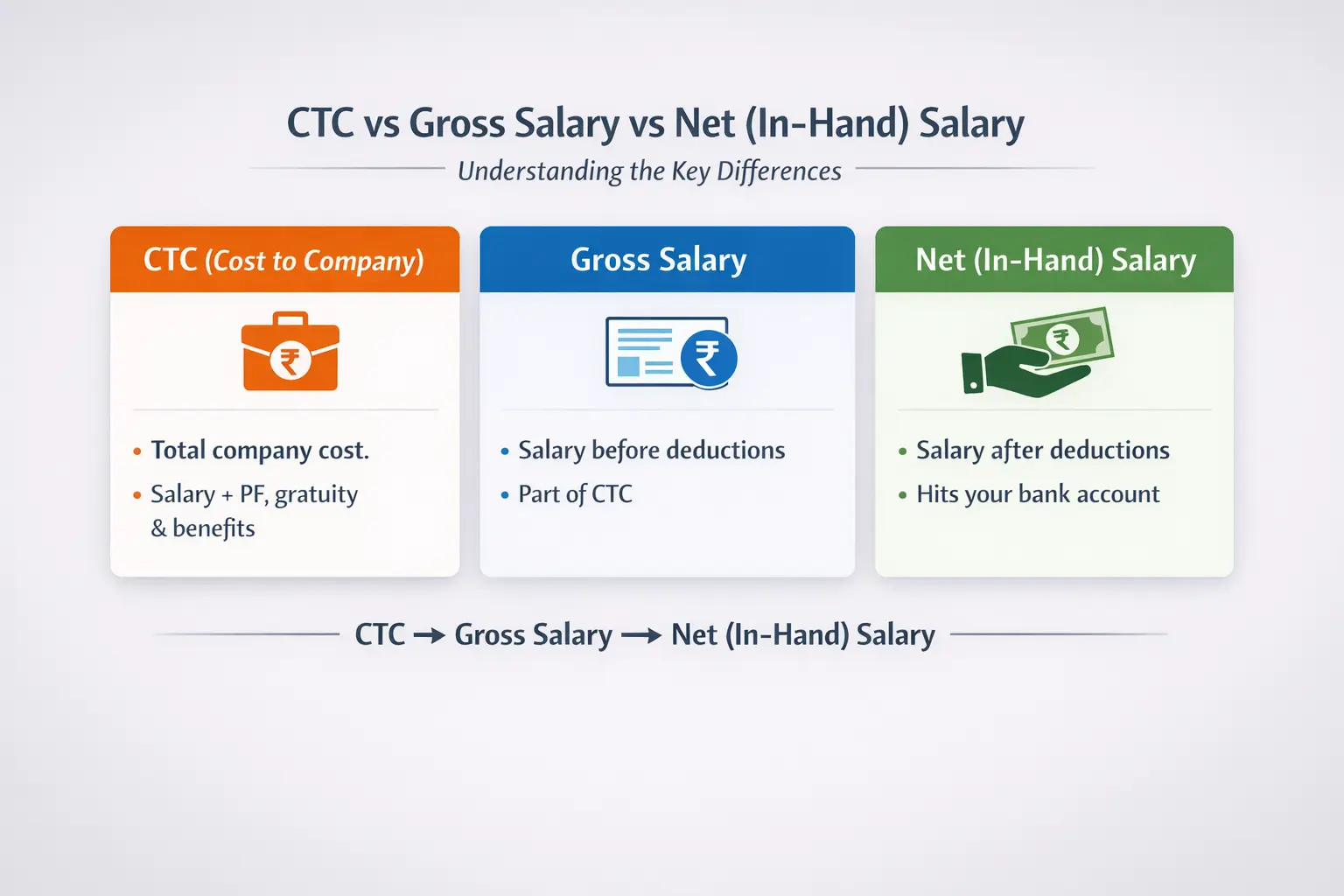
CTC, gross salary, and net salary are three different numbers - and mixing them up is the main reason people feel misled by their offer letters.
CTC (Cost to Company)
The total annual cost your employer spends on you, consisting of your salary plus employer PF, gratuity, insurance, and other benefits.Gross Salary
Your salary before any deductions. This is what your PF and income tax are calculated on. Gross salary is part of CTC.Net (In-Hand) Salary
What reaches your bank account after deductions like employee PF, TDS, and professional tax.
Conclusion
The CTC vs In Hand debate starts with a moment of confusion. Either an employee wondering where the money they were promised disappeared, or an HR leader trying to explain to the employee why there is a gap between an initial big offer and a realistic paycheck.
At the end of the day, understanding this breakdown is essential for both parties to maintain trust.
Hopefully, this guide cleared the fog around those line items. If you came here wondering what is CTC in salary with example, did the numbers finally start to make sense?
FAQs
1. Is CTC the same as gross salary?
No. Gross salary is a part of CTC. CTC includes employer contributions and benefits that don’t form part of gross.
2. What components reduce my in-hand salary?
Components like employee PF, professional tax, income tax (TDS), and voluntary contributions (like NPS) directly reduce what you receive each month.
3. How does PF affect take-home pay?
Employee PF is deducted from gross salary every month (usually 12% of basic). Although it reduces your take-home pay, it adds up to your retirement savings.
4. Which tax regime should I choose?
It depends on your investments and exemptions. The new regime offers simplicity and a higher take-home if you don’t claim many deductions. The old regime can be better with big 80C investments.
5. Does gratuity affect my monthly salary?
No. Gratuity doesn’t reduce your in-hand pay. Even if it’s shown as part of CTC, you receive it only when you leave the company after completing at least five years of continuous service.
6. Should HR clarify the CTC vs in hand salary difference during recruitment?
Yes. Clarifying the difference at the time of recruitment can help set the right expectations and avoid any chances of awkward conversations after the offer is accepted.

Most Popular Post

Why Accurate Attendance and Leave Management Matters for Business Growth?
Read More →Why Accurate Attendance and Leave Management Matters for Business Growth?
How To Leverage Attendance Data For Better Workforce Management?
Read More →How To Leverage Attendance Data For Better Workforce Management?