7 Reasons Businesses Are Switching to Cloud-Based HR and Payroll Software in 2026
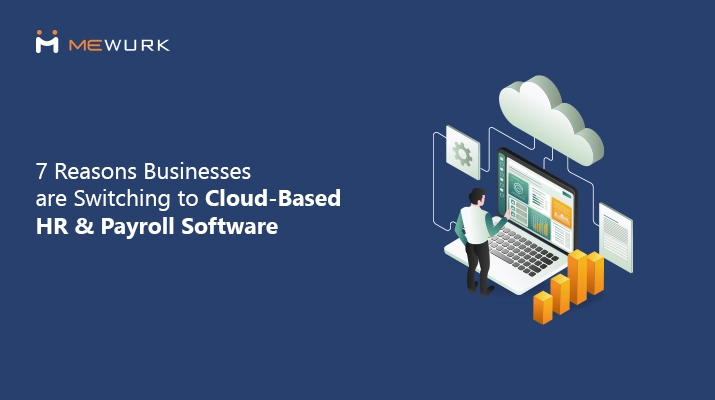
Since cloud computing entered the world of HR and payroll software, demand for these systems has steadily grown.
Although you could still see the HR team managing their admin/payroll tasks on books, spreadsheets or on-premise software, the gap between those businesses and the ones using cloud based HR and payroll software is widening fast.
What’s driving all the buzz around cloud HR?
Companies that have made the switch report not just time savings, but a fundamental improvement in how HR decisions get made. The global HR software market was valued at over $16 billion in 2023, and cloud adoption is driving nearly 80% of that growth.
Here is what is pushing businesses across industries to finally make the move.
7 Reasons Pushing Businesses to Adopt Cloud Based HR and Payroll Software
1. Real-Time Access to Employee Data Across Locations
Any HR management tools, whether it’s desktop software, an on-premise server setup, spreadsheet-based tracking or paper setup, that aren’t cloud-based suffer from being locked in a single location.
If you happen to be a multi-location company, you may have an HR team in one place and a payroll team in another. In such setups, both teams cannot access or update the same employee data at the same time. Cloud based HR and payroll software changes that entirely.
What Becomes Easier When HR and Payroll Run on the Cloud
- HR teams can access live employee records, attendance logs, and payroll summaries from any device at any time.
- Managers in remote offices can now approve leave requests and expense claims.
- Since the employee, HR and payroll team have the same employee work data, it is perfectly verified and does not cause payroll discrepancies.
- Duplicate employee records caused by siloed systems won’t be a concern anymore for multi-location businesses.
- You will get automatic audit trails, which matter enormously during compliance reviews.
The best part of the advantages from cloud based HR and payroll software goes to distributed teams, where centralised, live data is very important.
Take, for instance, a manufacturing firm with plants in three states. They cannot waste hours every week on data reconciliation. Cloud HR makes that a non-issue.
2. The Cost Equation Has Changed
One of the biggest misconceptions about cloud based HR and payroll software is that it is expensive. For mid-size businesses especially, the math runs the other way.
While the upfront cost of on-premise HR systems, including hardware, IT infrastructure, licensing, and annual maintenance, can run into six figures, cloud-based systems operate on a far more manageable subscription model.
Below is a table to help you understand it better.
| Cost Factor | On-Premise HR System | Cloud-Based HR System |
|---|---|---|
| Initial Setup | ₹8,00,000 – ₹30,00,000+ for servers, licenses, and implementation | ₹0 – ₹50,000 onboarding or setup fee |
| Annual Maintenance | ₹1,50,000 – ₹6,00,000 for AMC, upgrades, and infrastructure upkeep | Included in subscription |
| IT Support Required | Dedicated IT staff | Minimal / vendor-managed |
| Upgrade Costs | Paid per version | Automatic, no extra cost |
| Scalability Cost | High (hardware) | Low (add users/modules) |
| Disaster Recovery | Separate investment | Built-in via cloud provider |
With a SaaS payroll software model, you can convert the capital expenditure into a predictable operating expenditure, which can be considered a strategic advantage, especially for growing companies.
3. Handling Compliance Gets Much Easier
When we talk about compliance in the employee management context within an organisation, there are several things happening in the background which we don’t usually notice.
Tax laws can change. The government may update the regulations regarding labour or want organisations to switch to newer reporting formats. All of these can disturb the existing peace within organisations that rely on outdated HR systems. They will usually learn about the compliance changes only after defaulting.
Cloud based HR and payroll software vendors design their product UI incorporating the latest compliance requirements. So the clients can’t overlook compliance unless they deliberately evade it.
Take a quick look at some of the key compliance updates you could be safely covered for if you are on a cloud based HR and payroll software.
Automated Tax Table Updates
When regulations change, such as income tax slabs, PF limits, ESI contributions, or professional tax, the system is updated by the developers to reflect those changes. The platform adjusts its calculations and interface accordingly, which helps payroll teams avoid errors that could lead to compliance issues.
Built-In Labor Law Alerts
Premium cloud HR platforms track legislative changes in the jurisdictions where your employees work and flag potential exposure. For this very feature alone, multi-state employers can justify their switching to HR and payroll software hosted on the cloud.
Statutory Reporting for Payroll
Any business that operates in India must periodically and regularly handle statutory filings such as TDS returns, Provident Fund (PF) contributions, Employee State Insurance (ESI) reports, and professional tax submissions.
Cloud based HR and payroll systems simplify this process. It generates the required reports directly from payroll and employee records. For the reason that the data exists inside the platform, the reports can be prepared quickly. There is no need to manually compile information from multiple sources.
Audit-Ready Record Keeping
Any action that you initiate through your cloud HR payroll system is kept timestamped and attributed. In case of a labour department inspection or compliance check, you will have a complete, exportable record of every payroll run, every employee change, and every benefits election.
4. Payroll Processing Stays on Schedule
Ask employees who have left organisations for reasons other than the usual ones, like better pay or career growth. Late or incorrect payroll often appears among the complaints about their previous workplace.
And in companies still running legacy payroll systems, errors caused by manual data entry are the norm. Cloud based HR and payroll software addresses this with automated payroll processing.
It could pull data from time-tracking, benefits allocation, and similar HR optimised data simultaneously and make sure that each employee receives the accurate and timely payouts.
SNAPSHOT: What Automated Payroll Processing Looks Like in Practice
To better understand the convenience and benefits automated payroll processing brings forth, let’s take the example of a retail chain with 400+ employees across 12 stores in Bangalore. The company switched to a cloud-based HR payroll platform in 2024.
Before the switch, their payroll team had to spend several days every month. They had to collect the accurate working hours of each employee. If anyone had LOP, they had to apply those deductions manually.
After migration, that same process ran in under 4 hours. Within the first six months of the adoption, they could see error rates dropping by 91%. They used to have a scramble every quarter for payroll tax filings. Now, that entire thing is reduced just to a background process. All it takes is a simple, quick cross-checking before the approval.
The best part of the payroll ease came from the integrated time and attendance modules in the cloud based HR and payroll software, which can feed directly into payroll calculations. Similarly, since they can automatically apply overtime rules, shift differentials, and commission structures based on the parameters they set once, the system runs the numbers on its own.
5. Employee Self-Service Lightens the HR Team’s Daily Tasks
HR teams in growing businesses spend an astonishing portion of their day answering questions that employees could answer themselves if given the right tools. Cloud based HR and payroll software from reputed brands like Mewurk, Keka, Zoho, etc. includes employee self-service portals that handle the routine.
What can employees manage through self-service portals:
- Payslip access and Form 16 downloads without needing to contact HR
- Bank account updates for salary credit, which earlier required submitting forms or emailing HR.
- Benefits enrollment and updates, such as health insurance nominations or changes during policy renewal periods.
- Leave balance checks and leave requests, automatically routed to the reporting manager for approval.
- Personal information updates like address changes, emergency contacts, or nominee details.
For HR teams managing more than 100 employees, self-service functionality within their HR tech stack typically saves 15 to 20 hours per week in administrative follow-up.
6. Integration With the Broader HR Technology Ecosystem
Modern ecosystems reject the idea of isolated platforms. You need a payroll system that can sync or integrate with attendance, leave and shift systems, just as your benefits data must sync with your core HRIS.
Because cloud based HR and payroll software is deliberately designed for an interconnected world to some extent, it offers native integrations that legacy systems fail to provide. Here is a short table showing the level of integration modern HR payroll software systems offer.
| Integration Type | Why It Matters | Example Tools |
|---|---|---|
| Time & Attendance | Hours feed directly into payroll runs | Mewurk |
| Applicant Tracking (ATS) | New hire data can be fetched into payroll without re-entry | Greenhouse, Lever, Workable |
| Benefits Administration | Deductions sync automatically from enrollment data | Benefitfocus, PlanSource |
| Learning Management (LMS) | Training completion ties to compensation triggers | Cornerstone, TalentLMS |
| General Ledger / ERP | Payroll journal entries post automatically | QuickBooks, NetSuite, SAP |
| Single Sign-On (SSO) | Employees access HR tools with one login | Okta, Azure AD |
7. Better Security and Data Protection Than In-House Capabilities
Many business owners assume that keeping HR data on internal servers is safer than putting it in the cloud. The evidence says otherwise.
Most data breaches in small and mid-size companies happen on internal servers, not on well-managed cloud infrastructure.
Cloud based HR and payroll software providers give first priority to data privacy and security. Below are some common security-related investments they make at scale.
SOC 2 Type II Certification
Reputable cloud HR vendors undergo annual third-party audits where their security controls, availability, and confidentiality practices are scrutinised. There is no such equivalent external validation in the case of most on-premise HR deployments.
Role-Based Access Control (RBAC)
Not everyone in your company needs to see payroll data. Cloud HR platforms let you define who should see what information. A typical example is a department head viewing headcount data without seeing salary figures.
Automatic Data Backup and Disaster Recovery
Enterprise cloud providers replicate data across multiple geographic regions, which means if a server goes down in one location, your HR data will be made immediately available from another. It is hard to achieve that level of redundancy on an on-premises setup.
Encryption in Transit and at Rest
Modern HR systems store critical personal information of employees. A typical employee record would have their social security numbers and banking details. They can’t be kept as they are but have to be encrypted both when they move across networks and when they sit in storage.
Most cloud based HR and payroll software vendors use encryption standards such as AES-256, which are stronger than what many internal IT teams deploy.
Conclusion
Businesses that have moved to cloud based HR and payroll software are not looking back.
The combination of real-time data access, cost efficiency, automated compliance, and enterprise-grade security gives them a structural advantage in managing their people.
Instead of asking whether cloud HR makes sense, an increasing number of businesses are now asking how soon they can implement it.
Frequently Asked Questions
1. Which are the best cloud HR and payroll solutions for small businesses?
The market offers countless options for cloud HR and payroll tools. It is hard to say which is best because the level of benefits from these tools varies by company. It is recommended to compare tools against your needs. Here is a list of the best cloud HR software for small businesses.
2. What is cloud based HR and payroll software?
Cloud based HR and payroll software is a web-hosted platform that manages employee records, payroll processing, benefits, and compliance in one system. It can be accessed from any device without an on-premise installation.
3. Is cloud based HR and payroll software secure enough for sensitive employee data?
Yes. Leading vendors use AES-256 encryption, SOC 2 Type II certification, and geographic data redundancy, which is far ahead of the security standards of in-house server setups.
4. How long does it take to implement a cloud HR system?
Mid-size companies can complete implementation within a couple of days to a week. Factors like data readiness and complexity, number of integrations, and the level of configuration required for payroll rules can influence the implementation speed. Check out our blog about the 10 causes of HR software implementation failure to stay alert.
5. Can cloud HR software handle multi-state payroll compliance?
Yes. If you are choosing an enterprise-grade cloud HR platform, it can help automatically apply state-specific tax rates, wage laws, and reporting requirements across all jurisdictions where your employees work.
6. What is the difference between HRIS and cloud based payroll software?
An HRIS manages employee data and HR workflows. Payroll software processes compensation and taxes. Cloud HR suites combine both into one integrated platform to eliminate manual data transfer between systems.

Most Popular Post
Why Accurate Attendance and Leave Management Matters for Business Growth?
Read More →Why Accurate Attendance and Leave Management Matters for Business Growth?
How To Leverage Attendance Data For Better Workforce Management?
Read More →How To Leverage Attendance Data For Better Workforce Management?