Top 10 Reasons Why HR Management Software Implementations Fail and What You Can Do Differently
The implementation of an HR management software (HRMS) or Human Resource Information System (HRIS) is frequently mischaracterised as a mere technology upgrade. In reality, it represents a profound organisational transformation. Historically, large-scale IT project implementation success rates are low, with some reports citing that more than 70% of projects end in failure.
For HRMS specifically, failure is typically defined by one of two outcomes: users refusing to adopt the system, or the system proving to be fundamentally unfit for its intended purpose. The analysis of widespread implementation issues reveals that while technical difficulties are present, the primary root causes are systemic.
In other words, they reside in deficient planning, compromised data integrity, and deep-seated organisational resistance to change. Mitigating this cycle necessitates the establishment of a comprehensive HR Tech Governance Framework designed to enforce clarity, accountability, and operational resilience from inception.
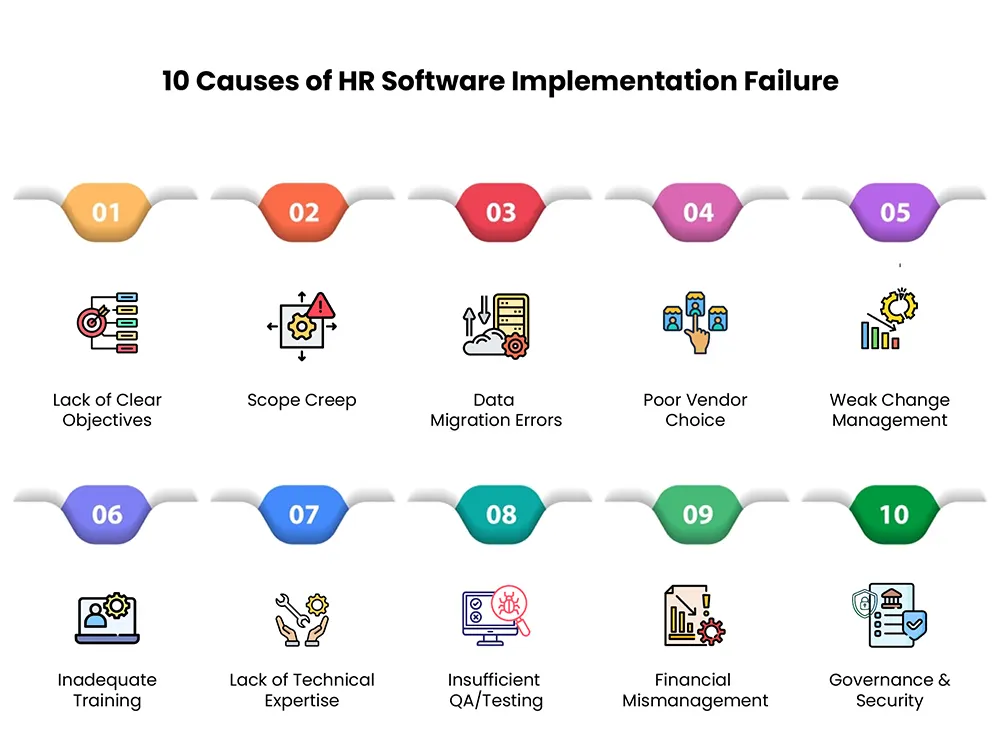
The Top 10 Root Causes of HR Management Software Implementation Failure (And How to Respond Differently)
1. Failure in Strategic Planning and Objective Clarity (The Foundational Flaw)
A common factor in HR management system implementation failure is the lack of clear, measurable objectives at the outset. When the end goals are vague, the resulting system cannot be properly evaluated or configured to meet business needs. You must define precisely what you aim to achieve, whether it is streamlining recruitment, improving payroll efficiency, or enhancing employee engagement, and these goals must be quantifiable and measurable.
Mitigation Strategy: Define Clear SMART Goals
The project to adopt an HR employee management software must be guided by clear, actionable metrics. Establishing and adhering to SMART criteria (Specific, Measurable, Achievable, Relevant, Time-bound) for the system prior to vendor selection helps set realistic expectations and reduces the risk of misalignment later. Furthermore, success should be documented in terms of expected return, such as reducing the administrative cost per employee, to ensure that the technology investment is in line with the overall financial objectives.

2. Unclear Scope Boundaries and Requirement Definition (The Budget Drainer)
If there is ambiguity and a failure to engage all necessary stakeholders regarding your decision to implement the HR management software for small business, you will have the initial phase of requirements gathering flawed. The results could be anything from confusion, conflict, and excessive rework. The most disruptive issue in this phase is the build-up of additional changes and ideas after requirements are already gathered and the implementation phase has begun. Continuous changes in organisational needs present a major obstacle that, if not managed, delays the project and pushes the budget past its threshold.
What to do differently: Define Needs Early and Manage Every Change
To prevent requirements ambiguity, utilise a structured, consistent language with functional-specific criteria, documented through tools such as user stories and use cases. Prioritisation must be formalised using frameworks like MoSCoW prioritisation (Must, Should, Could, Won't) to differentiate core requirements from optional features. Crucially, establishing a formal change control board to manage and vet every subsequent change request, thereby minimising the financial and schedule damage caused by scope drift, keeps priorities in check.
3. Data Errors and Migration Fails (The Trust Killers in HR Management Software Projects)
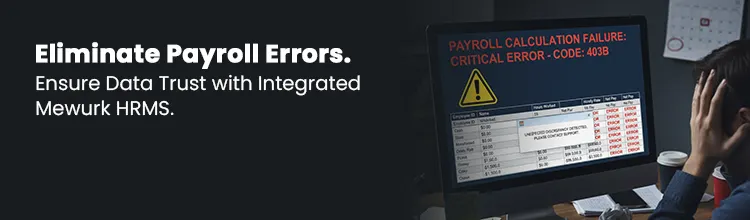
The issue of incorrect data, which may be fragmented, inaccurate, or incomplete, is a recurring obstacle in HR employee management software projects. Data quality failures have severe downstream consequences, including inaccurate employee information leading to payroll errors, breaches of employee confidentiality (such as employees viewing another person's documents), and the irreversible loss of historical data.
The moment employees first log into the new HR management software and encounter missing or inaccurate data, they immediately lose confidence in the new platform. It could then render all subsequent Organisational Change Management (OCM) efforts less effective
Corrective Action Plan: Audit and Secure Your Data
Data cleansing must be treated as a critical, discrete phase preceding migration. Before you plan the data migration, emphasise the correction of errors. Ensuring security and compliance are mandatory, too. The data must be encrypted during transfer and storage. Also, access to migration files should be made strictly limited to essential personnel. A detailed audit log of all modifications is to be maintained.
4. Choosing The Wrong HR Management Software Or Vendor Ecosystem
Many businesses choose what looks cheapest instead of evaluating what makes the best software for HR management for their long-term goals. Inevitably, this will result in a system that lacks essential features, cannot integrate with their existing business tools, or fails to scale as the company grows. Navigating the expansive HR management software market requires deep technical knowledge. Without this expertise, the selection process will be quite like trying to find a needle in a haystack.
If you end up with a poor vendor choice, you will have frequent troubles like weak customer support, limited options, and ongoing technical issues that necessitate switching systems prematurely. In the end, what you got from the implementation is nothing but wasted time and resources.
Way To Reduce Risks: Do A Comprehensive Vendor Assessment
The decision-making process about a cloud based hr management software must prioritise long-term scalability and better integration capabilities over short-term cost savings. Conduct thorough vendor due diligence. In other words, assess the vendor’s security posture, their technology stack (such as API-first design), and their ability to adapt to future technological trends, including Generative AI integration.

5. Inadequate Organisational Change Management (OCM)
A failure to focus on User Acceptance is a critical flaw, which is usually evidenced by strong reluctance to change among employees. Poor communication exacerbates this problem. A large-scale organisational adoption approach will face a low success rate, averaging around 50%. Constant shifts in structure or process can wear people down. They will be less open to new tools or updates.
Contingency Strategy: Communicate Clearly and Listen Actively
Successful OCM, especially when it is about implementing HR management and payroll system software, mandates transparency and truthfulness from management throughout the change process, which is essential for building trust, especially given that many employees, even those hired as contingent workers, are inherently uncomfortable with change.
6. Underinvestment in User Training and Technical Fluency
Insufficient investment in training is very often cited as an obstacle to successful HR management software implementation. Some even describe it as a fast route to implementation failure. The training requirement is not monolithic; hence, it must be segmented based on the user group's role. HR staff require training on new interfaces, managers need instruction on utilising strategic HR dashboards, executives need to understand how to leverage new strategic data, and general employees require proficiency in Employee Self-Service (ESS) functionality. If you don’t invest in this personalised user training development, you can be guaranteed of underutilization of the HR management system’s advanced capabilities.
Response Plan: Continuous Learning and Digital Maturity Assessment
Organisations must invest in comprehensive, role-specific training programs. A crucial prerequisite is the assessment of the organisation’s current digital maturity level, which provides insight into how new technology like HR management system software will affect employee roles and skills, thereby informing the structure and focus of the necessary upskilling initiatives.
7. Neglecting Technical Expertise in Selection and Configuration
Technical expertise is a critical requirement for successful HR management software implementation and configuration. Commercial off-the-shelf HR solutions rarely fit organisational needs perfectly. As a result, most companies that choose such systems soon start to face complex customisation and configuration woes. This is where specialised technical depth works in favour of navigating the numerous options available and avoiding poor configuration, which can directly lead to data security vulnerabilities (such as mishandling sensitive local data) and inadequate system troubleshooting.
Backup Strategy: Secure Specialised Resources
Dedicated technical resources must be secured early in the project lifecycle to manage complex integration configurations, establish a robust semantic data layer, and perform essential technical troubleshooting. Investing in the best HR management software in India, like Mewurk, which offers robust system support, is essential to counter the negative consequences associated with limited internal technical capabilities.
8. Insufficient System Testing and Quality Assurance (QA)
The failure to test the HRMS thoroughly is a high-risk operational lapse. Given that HR systems manage personal, confidential data, and often integrate with payroll software, the margin for error should be virtually zero. Even the smallest glitch in performance or data accuracy will result in significant user complaints and potential compliance risks.
Prevention Strategy: Run a Parallel System and Beta Cadres
Your QA process must include a serious User Acceptance Testing (UAT) and comprehensive scenario testing. Parallel running is a reliable method for uncovering bugs before the official launch. It is simply the act of operating the new system simultaneously with the legacy platform you are currently on. Additionally, you could consider engaging a cadre of enthusiastic 'beta users' and get their invaluable feedback by testing real-world performance and spotting snags in the new system under operational conditions.
9. Budget Mismanagement and Ignoring Total Cost of Ownership (TCO)
Poor budget management is a persistent challenge in HR technology projects. If you make financial projections with overly optimistic timeline assumptions and neglect the ongoing maintenance costs inherent in managing enterprise software, it could be a costly oversight.
Also, keep in mind not to chase vanity metrics, as it will lead you to misjudge what the system is doing for the business. True Return on Investment (ROI) is achieved by quantifying recovered productivity and efficiency gains, which demands that executive dashboards track metrics reflecting genuine business impact.
Preventive approach: Adopt TCO Modelling and Post-Implementation ROI
Calculate the Total Cost of Ownership (TCO), explicitly incorporating all ongoing maintenance, support contracts, and required resource costs. Post-implementation success should be defined and tracked using operational efficiency metrics such as process cycle time reductions, HR service ticket resolution time, and the administrative cost per employee.
10. Lack of Security, Privacy, and Compliance Governance
Data security and employee privacy management are among the most critical challenges faced by the IT departments during HR management software implementation. A fundamental strategic misconception is that risk can be outsourced simply by relying on a vendor. In reality, risk cannot be outsourced. Failures in vendor management are accountable for over 80% of corporate scandals. This is because customers and employees hold the organisation, not the vendor, accountable for mishaps.
Corrective Action Plan: Implement Risk-Based Governance and TPRM
An organisation should always have a formal HR Tech Governance Framework to define roles, policies, and ethical boundaries. Whenever it becomes unavoidable to manage new complexities, for instance, Generative AI integration, it’s best to fall back on the framework to navigate those changes responsibly.
But don’t forget to integrate Third-Party Risk Management (TPRM) best practices with stringent vendor due diligence, the use of performance scorecards, and comprehensive contingency planning to minimise exposure to vendor-related disruptions
Table Summary: 10 HR Management Software Implementation Failures, Consequences, And Solutions
| Failure Reason | Immediate Organisational Impact | Core Mitigation Strategy |
|---|---|---|
| 1. Lack of Clear Objectives | Choosing the wrong system, inability to measure ROI | Define measurable SMART goals aligned to core business outcomes |
| 2. Scope Creep | Budget overruns, project delays, rework | Implement MoSCoW prioritisation and strict change control protocols |
| 3. Incorrect Data/Migration Errors | Loss of employee confidence, payroll errors, blurred audit trail | Conduct pre-migration cleansing and secure data transfer (encryption, audit logs) |
| 4. Poor System/Vendor Choice | Lack of features, scalability issues, and weak support | Engage technical experts for due diligence; prioritise long-term ecosystem fit |
| 5. Inadequate OCM | Low user adoption, staff resistance, and managerial difficulties | Ensure transparency, two-way communication, and manage change fatigue |
| 6. Training Deficit | Underutilization of strategic capabilities (dashboards, ESS) | Implement segmented, role-specific training programs |
| 7. Lack of Technical Experts | Configuration woes, system integration failures, debt accumulation | Secure specialized resources for configuration and integration architecture |
| 8. Insufficient QA/Testing | High compliance risk, reputational damage from errors | Rigorous parallel running and scenario testing before go-live |
| 9. Financial Mismanagement | Unforeseen maintenance costs; use of vanity metrics | Comprehensive TCO modeling and tracking efficiency KPIs (Cycle Time, CPE) |
| 10. Weak Governance/Security | Data privacy breaches, unmanaged third-party risk | Adopt TPRM, vendor scorecards, and a formal governance framewor |
Conclusion
The high rate of HR management software implementation failure stems from a tendency to treat these projects as straightforward technical installations rather than complex organisational change initiatives. The success of modern HR technology deployment hinges not primarily on the software’s features, but on the design and governance of the surrounding processes.
Achieving digital resilience requires a shift in focus toward foundational strategic steps: establishing clear, measurable objectives (SMART criteria), rigorously enforcing scope control, prioritizing comprehensive data integrity efforts, and securing specialized expertise for configuration and integration. To put it plainly, if the groundwork is solid, every HR system you build on it will stand taller.
FAQ
How can organisations strengthen vendor management and accountability?
Implement a strong Third-Party Risk Management (TPRM) framework to continuously track vendor performance. Also, enforce contract compliance, and centralise vendor data to maintain transparency, mitigate risk, and ensure accountability across all technology partnerships.
How can I measure HR management software success after implementation?
The success of an HR system goes beyond mere cost savings. To estimate the real ROI, track metrics like process efficiency, system uptime, and user engagement. Once you have a proper methodology to track these metrics, keep an eye on them to ensure the technology delivers measurable business value and productivity improvements over time.
Which is the best HR management software in India?
Mewurk stands out as one of the top HR management software options in India. It offers attendance, payroll, leave, and shift management and is specifically built for Indian compliance, mobile access, and effortless workforce management across industries.
How can HR drive change management and digital readiness?
HR must prioritise the human side of change. They must engage employees early, encourage open communication, and equip teams with the right tools and information to adapt confidently to evolving digital processes and workplace technologies.

Most Popular Post

Why Accurate Attendance and Leave Management Matters for Business Growth?
Read More →Why Accurate Attendance and Leave Management Matters for Business Growth?
How To Leverage Attendance Data For Better Workforce Management?
Read More →How To Leverage Attendance Data For Better Workforce Management?