Why the Restaurant Industry Needs a Shift Scheduling App in 2026?
Managing a restaurant today is no longer limited to the challenge of preparing and serving great food. The success of hotel and restaurant businesses is now driven by operational excellence. With urban Indians dining out 5 times a month and expected to increase to 7-8 times monthly, the pressure on restaurant operations has never been higher.
This blog explores why shift scheduling apps have become essential for India's booming food service sector. You'll discover how smart scheduling can solve staff shortages, high turnover, runaway labour costs, and ultimately improve your business’s bottom line. Whether you run a cloud kitchen or a full-service restaurant, the best shift scheduling app could be your competitive advantage.
Restaurant Industry in India: Key Metrics and Trends
- Market Size & Growth: India's food service market reached $50.99 billion in 2024 and is projected to reach $123.5 billion by 2033 at a growth rate of 10.33%.
- Employment Impact: The restaurant industry is one of India's largest employers. It employed 8.5 million people in 2024 and is expected to grow to 10.3 million by 2028.
- Segment Leadership: Full-service restaurants dominate with approximately 32% market share.
- Digital Transformation: 70% of restaurant revenue in Tier 1 cities now comes from online ordering.
- Consumer Behaviour: About 60% of consumers between the ages of 16-44 order using food delivery apps 1-2 times daily
- Fastest Growing Segment: Cloud kitchens are projected to grow at approximately 17% during 2024-2029.
What’s Happening in India’s Restaurant Industry?
The post-pandemic period introduced unique operational pressures to restaurants, such as volatile demand fluctuations and regulatory shifts in labour law.
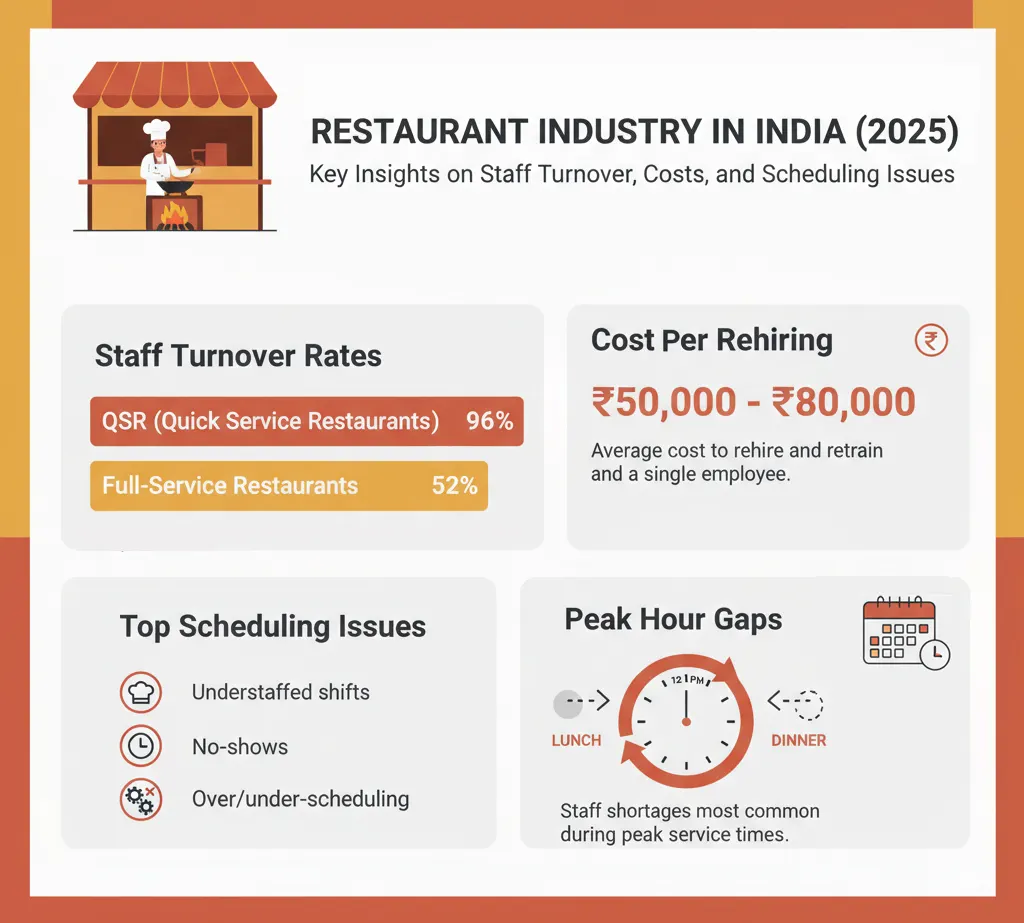
In 2026, full-service restaurants face 75-100% turnover, while quick-service hits over 130%. Another recent report shows 26% average turnover at full-service spots, but broader data indicates that it pegs it at 75% industry-wide. The soaring turnover rate in the hospitality sector is costing restaurants in rehiring and training. On average, it costs them $5,000-$10,000 per employee. Poor employee scheduling was cited as a key reason for their decision to leave by 30% of workers.
Why Do Restaurants in India Face Constant Staffing Challenges?
An analysis of 63,000 restaurant managers shows that most scheduling disasters in India’s restaurant industry come down to three things: not enough staff during peak hours (seen in 40% of shifts), constant turnover causing no-shows (in about 25% of schedules), and logistical slip-ups like overtime violations. It is believed that 67% of managers spend over 6 hours weekly on staff scheduling. Some leading factors fuelling scheduling conflicts are booking unavailable staff (30% incidence), last-minute cancellations (20%), and no-shows (15%).
Scheduling Challenges in the Restaurant Sector and Impact
| Challenge | Description (Restaurant Context) | Prevalence/Stat | Impact on Operations |
|---|---|---|---|
| Insufficient Coverage | Failing to staff peak times like dinner rushes due to availability conflicts | 40% of shifts affected (7shifts data) | Service delays, a 20% drop in table turnover, and increased customer complaints |
| No-Call No-Shows | Employees absent without notice, common in high-turnover QSRs | 15-25% of scheduled shifts (Toast/7shifts) | Immediate understaffing, overtime costs up 10-15%, and team burnout |
| Over/Under-Scheduling | Misaligning staff with demand forecasts, e.g., overstaffing slow lunches | 67% managers >6 hrs/week manual scheduling (Metrobi) | Labour costs exceed 30% of sales, wasted wages $2,000+/month per location |
| Poor Communication | Delayed shift changes via texts/emails in multi-location chains | 81% workers value open comm (7shifts) | Morale dips, 30% turnover linked to schedule dissatisfaction |
| Compliance Violations | Ignoring rest breaks or predictive scheduling laws in states like CA | Common in 47% operators facing labour issues (Crisp) | Fines up to $1,000 per violation, legal risks |
How Does a Shift Scheduling App Benefit the Restaurant Sector?
A dedicated shift work schedule app for the restaurant sector has the potential to revolutionise operations by taking employee management to the optimal level of efficiency. Here’s how they make profitability possible in a high-turnover restaurant industry.
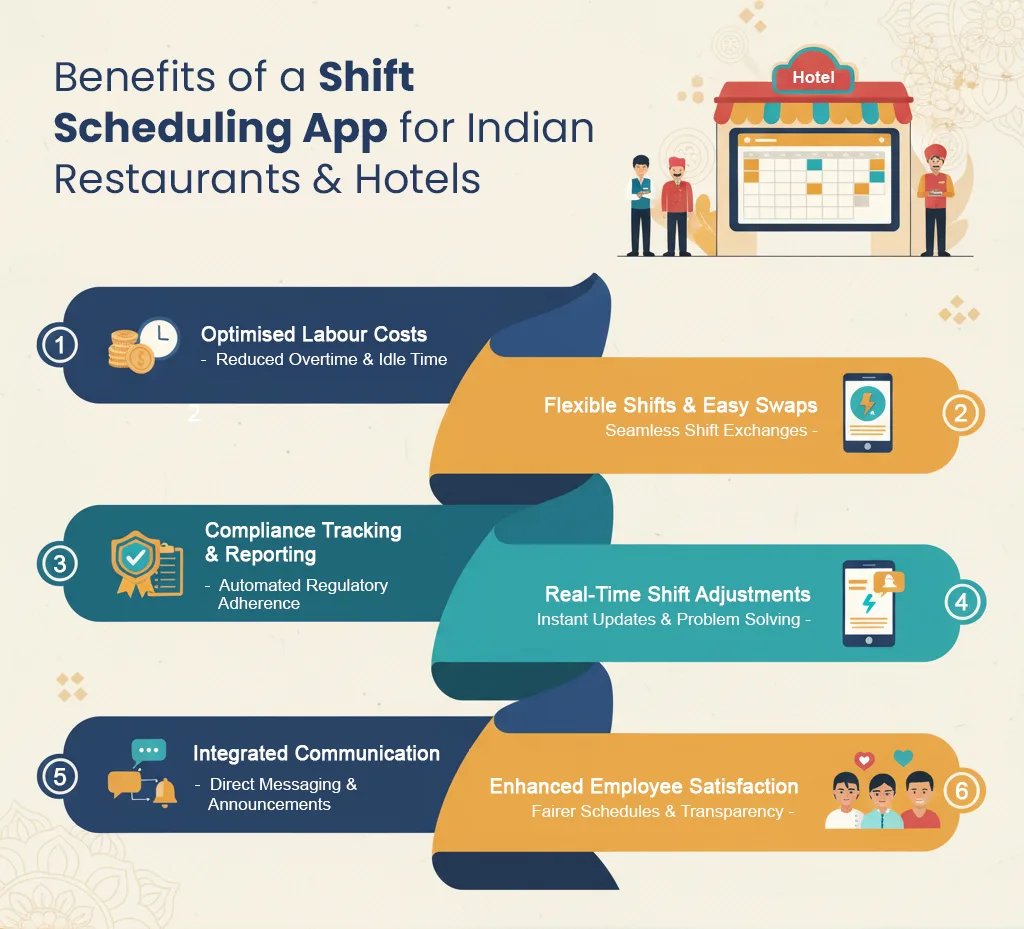
Optimised Labour Cost Control
Restaurants often have to let their employees work overtime to meet daily operational needs, which is indeed an additional expense. Precise shift planning can, however, make this extra cost under control. A sophisticated employee shift schedule app can allow the restaurant owners to forecast peak hours and allocate their staff wisely. Both overstaffing and understaffing can be easily prevented by this approach.

Enhanced Employee Satisfaction Levels
Staff enjoy flexible scheduling. Try letting your cooks and servers make requests for shift swaps through a simple feature in the staff scheduling software. You will see them enjoying the work far better than they used to do so far. Fair shift rotations remove the possibilities of employees experiencing burnout.
Tighter Compliance and Accurate Reporting
Labour laws in India, as outlined under the Shops and Establishments Act (which varies by state), mandate that restaurant staff work only within prescribed shift hours and receive proper overtime pay for any extra hours. The use of staff scheduling software helps ensure tighter compliance with this law and generates reports on breaks and accurate wages by hours effortlessly.
These systems can be customised to send alerts whenever scheduled hours and actual attendance don’t match, so HR can step in quickly and keep operations running legally, even with all the shifting rules and regulations.
Real-Time Shift Adjustments
If you face a last-minute no-show from servers or sudden rushes during lunch or dinner hours, you can instantly make shift adjustments with a smart shift scheduling app and its instant notification or alert capabilities.
For instance, managers can quickly reassign a line cook from prep to grill or move a server to the busiest section using the app. You can totally handle the situations with the flexibility it offers and keep orders moving, and prevent long wait times. You will have diners leaving your restaurant happy, even on unpredictable nights.
Integrated Communication Channels
Most shift scheduling apps are part of an integrated HRMS system. It means you will have built-in messaging features to broadcast updates about daily specials, menu changes, or unexpected closures straight to your entire team. Centralised communication keeps kitchen staff and servers on the same page, which directly translates to smoother service and better guest experiences.
Organised Front and Back Operations
An employee shift schedule app bridges the gap between front-of-house and back-of-house teams. You can coordinate timing so that kitchen staff align perfectly with floor coverage during peak hours. Your line cooks stay busy during slow periods and aren’t overwhelmed when the restaurant is fully booked.
The synchronised work times match up, which stops things from getting stuck, helps both groups work without issues, and makes sure every work period goes well from the start of the day until the end.
Smooth Payroll Integration
With a leading shift scheduling app like Mewurk, you can easily transfer shift data directly to an integrated payroll system, allowing monthly salaries to be processed automatically in the background. Consider the challenge of managing payroll for line chefs or servers with inconsistent attendance and shifting schedules. This is typically a major headache for payroll teams, but with integrated payroll, every schedule change becomes far less of a challenge.
Conclusion
Manual, error-prone scheduling costs Indian restaurants time, money, and staff. Can your restaurant afford to lose another employee to poor scheduling? The data clearly shows that a dedicated shift scheduling app can be your competitive advantage in India's booming food service sector. What’s the toughest staffing problem your restaurant faces right now? We’d love to hear your thoughts.
Frequently Asked Questions
How does a shift scheduling app directly impact customer experience in a restaurant?
You can strategically use your employee shift schedule app to ensure optimal staffing during peak hours and thereby reduce wait times and service delays. The top reasons for table turnover and customer dissatisfaction at Indian restaurants are slow service and unacceptable wait times before a staff member even attends to guests.
How can smart scheduling address the high turnover rate in the hotel and restaurant industry?
Fair rotations and easy shift swaps through a scheduling app help reduce dissatisfaction and burnout, which often drive employees to quit in Indian restaurants.
Does shift scheduling software ensure compliance with Indian labour laws?
Absolutely. The software can help you track shift hours, mandated breaks, and overtime per the Shops and Establishments Act. Whenever there are any discrepancies between scheduled and actual hours, it will send alerts to prevent legal issues.
Is a free shift scheduling app sufficient for my small Indian restaurant?
Free shift scheduling apps are often limited by features, the number of staff members you can add, or the number of days you can use them. However, if you want to try rota planning software at no cost and see whether it truly meets your needs, the best option is Mewurk’s shift management system. Its free trial lets you access all features for up to six months, and you can upgrade to the paid version only if you’re convinced.

Most Popular Post
Why Accurate Attendance and Leave Management Matters for Business Growth?
Read More →Why Accurate Attendance and Leave Management Matters for Business Growth?
How To Leverage Attendance Data For Better Workforce Management?
Read More →How To Leverage Attendance Data For Better Workforce Management?