Why Indian Businesses Are Choosing HR Software Companies in India Over Global Vendors
The global Human Resources Management System market continues to expand at remarkable rates and is projected to reach USD 44.28 billion by 2032, according to a report published by Verified Market Research. Within this explosive growth trajectory, an intriguing shift is reshaping how organisations approach their HR technology investments.
Companies in India, from ambitious startups to established enterprises, increasingly favour local HR software companies in India over internationally recognised platforms. More than simple cost considerations, it reveals something very strategic. The Indian clients are deeply concerned about compliance complexity, cultural nuance, and operational agility.
The India HR software market itself shows the highest compound annual growth rate in the Asia Pacific region through 2030, which signals that vendors specialising in this geography understand requirements that global platforms consistently underestimate. This blog outlines the key reasons Indian businesses now prefer HR software companies in India.
Why Do Businesses Prefer HR Software Companies in India with Local Expertise?
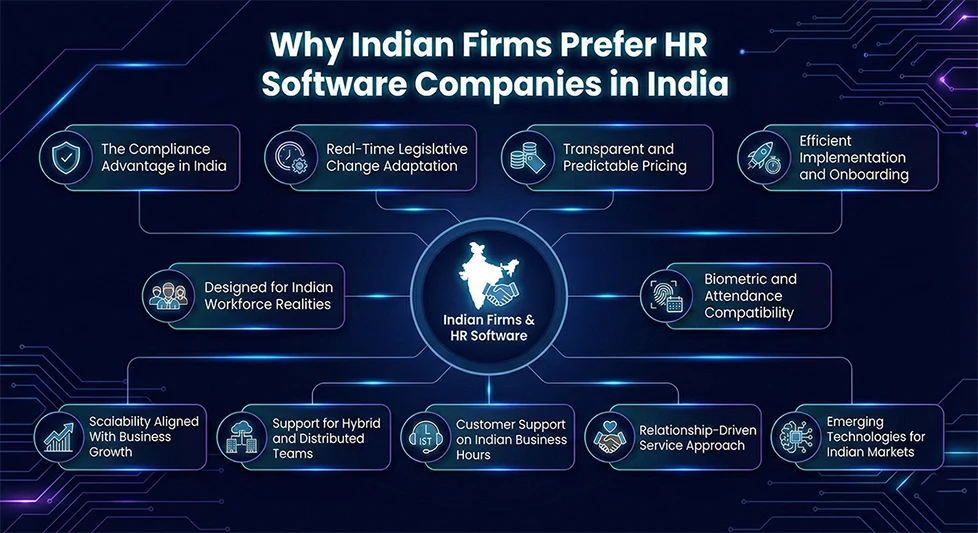
1. The Compliance Advantage
India's regulatory framework presents formidable challenges that generic international platforms struggle to address comprehensively. Payroll processing alone requires personalised handling of Provident Fund contributions, Employee State Insurance schemes, Professional Tax across different states, and Tax Deducted at Source calculations.
Leading HR software companies in India, like Mewurk, Keka, Zoho People, etc., build these statutory requirements directly into their core architecture rather than treating them as add-on integrations. Global vendors normally offer India compliance as an extension module. Consequently, whenever there are legislative changes that need to be implemented, updates lag behind by months.
2. Real-Time Adaptation to Legislative Changes
The labour law landscape in India evolves continuously, with state-specific amendments, judicial interpretations, and administrative circulars creating an environment requiring constant vigilance.
HR Software Companies in India distinguish themselves through their embedded understanding of how these changes ripple through payroll calculations, leave policies, and statutory reporting. Their development roadmaps prioritise regulatory alignment because their entire customer base operates under identical compliance obligations.
International platforms, serving dozens of countries simultaneously, must prioritise updates based on global revenue impact. Indian compliance modifications compete with European GDPR enhancements, American ACA reporting requirements, and Chinese social insurance updates. For organisations in Bangalore or Mumbai, this prioritisation methodology introduces unacceptable risk.
3. Transparent Pricing Model
Pricing models reveal another dimension where HR Software Companies in India deliver tangible advantages. Domestic platforms structure their fees around rupee-denominated per-employee-per-month models ranging from ₹40 to ₹150, with volume discounts activating at reasonable thresholds. For instance, startups with a headcount of 25 employees can access comprehensive HRMS solutions for just ₹1,499 monthly, with incremental costs remaining predictable as headcount grows.
Global vendors present pricing in dollars or euros. Sooner or later, currency conversion and exchange rate fluctuations begin to affect overall costs. Their per-employee costs might start, for instance, at $8-$15 monthly, which translates to ₹660-₹1,240 per employee before considering implementation fees, integration charges, and mandatorytraining costs. For a 500-employee organization, this pricing differential compounds into annual savings exceeding ₹30 lakhs when choosing local platforms.

4. Implementation and Onboarding Efficiency
Beyond subscription fees, the total cost of ownership encompasses implementation investments that global vendors structure differently than their Indian counterparts. For example, international platforms charge 50-100% of annual software expenditure for implementation alone, alongside separate fees for data migration, workflow configuration, and user training. These projects could stretch across quarters and consume both financial resources and internal team bandwidth.
HR Software Companies in India have refined implementation methodologies which they have designed specifically for the Indian market's urgency and budget consciousness. Many providers include standard implementation within subscription packages with guided setup that organisations complete within weeks.
Their customer success teams operate in Indian time zones, can communicate without linguistic barriers, and understand cultural expectations around responsiveness and relationship management. This kind of localised support infrastructure dramatically reduces the friction traditionally associated with enterprise software deployments.
5. Functionality Designed for Indian Workforce Realities
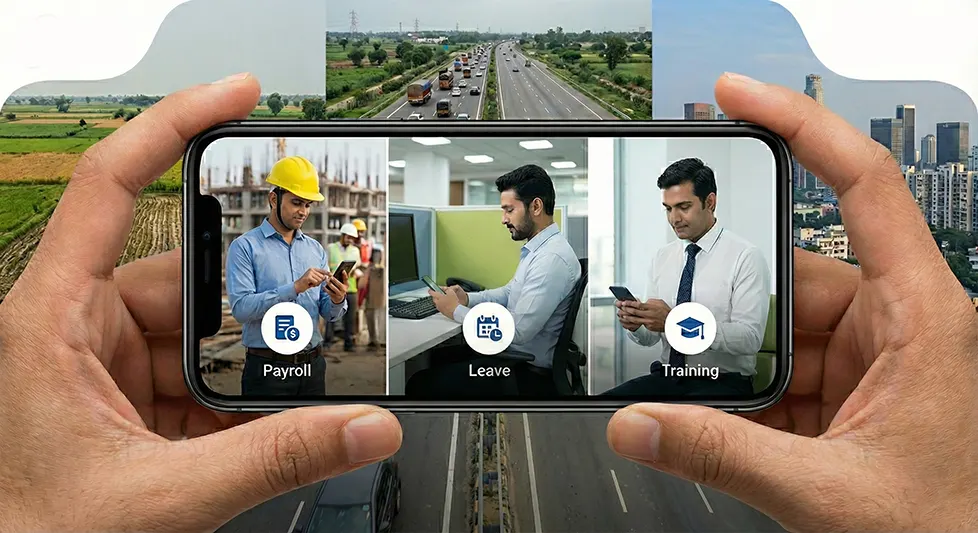
India's workforce demographics demand technology approaches that global vendors designing primarily for Western markets overlook. With smartphone penetration accelerating and desktop computer access remaining inconsistent across manufacturing facilities, retail locations, and field operations, mobile accessibility transcends convenience to become an operational necessity.
HR Software Companies in India build mobile-first platforms acknowledging that attendance marking, leave applications, and payslip access must function without interruptions on affordable Android devices. Reliable platforms like Mewurk incorporate geo-fencing for attendance verification, real-time data sync and alerts, and location tagging for field teams.
Global HRMS solutions, on the other hand, offer mobile apps as secondary interfaces, often optimised for executives to review dashboards rather than frontline employees to clock in from remote sites.
6. Biometric and Attendance System Compatibility
Physical attendance infrastructure across Indian enterprises relies on diverse technologies, from fingerprint scanners to facial recognition systems to RFID cards, with varying technical specifications. HR software companies in India maintain compatibility libraries supporting dozens of biometric device manufacturers common in the Indian market, alongside expertise in troubleshooting device communication protocols and handling network configurations specific to Indian IT environments.
International vendors approach attendance integration through standardised APIs, which indirectly places a burden on customers to ensure their existing hardware communicates properly. When compatibility issues arise, resolution requires coordinating between the device vendor, local IT teams, and the HRMS provider's international support, which can often lead to frustrating delays. Local platforms eliminate this complexity through tested device integrations and readily available local technical support familiar with common hardware deployments.
7. Scalability Aligned with Growth Trajectories
Growth-stage companies require software architectures accommodating evolving needs without forcing wholesale platform migrations. HR Software Companies in India structure their solutions around modular frameworks where organisations initially implement core HR and payroll functionality, subsequently adding recruitment modules, performance management systems, learning platforms, and advanced analytics as requirements mature and budgets expand.
This composability prevents the overbuying trap where global vendors push comprehensive enterprise suites with numerous features that organisations won't utilise for years. Local platforms further align their pricing with actual module activation, so as to allow companies to pay only for the capabilities they are actively using rather than amortising costs across unused functionality. As startups transition into mid-market organisations and eventually enterprise scale, their HRMS investments scale proportionately without necessitating expensive platform replacements.
8. Supporting Hybrid and Distributed Team Models
The pandemic permanently transformed workforce distribution patterns, with Indian organisations now managing combinations of office-based employees, remote workers, field staff, and contingent labour. HR Software Companies in India have adapted their platforms specifically for these hybrid realities. They are incorporating features like shift scheduling for manufacturing facilities, remote attendance verification for work-from-home employees, and contractor management for gig workers within their unified platforms.
Since several of the leading global vendors we are familiar with have designed their core architectures before distributed work became mainstream, the remote work features show clear limits at scale. For instance, user experience inconsistencies and administrative complications when policies differ across worker categories. Domestic providers built hybrid workforce management into their fundamental design, acknowledging that Indian enterprises routinely manage diverse employment types requiring differentiated treatment within single HRMS platforms.
9. Customer Support That Operates on Indian Time
Technical support becomes critically important during payroll processing windows, statutory filing deadlines, and system configuration challenges. HR Software Companies in India staff their support teams in Indian time zones. When Bangalore-based HR managers encounter issues at 9 PM during month-end close, they could reach knowledgeable support engineers immediately without submitting tickets queued for teams in San Francisco or Dublin, who might begin their workday hours later.
Beyond temporal alignment, linguistic and cultural fluency further accelerates problem resolution. Since the support conversations occur without accent barriers, using terminology familiar to Indian HR professionals and referencing regulatory contexts that both parties understand implicitly, issues get resolved faster with fewer clarifications.
Although global HR software vendors increasingly staff support centres in India, these teams support worldwide customer bases and may lack deep specialisation in India-specific compliance nuances that local vendor support engineers possess inherently.
10. Relationship-Driven Service Models

Indian business culture values relationship continuity and personalised service delivery differently than transactional support ticket systems common with international software vendors.
HR Software Companies in India assign dedicated account managers who develop institutional knowledge about specific customer environments, understand organisational growth trajectories, and proactively suggest configuration optimisations based on their intimate familiarity with the client operations.
This relationship model contrasts sharply with global vendors' tiered support structures, where customers interact with rotating support representatives, escalate through multiple levels for complex issues, and rarely receive proactive guidance.
For HR leaders managing software investments significant to their organisations, the assurance of knowing they can reach a familiar support partner who understands their context provides value extending beyond technical problem resolution.
11. Emerging Technologies Adapted for Indian Markets
Artificial intelligence capabilities increasingly differentiate modern HRMS platforms, but effective AI implementation requires training data reflecting the workforce patterns and regulatory environments where algorithms will operate. HR Software Companies in India, like Mewurk, have developed their AI features using datasets from Indian enterprises. Their screening algorithms understand Indian workforce behaviour patterns, and chatbot interfaces handle queries specific to Indian statutory benefits.
Global platforms train their AI systems primarily on Western workforce data, which might introduce biases and reduce accuracy when applied to Indian contexts.
Conclusion
The ascendance of HR Software Companies in India within their home market reflects neither protectionism nor short-term cost arbitrage. Rather, it demonstrates how software serving specialised regulatory, cultural, and operational contexts requires purpose-built solutions from vendors possessing intimate domain expertise.
Global platforms excel at delivering standardised functionality across numerous countries, but this breadth compromises depth in any single geography. For organisations where Indian operations constitute their primary or entire footprint, platforms optimised specifically for Indian compliance complexity, workforce demographics, integration ecosystems, and business practices deliver superior outcomes.

Frequently Asked Questions
1. Are HR Software Companies in India as secure as global vendors?
Absolutely. Security concerns about local providers have proved unfounded. Leading HR Software Companies in India maintain ISO 27001 certifications, implement bank-grade encryption, achieve SOC2 compliance, and host data in Indian data centres subject to stringent data protection regulations. Today, an increasing number of organisations prefer domestic hosting for data sovereignty and faster application performance.
2. Can Indian HR software handle multi-country operations if we expand globally?
Many HR Software Companies in India now support multi-country payroll and compliance, particularly for companies expanding within the Asia Pacific. However, organisations planning significant operations across numerous geographies may eventually require global platforms.
The ideal approach involves starting with local solutions for Indian operations while evaluating integration capabilities with international systems if global expansion materialises.
3. Do Indian HR platforms integrate with global enterprise systems like SAP or Oracle?
Yes, established HR Software Companies in India provide API connections and pre-built integrations with major ERP systems, including SAP, Oracle, and Microsoft Dynamics. Integration capabilities vary by vendor, so you should specifically verify connectivity requirements during evaluation processes.
4. What is the typical implementation timeline for Indian HRMS solutions?
Standard implementations with HR Software Companies in India usually complete within 1 to 2 weeks for mid-sized organisations, significantly faster than global platforms, which require a couple of months. This efficiency stems from pre-configured templates aligned with common Indian business practices and experienced implementation teams handling numerous similar deployments.
5. How do Indian HR software vendors handle product updates and feature releases?
Reputable HR Software vendors in India follow regular release cycles. They might deploy updates monthly or quarterly. Cloud-based platforms automatically receive updates without customer intervention.
Leading vendors maintain transparent product roadmaps and always put customer feedback into their development priorities. They would communicate upcoming changes through customer advisory councils and release notes. Their update velocity exceeds global vendors for India-specific compliance and feature enhancements.

Most Popular Post
Why Accurate Attendance and Leave Management Matters for Business Growth?
Read More →Why Accurate Attendance and Leave Management Matters for Business Growth?
How To Leverage Attendance Data For Better Workforce Management?
Read More →How To Leverage Attendance Data For Better Workforce Management?