Why Geofencing Attendance Is the New Standard for Field Teams
A project manager once told me about an incident that was both amusing and annoying. His crew was supposed to start work at a construction site by 8 a.m. sharp. By 8:10, the site was still empty. But when he checked the attendance logs, it showed half of the employees as clocked in. Within minutes, they all arrived. Some had marked attendance while on the way, and others from the tea stall down the street.
It doesn’t look like a catastrophic workplace loophole. But the very habit or temptation to log in from the wrong place can chip away at a workplace’s push for punctuality, fairness, and accountability. For anyone running a field site, it’s a daily frustration, though. Geofencing attendance offers a clear solution to this challenge.
Read on to discover why geofencing is fast becoming the new standard in attendance management today, especially for industries that run on field teams.
What Is Geofencing Attendance?
Geofencing attendance is a location-based technology that uses virtual perimeters known as geofences to track employees’ clocking in and clocking out at designated work zones. Instead of relying on manual timesheets or physical punch cards, here, employees can do their clocking in/out using the geofencing attendance app on their mobile phones.
- GPS builds the boundary for the job site
- An employee’s mobile attendance app detects entry/exit
- Attendance records get logged instantly in the backend
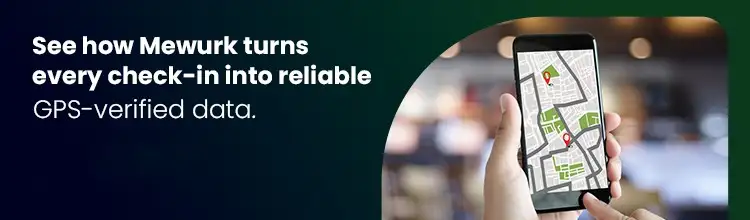
The geofencing time and attendance feature makes it particularly powerful for field teams who work across multiple job sites or remote locations. While it means reliable attendance data for the managers/supervisors, it means fewer steps and zero confusion about how their hours are being counted for the employees.
How Geofencing Attendance Works for Field Teams?

If you’ve ever tried to manage a crew across multiple sites, you know the usual set of troubles that are likely to happen. There will always be someone who forgets to sign the register or another who comes late but still enters “on time.” If any records don’t tally, the challenge and struggle of reconciling them falls on your shoulders. Geofencing solves field staff management challenges by making attendance automatic and location-tied. Here’s how it works in practice:
Core Technology Behind Geofencing
At its core, geofencing relies on GPS, Wi-Fi signals, or cellular data to create invisible boundaries around a worksite. When an employee carrying a registered mobile device clocks in, the system checks their location. If they are inside the boundary, the entry is valid; if not, it’s flagged for review.
The Workflow Behind Location-Verified Geofencing Attendance
- Define your job sites. Managers will first set up virtual geofences around specific work zones.
- Equip employees with the mobile app. Workers use a simple app that connects their location data to the system.
- Location-verified clock-in/out. Employees mark their attendance in the app, and the system verifies whether they are inside the geofenced zone.
- Real-time data sync. Attendance records are updated instantly on the system and will be available for managers to see who is in or out right away.
Integration with Other Tools
Modern geofencing attendance platforms are equipped to connect with other HR modules, as they come as part of a broader HR suite bundled with payroll, leave, and analytics. This integration is the real turning point in workforce management. By linking these systems together, payroll errors can be brought to zero and solving attendance disputes becomes much easier as there are mutually verified records in place.
How Do Geofencing Services in Attendance Management Prevent Time Fraud?
Geofencing relies on each employee’s smartphone app to confirm attendance. The app can only turn on if the GPS feature is enabled, which in turn ties the person to their location. Only the person present at the site can record their time by marking attendance through the app. This setup removes the chance of mix-ups or accidental misreporting while keeping records accurate and reliable.
Key Benefits of Geofencing Attendance for Field Teams
If you're a manager or supervisor who has managed field staff attendance using timesheets, outdated punch clocks, or any other traditional method, you don't need a briefing on the seemingly minor leaks that gradually add up. It could be a late sign-in, a case of buddy punching, or just a shift logged under the wrong time. Geofencing attendance plugs those leaks while offering a series of new advantages that traditional systems can't match.
Fair and Accurate Attendance Records
When you have geofencing services enabled for your employees’ attendance, every check-in is tied to their location. That means there will not be any room for mix-ups or incorrect data. The system will track and record accurate data that both employees and managers can trust.
Clear Visibility for Managers
Using geofencing for time and attendance gives supervisors a live look at their team's status on any job site. Knowing the exact headcount lets them instantly reallocate tasks, which cuts down on wasted time and keeps projects moving forward.
Cost Savings and Payroll Efficiency
Because attendance is verified through geofencing, logged hours reflect actual time on-site. Correct billing hours reduce admin workload, leaving no room for disputes between employees and managers regarding hours worked. And since there are no overpayments, the result is even greater cost savings.
A Safer, Compliant Workplace
Geofencing attendance lets managers monitor restricted areas, verify site presence, and verify compliance with various regionally specific labour laws and safety protocols.
Better Employee Accountability
Discrepancies like time theft happen as a result of available loopholes in workforce management. If there are transparent location-tied attendance management protocols in place, it will leave no chance for anyone to leave work early or come late just for the sheer temptation of doing it.
Benefits vs. Challenges of Geofencing Attendance for Field Teams
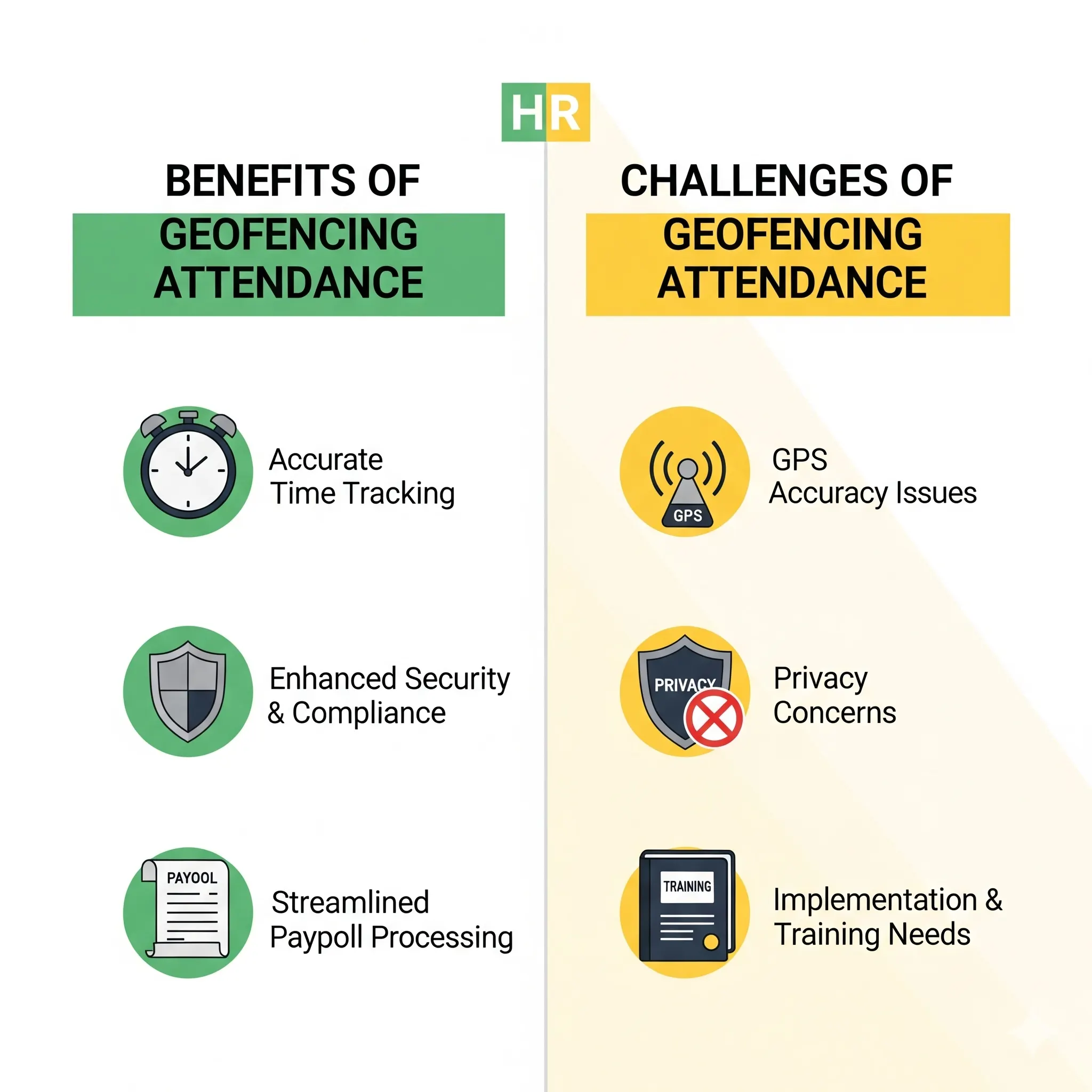
| Aspect | Benefits (Geofencing) | Challenges (Considerations) |
|---|---|---|
| Accuracy | High, GPS-tied records | May depend on mobile signal/GPS |
| Time Theft Prevention | Eliminates buddy punching, fake check-ins | Employees may worry about privacy |
| Cost | Low ongoing costs, no hardware required | Initial software purchase and setup investment |
| Management Visibility | Real-time insights into workforce location | Needs employee training |
| Compliance | Stronger labour laws and safety adherence | Must balance tracking with trust |

Real-World Case Studies and Success Stories
The choice of technology, like a geofencing attendance app, only matters if it works in unpredictable job sites, service calls, and remote operations. Geofencing attendance has already proven its value across industries where field teams are the pillar of operations. Let’s look at some real-world examples of its impact.

Case Study 1: How Geofencing Fixed Payroll Losses for a Delhi-Based Construction Firm
A mid-sized construction firm in Delhi was reporting 8 to 10% of payroll loss due to incorrect timesheets and late but logged ‘on-time’ arrivals. After they learned about the benefits of location-tied attendance tracking, they adopted it. The following month’s result was a quick reversal from what used to be the case previously. The setup meant that employees could clock in only after entering the job site.
Case Study 2: Smarter Field Service Management with Geofencing
A mid-sized cable and broadband provider managing installation crews across multiple districts in Gujarat used to rely on phone-in check-ins (workers had to call their supervisor to confirm they had reached the site). Missed calls and fudged timings were a regular thing the company had to deal with.
After switching to geofencing attendance, their crews could log in correctly once they reached assigned locations. Dispatchers saved a lot of time on tracking and could send the right person faster, since they always knew which crew was nearest to the next job.
Case Study 3: How Geofencing Helped Remote Teams Work Better
For a renewable energy company overseeing solar panel maintenance in the rural areas of Maharashtra, geofencing meant knowing with certainty that their technicians reached sites on time. The integration of this smarter attendance tracking mechanism could slash their administrative overhead by 40%. Managers didn’t need to cross-check travel logs with attendance sheets since geofencing kept them in sync. Employees appreciated the fact that their work hours were now verified objectively.
These cases reflect a broader trend. Though the primary reason for industries with field-heavy operations to adopt geofencing is more transparency and accuracy, it creates a ripple effect and leads to tighter schedules, faster billing, and fewer disputes between managers and employees.
Implementation Tips for Adopting Geofencing Time and Attendance
Rolling out geofencing attendance is quite like weaving a new habit into the way field teams work. But since it is an enforced habit, it takes deliberate practice before it can settle in. And to make the process smoother and more sustainable, the steps below will guide you.
1. Choose the Right Software
When you choose an attendance management software or app with geofencing services, what matters the most is how practical they are. The best system for field teams is one that:
- Integrates smoothly with HRMS and payroll.
- Scales easily as sites or crews grow.
- Is simple enough that employees don’t need multiple training sessions to get started using it.
2. Address Privacy Concerns Upfront
Employees who learn about geofencing attendance for the first time may feel like it is a surveillance on them. Don’t let such misconceptions brew in their thoughts. Educate them about the purpose and address their privacy concerns. The system is basically there to track their entry and exit at work zones. It won’t watch them over their every move. Conveying this very truth is essential to bring transparency and build their trust.
3. Begin small before going all in
Don't roll it out everywhere at once. Run a pilot program at one or two locations to work out any problems and get feedback.
Run a pilot program at one or two locations to work out any problems and get feedback. Once the teams see that the system is fair and effective, it will be easier to expand to all other sites.
4. Train Instead of Passing on Rules
Sending one email with a PDF guide and expecting adoption from your team is unrealistic. When you roll out a critical change like geofencing time and attendance, change management has to be intentional.
Even if the system is simple, take time to walk employees through it. A 15-minute demo with a good walkthrough would be enough to save weeks of resistance.
5. Budget for Setup, Save on Oversight
Don’t see the whole thing of implementing a geofencing time and attendance system as another expense. Rather, see it as a tool that can effectively plug all the leaks in your payroll bucket.
True that there is an initial investment. But compare that to what you will lose every month in time theft, payroll disputes, and administrative hours.
Concluding thoughts
In the end, geofencing is more than putting a virtual fence around your job site. It is building a better, fairer system for everyone by replacing uncertainty with certainty, disputes with data, and frustration with peace of mind.
So, if you are tired of the old excuses and ready to run a tighter, more transparent operation for your field team, geofencing is your next step.
FAQs on Geofencing Attendance
What is geofencing attendance?
Geofencing attendance is a location-based system that uses virtual boundaries (via GPS, Wi-Fi, or cellular data) to automatically record when employees enter or leave a designated work area.
What is the purpose of geofencing?
The purpose of geofencing is to link actions to specific locations. In workforce management, it’s used to keep track of employees’ attendance behaviour and rule out any room for time theft. Most importantly, having accurate attendance records helps improve payroll accuracy.
What is geo-tagging attendance?
Geo-tagging attendance records the exact location where an employee clocks in or out, in addition to the timestamp. It is used in a mobile geofencing attendance app for field staff to verify their presence at the correct job site.
Is geofencing legal in India?
Yes, geofencing is legal in India when used for legitimate business purposes like attendance and workforce management. However, companies must be transparent with employees about how their data is collected, used, and protected to stay compliant with data privacy regulations.

Most Popular Post
Why Accurate Attendance and Leave Management Matters for Business Growth?
Read More →Why Accurate Attendance and Leave Management Matters for Business Growth?
How To Leverage Attendance Data For Better Workforce Management?
Read More →How To Leverage Attendance Data For Better Workforce Management?