Why Companies Prefer Attendance Management System Using Face Recognition in 2026
Indian businesses know the cost of inefficiencies in workplaces from poor workforce management all too well. Issues like time theft, manual registers, and outdated biometric devices quietly erode productivity. In fact, reports show workplace disengagement and attendance manipulation are costing companies billions worldwide. In India, where companies manage quite large workforces, multi-shift operations, and hybrid setups, the demand for smarter solutions is very clear.
As we go further into 2026, organisations are rethinking how they manage attendance. The shift is toward an attendance management system using face recognition. Touchless, fast, and precise, it suits the scale and complexity of Indian workplaces. In this blog, we’ll unpack why companies are moving in this direction, highlight real examples, and discuss both the benefits and challenges.
The Rise of the Attendance Management System Using Face Recognition
According to a report published in Statista, the facial recognition market is projected to hit US$5.73 billion in 2026. Within this, attendance management software powered by AI is expanding rapidly. The global market, attendance included, will grow from $6.94 billion in 2024 to $7.88 billion in 2026 at a CAGR of 13.5% (The Business Research Company).
In India, the adoption curve is steep. Companies that once relied on fingerprint machines or ID cards now face challenges with hygiene, data accuracy, and fraud. Younger employees are already comfortable with biometric authentication, and that acceptance is translating into workplaces adopting online attendance management systems.
Still, risks exist. Gartner predicts that by 2026, more than 30% of enterprises may question biometrics in isolation due to deepfake concerns.
The push, however, is unstoppable. COVID accelerated India’s reliance on cloud based attendance systems, especially in manufacturing hubs and IT parks where thousands of employees move daily. In 2026, face recognition is not limited to the confines of marking presence. It has started to play a central role in compliance, efficiency, and building workplace trust. Companies like Mewurk, with integrated AI-driven platforms, are enabling this shift at scale.
Benefits of Using Face Recognition in Attendance Management Systems
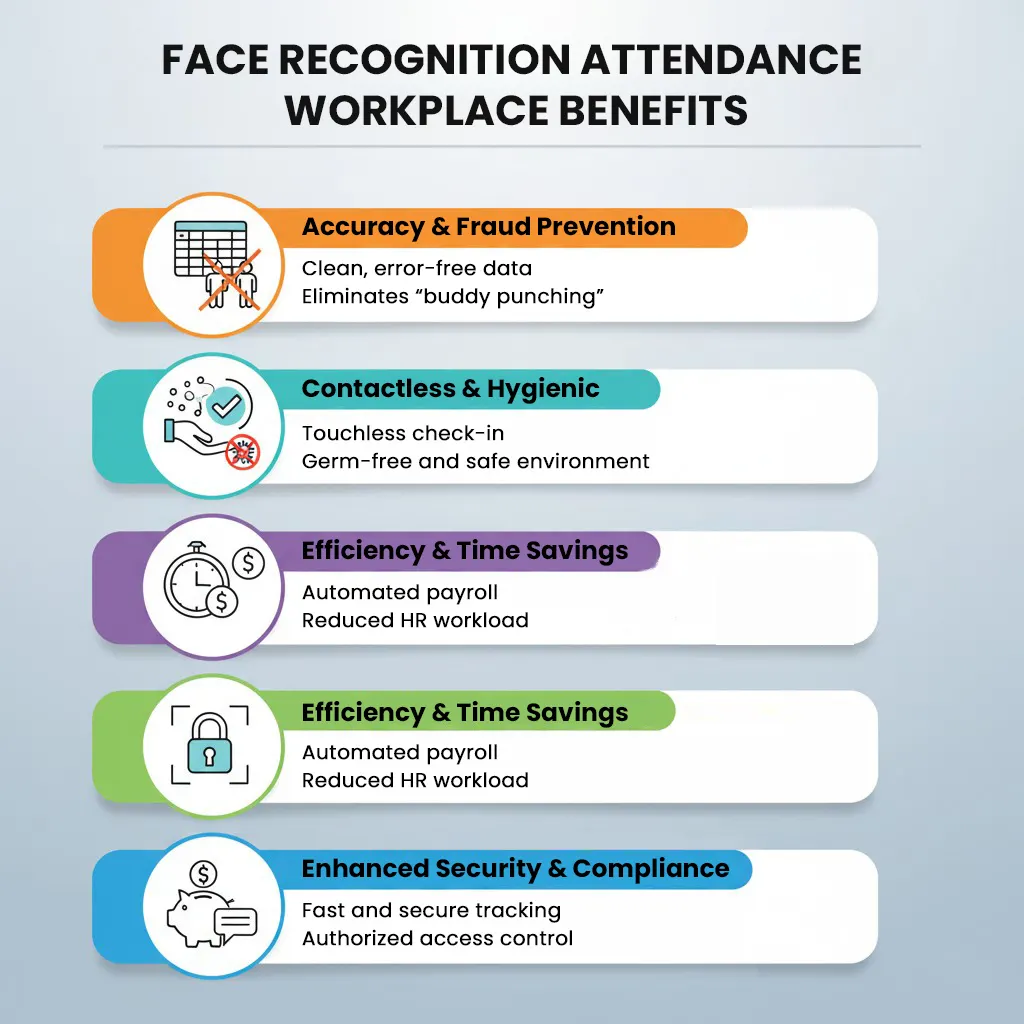
The integration of face recognition technology in attendance management systems has significantly improved the speed, accuracy, security, and safety of employee tracking. Let’s analyse some of the core benefits it promises.
Accuracy and Fraud Prevention
An attendance management system using face recognition achieves 97–99% accuracy. In companies where buddy punching and proxy attendance are common headaches, this level of accuracy brings measurable savings. Not only will there not be any errors from manual registers or fingerprint mismatches, but you'll also have cleaner, more reliable data for the records.
Contactless and Hygienic
For workplaces that handle high footfall, for instance, factories, hospitals, and retail outlets, touchless attendance systems are a sheer necessity. We experienced how vulnerable we were during the COVID-19 pandemic a few years ago due to the spread of germs through shared surfaces. Cloud-based attendance management systems using face recognition help maintain the stringent hygiene standards that you can count on.
Efficiency and Time Savings
Hundreds of small and mid-sized Indian businesses admit they unnecessarily waste time and resources on attendance reconciliation. Automated attendance management software can easily remove that friction. With it, the most noticeable difference becomes visible through payroll integration.
In payroll management, confusion often resulted from manually calculating employees’ overtime and unpaid leave. An online attendance management system is designed to track these variations in the normal attendance patterns accurately without letting HR bother and handle anything manually.
Enhanced Security and Compliance
Beyond verifying an employee’s punctuality in clocking in and clocking out, workforce tracking is tied directly to compliance with Indian labour laws and secure workplace access. No unauthorised entries can possibly happen with an attendance management system using face recognition.
Cost-Effectiveness
The upfront investment cost of installing a biometric face recognition attendance system is offset by reduced fraud, fewer disputes, and faster operations. Gradually, this will also start reflecting in the form of a decline in the admin overhead. This is because HR now does not require making tweaks in the attendance records for the sake of payroll reconciliations. For Indian SMEs especially, shifting to an online attendance management system means tighter control over costs.

Real-World Applications and Case Studies
Attendance management systems using face recognition have already become the norm in more than 60% of the IT companies in cities like Bangalore, Chennai, Mumbai, Ahmedabad and so on. Beyond enterprises, many colleges, universities, hospitals, government offices, and retail chains are piloting attendance management systems using face recognition to log attendance in a way that makes proxy punching nearly impossible.
In Gujarat’s manufacturing clusters, hundreds of factories have deployed facial recognition, and that has helped them see a significant decline in absenteeism and improvement in accountability across multiple shifts.
But the application of facial recognition tracking goes beyond workplaces and campuses. At massive gatherings like India’s Maha Kumbh Mela, AI-driven facial recognition has reportedly helped manage crowds at scale.
Mewurk is part of this momentum. We offer scalable, AI-powered attendance solutions equipped with advanced IoT-based face recognition biometrics. From startups to large organisations, our systems adapt to diverse needs and create measurable outcomes - fewer disputes, faster processes, and stronger trust in workforce data.
Overcoming Obstacles in Face Recognition Adoption
The adoption of an attendance management system by using face recognition technique is not without its hurdles. One of the primary obstacles is privacy and data security. As this technology relies on collecting and processing sensitive biometric data, there are concerns about how this information is stored, used, and protected from misuse.
The good news is that with a future-proof system like Mewurk HRMS, these concerns are fully addressed. Our system secures all biometric data through encryption and actively audits for compliance with data protection regulations. The data collected can be strictly restricted for limited access to authorised personnel.
Future Trends in Face Recognition
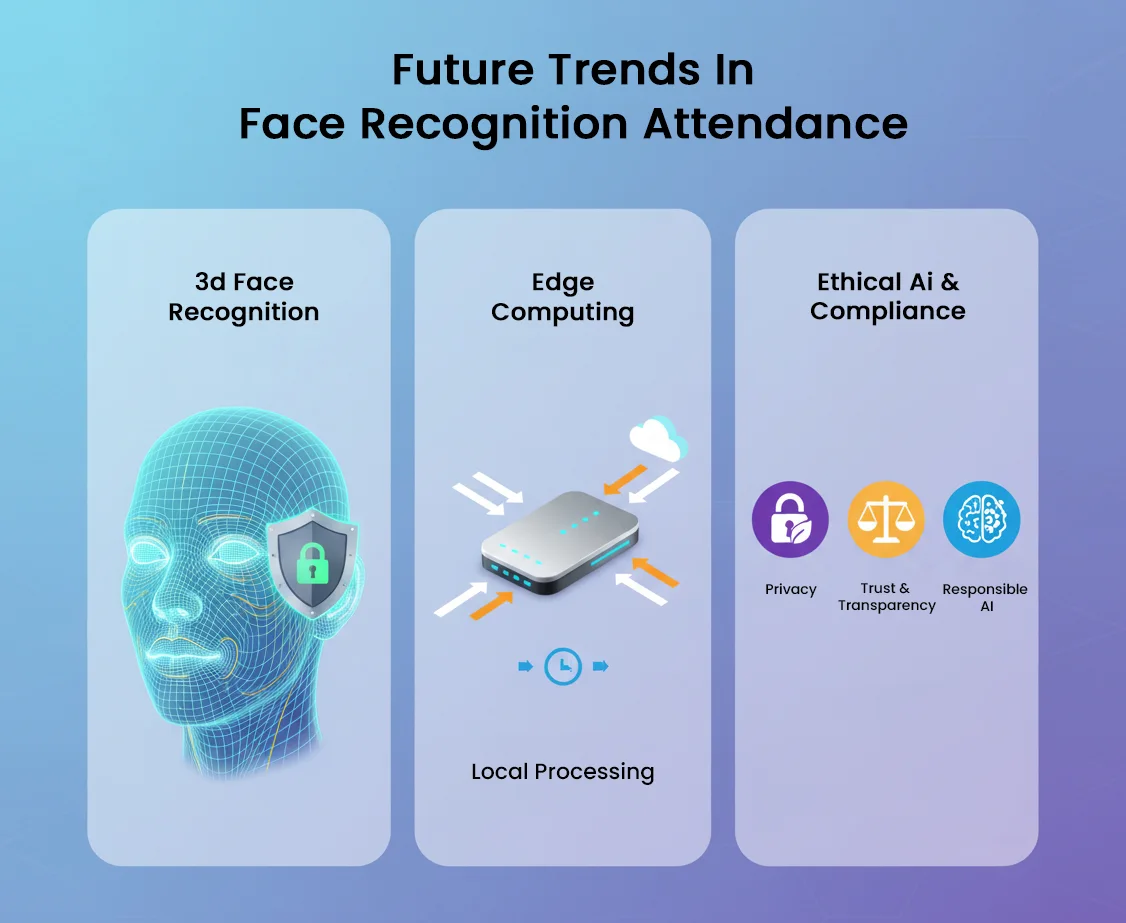
3C Face Recognition
The overall domain of attendance management system using face recognition is rapidly evolving, with several key trends shaping its future. 3D face recognition is one such technology that is gaining traction. The system offers enhanced accuracy and resistance to spoofing attacks by analysing the unique contours of a face.
Edge Computing
The integration of edge computing (processing data locally on devices before sending it to the cloud) would speed up the recognition process even further. We are also witnessing a shift towards ethical AI frameworks and stricter regulations in addressing privacy concerns and mitigating bias. Therefore, in the future, there is no doubt that there will be more responsible and equitable application of this powerful technology.
Conclusion
The advantages of an attendance management system using face recognition have turned out to be something very undeniable for Indian businesses today. Looking forward, cloud based attendance systems integrated with IoT will dominate the Indian market as accuracy, hygiene, compliance, and scalability are valued far more by companies than mere timekeeping.
For leaders looking to modernise HR, platforms like Mewurk deliver not just attendance tracking, but a complete workforce management solution built for the future.
FAQ
How secure is an attendance management system using face recognition?
It is safe if you choose a service provider that takes special attention to encrypting all biometric data and tiered access controls (restricting access to authorised personnel only). HRMS providers like Mewurk are known for their robust security measures and privacy-first approach.
Is face recognition-based attendance management software ideal for large, multi-shift workplaces?
Absolutely. Modern AI-driven cloud based attendance systems are designed to handle thousands of employees across multiple shifts. They can support fast, accurate check-ins besides facilitating integration with payroll.
Is the attendance management system using face recognition cost-effective for SMEs?
Yes, it is cost-effective in the long run, although initial installation costs exist. You will see the payoff on multiple fronts, like a steep decline in attendance errors, fewer disputes, faster payroll, and lower admin overheads. When all these are factored in, you can notice that the benefits quickly offset the price you initially have to pay. For small and medium enterprises, these systems are definitely affordable and scalable.
What happens if the system fails to recognise an employee’s face?
Most systems include fallback options, like manual check-in or ID verification. So if it fails to identify you after scanning your face, there are still options to clock in. With the Mewurk attendance management system using face recognition, you can have our AI models continuously learn from exceptions and thereby gradually develop improved recognition capabilities over time.

Most Popular Post

Why Accurate Attendance and Leave Management Matters for Business Growth?
Read More →Why Accurate Attendance and Leave Management Matters for Business Growth?
How To Leverage Attendance Data For Better Workforce Management?
Read More →How To Leverage Attendance Data For Better Workforce Management?