HR Software for Small Business: A 2026 Guide to Smarter HR Management
Small businesses don’t have the luxury of burning money on trial-and-error. Every rupee, every hour and every employee matters to them. That’s why, when it comes to HR, most small businesses stick to what feels cheaper for them, such as Excel sheets for payroll, notebooks for employee attendance, and SMS/Email or WhatsApp reminders for shift changes instead of investing in HR software for small businesses.
The biggest drains, however, on small businesses are not always obvious. Problems such as payroll errors, missing deadlines for important paperwork, and a decline in employee morale can quietly hinder a business's growth.
These issues may not appear as a clear expense on a balance sheet, but they still have a significant impact. In 2026, the small businesses that thrive won’t be the ones treating HR management as an unnecessary expenditure. They’ll be the ones who let HR software for small businesses handle the essential people management functions.
What Is HR Software for Small Businesses?
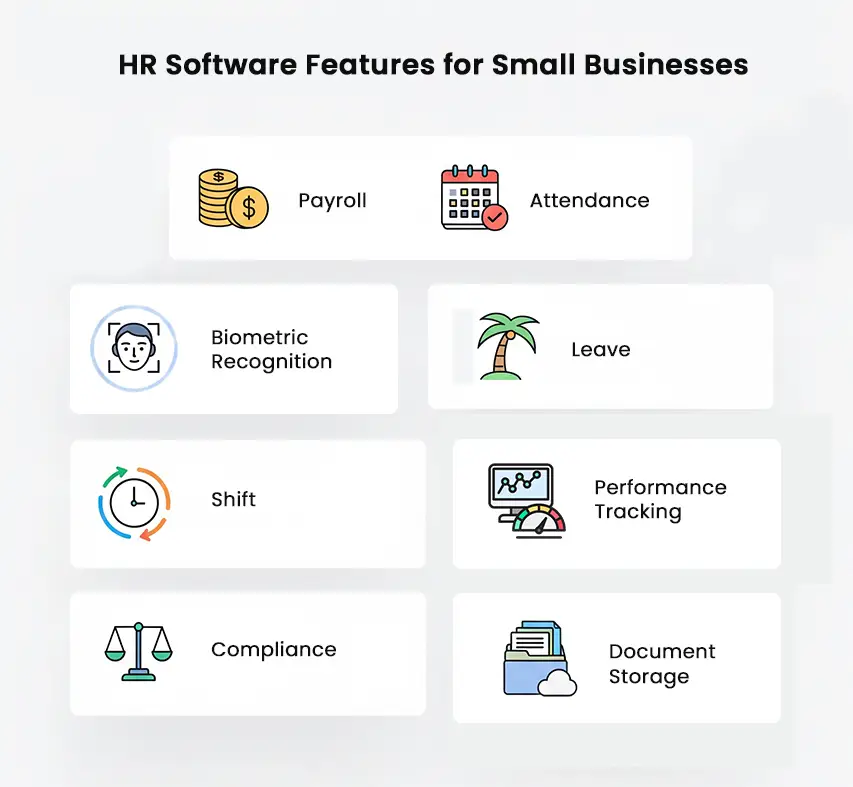
HR software for small businesses is a purpose-built suite of affordable HR tools for small and medium businesses that want to automate essential employee-related tasks in one place. An ideal people management software for small businesses should help you automate:
- Payroll processing
- Attendance tracking
- Leave management
- Compliance (TDS, PF, ESI, the whole alphabet soup)
- HR document storage
As far as small businesses are concerned, what they consider the highest priority in HR software solutions isn’t shiny dashboards or features with AI buzzwords. All they want is a simple system which they can afford and that does the work exactly the way they want it to. For instance, an assurance that the salaries are set to go out on time, deductions are accurate, and your team trusts you enough not to jump ship over sloppy HR practices.
HR & Payroll Automation: Why Small Businesses Hold Back vs. The Truth
| Common Excuse from Small Businesses | The Risk/Reality They Overlook |
|---|---|
| It’s too expensive. | Payroll errors and compliance fines can cost far more. Modern HR software packages for small businesses cost less than a monthly team lunch. |
| We only have 20 employees, so we don’t need it. | Even with 5+ employees, manually doing HR can eat up hours every week with guaranteed chances of mistakes. |
| HR software for small businesses sounds complicated; Excel works fine for us. | Cloud-based HR tools can be set up in hours. Sticking to old methods can cost you more time and leave your business exposed. |
| Implementation is complicated and time-consuming. | Modern cloud-based HR software systems are plug-and-play. The real complication is having to deal with errors, late salaries, and compliance penalties. |
How Does Doing HR Manually Drain Your Business?
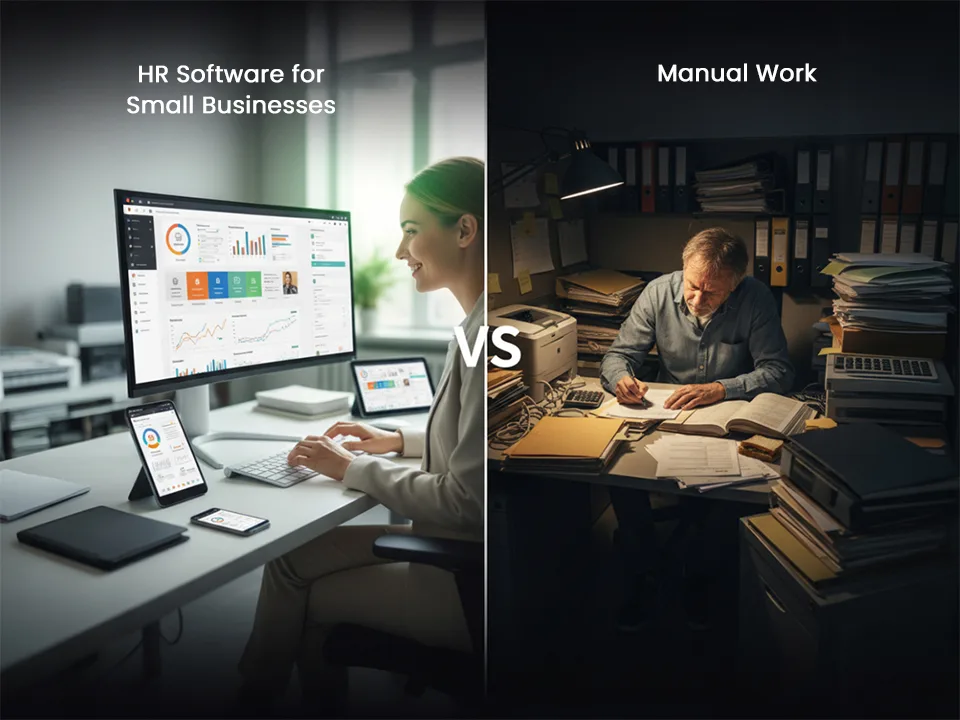
One of the biggest justifications companies give for not switching to HR tech for startups is that they are a small team, and investing in software is not worth it. But the real cost of doing it manually isn’t visible until they experience the difference of having the best HR software for small businesses. Here are some eye-opening figures to consider.
Compliance Fines
Missing PF or ESI filings incur hefty penalties even if you are a small business owner. Per India’s EPF & MP Act, late PF payments attract 12% annual interest plus 5-25% damages. For 20 employees at ₹15,000/month, a two-month delay can cost ₹4,320 (EPFO, 2023). ESI delays add 12% interest and up to ₹10,000 fines (ESIC, 2023).
Salary Errors
According to a 2025 report by People Managing People, manually processing payroll creates errors that cost 1-8% of payroll expenditure annually. For a ₹10 lakh monthly payroll, that’s ₹10,000–₹80,000 lost. Both underpayment and overpayment cost companies. While the former risks legal disputes, the latter is hard to recover.
Wasted Hours
Manual HR work, whether it is tracking attendance, updating leave records, or fixing payroll mistakes, can take 10–20 hours every month. For an HR professional earning ₹50,000 per month, that’s ₹2,500–₹5,000 lost to admin work.
Employee Turnover
Poor HR processes can lead to employee turnover, and replacing an employee can be expensive. For an employee making ₹6 lakh per year, rehiring costs can range from 50-60% to 90-200% of the salary, which can translate to ₹3 lakh to ₹12 lakh (SHRM 2024).
HR Software for Small and Medium Businesses: Latest Adoption Trends And Market Stats
As we enter the third quarter of the year, the most recent figures and market statistics show a positive trend in HR software adoption. In the tier one cities of India, more than 70% of the small businesses have already started to use HR automation tools. This shows a clear growth trajectory backed by the democratisation of payroll and hr software for small businesses by emerging brands like Mewurk.
The HR software market is $410B in 2025 and is on track to reach $740B by 2030. Small businesses will drive this growth by accounting for more than 80% of new sign-ups, reports Select software Reviews.
Among the SMBs that have switched to small business payroll software, 72% reported improved accuracy. Automation of tasks like tax calculations, timesheet processing, and compliance reporting, previously time-consuming and error-prone, made the biggest contribution to this measurable ROI.
By 2025, seven out of ten organisations are expected to rely on AI-driven HR tools, with the biggest focus on recruitment and employee engagement. But there’s a shift underway. 81% of these companies are moving toward skills-based hiring, with the aim of cutting down biases that traditional hiring methods carry.
As time passes, this adoption wave is only set to rise. Therefore, it is the right time for SMBs to invest in the best HR software for small businesses in India to stay competitive and future-ready.
How Does HR Software Deliver Value to Small Businesses?
Workforce management for small business looks different depending on the size of the team, the industry, and even how quickly the company is trying to grow. But the pain points are familiar. Payroll errors, compliance stress, admin overload, and employee disputes. HR software tackles these head-on. Here’s how:
Removes Payroll-related Challenges
For small businesses, payroll processing creates the biggest workplace headaches. Since HR software designed for these companies includes payroll as an essential feature, you get automated salary calculations, streamlined deduction management, accurate overtime tracking, simplified bonus administration, and complete payroll control.
Ensures Compliance Without Causing Panic
Laws centring around employee rights and regulations keep changing. The best HR and payroll software for small businesses does not let you fall behind. They update the rules automatically and make sure your filings are on time and accurate. Which means no penalties or stress.
Frees up time and protects your budget
Another great payoff is HR software for small businesses buys back time. Imagine reclaiming 10 hours a month from your HR admin. It is about 6% of their working hours. If they were earning 50,000 in a month, that is roughly 3,000 saved. That’s a huge return for just cutting admin work. The regained time you can spend on a variety of high-value tasks like team planning, client work, or strategy.
Builds Confidence in Leadership
Employees pay close attention to how their workplace is managed. From how leave requests are handled to how performance is reviewed. HR software for small businesses creates fairness and consistency across all these touchpoints. When people see decisions backed by clear data instead of bias, it naturally establishes trustworthiness and signals to employees that their leadership values transparency, accountability, and order. These are essential qualities that make them believe in the people leading the company.
Keeps Records Audit-Ready
Nothing rattles a small business more than a sudden audit request. Having to search through disorganised files can be both stressful and occasionally land you in unforeseen trouble. An HR software keeps all the necessary documents like payroll running history, attendance log, and compliance documents organised and accessible. You are prepared for anything and can provide information to auditors at a moment's notice.
Essential HR software features for SMEs
Small businesses don’t need enterprise-level employee management software with modules they are never going to use. What you need is lean and useful, such as:
- Payroll automation (with tax compliance built in)
- Attendance + leave tracking (biometric or mobile app)
- Shift scheduling (for teams that don’t work 9-to-5)
- Employee self-service (download payslips, apply for leave)
- Document management (keep HR files in one place)
That’s it. Everything else is fluff vendors tack on to dress up their product, justify bloated pricing, and confuse small businesses into paying for features they will rarely, if ever, use.
How To Choose the Right Online HR Software for Small Businesses?
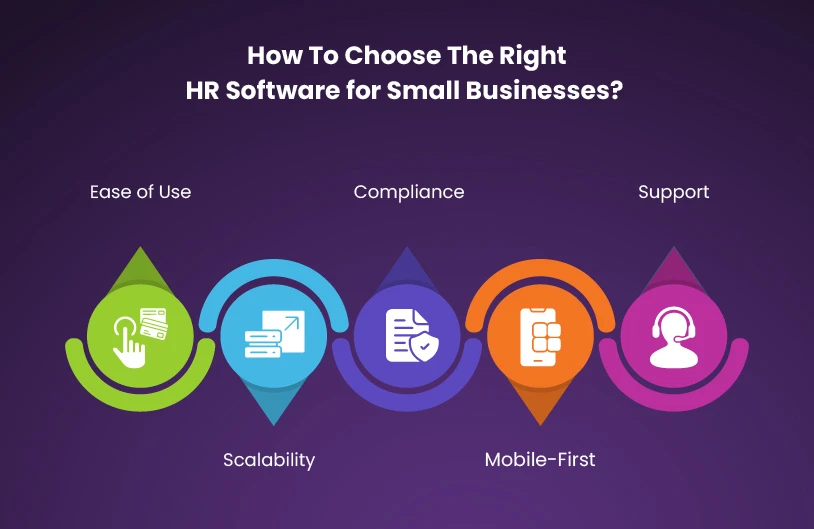
Don't get distracted by a bunch of fancy features you will never use when you are shopping for HR software. Instead, focus on these few areas:
- Ease of use: If your team can’t figure it out, it’s useless. The software should reduce complexity rather than adding another layer of confusion.
- Scalability: Today you’re 20 employees; tomorrow, maybe 50. The software should be scalable as you grow.
- Compliance updates: When there are changes in the laws or regulations, it must be easy for you to adjust the software accordingly.
- Mobile-first design: Your employees will use their phones more than desktops.
- Support: A vendor that disappears after onboarding adds little value. Ongoing guidance, timely assistance, and responsiveness matter just as much as the product itself.
HR Software in Action: JR Automation’s Story
One perfect example of how HR software for small businesses works in a real-world context is JR Automation Technology Pvt. Ltd., which adopted Mewurk to manage HR more effectively. Here’s how it impacted their operations.
Company: JR Automation Technology Pvt. Ltd.
Industry: Industrial Automation
The Challenge
As JR Automation grew from a small startup to an emerging brand of industrial automation, its managing HR tasks with spreadsheets and manual processes started breaking down. Payroll needed constant checks, attendance was messy, and handling approvals took more time than it should have. Tracking employees on field assignments was an added headache. The company needed a system that would make HR more accurate, organised, and less dependent on rework.
The Solution
JR Automation implemented Mewurk HRMS to centralise payroll, attendance, leave management, employee records, and approvals. The mobile app, with geotagging built in, allowed their managers to track in-and-out locations for field staff. Every process started to flow through a structured approval chain.
Anu Lata, HR Generalist at JR Automation, Explains:
“Managing HR tasks has become more organised and accurate since switching to Mewurk. I don’t have to look back and recheck things anymore, which saves a lot of time. Its automation and user-friendly interface have truly changed our HR operations. It’s easy for both employees and employers to use.”
For the leadership, too, the difference was just as clear.
Vishal Tejani, CEO of JR Automation, Says:
“Mewurk brought the entire employee management process online and made it smooth and easily accessible. The support has also been very good - whenever we wanted to understand a feature, we got immediate help. Implementation was smooth, and overall, our experience with Mewurk has been excellent in terms of employee management.”

Final Thoughts
Small businesses don't fail because they aren't ambitious. They fail because they don’t solve basic problems they could have easily avoided. Don't let your employee management be one of those problems. Choosing the right HR software for small businesses will keep your employee management under control, so your growth won’t be derailed by the basics.

Most Popular Post
Why Accurate Attendance and Leave Management Matters for Business Growth?
Read More →Why Accurate Attendance and Leave Management Matters for Business Growth?
How To Leverage Attendance Data For Better Workforce Management?
Read More →How To Leverage Attendance Data For Better Workforce Management?