How Cloud Based Document Management System Solves HR’s File Storage Challenges
If you work in HR, you know pretty well about the challenges of dealing with employee files or documents. You routinely get to deal with a huge pile of them. Onboarding packets, PAN and Aadhaar, the performance reviews, the confidential benefit claims, the list is long and diverse.
When anyone asks you where a file is, they assume you have an immediate answer. But very often, finding a single document feels like an archaeological dig that takes hours and causes you to lose track of what you were doing prior to that. What if the question of "where is that file" became as simple as a single search? This is the promise of a modern cloud based document management system.
Why the Old-Style File Management Is Not Feasible Today?
We often stick with familiar processes because switching to newer systems or processes makes us uncomfortable. It is quite true in the case of document management, too. But we don’t realise that the old ways come with a hidden and heavy price tag.
If you compare the physical space, time, risk and opportunity cost with the best cloud based document management system, you know the stark difference that exists between the two. Let's break down the challenges you might be encountering routinely without a great employee record management system.

Challenges of Physical File Storage
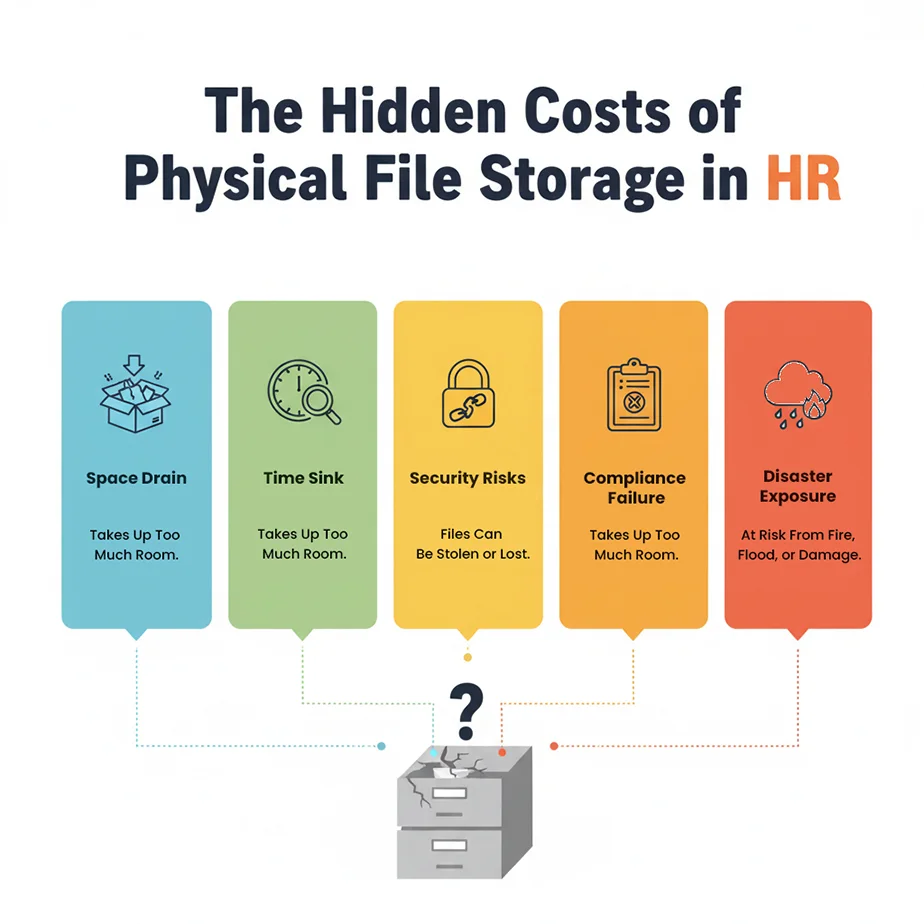
If you use physical file storage units to store employees' details, business records and other legal documents, they can take up a lot of room. Every new hire requires another inch of paper. The most challenging part comes with retrieving files. Basically, you have to dig through it yourself, and that can take a while.
If you use a cloud-based document management system, you don't have to search for files in person. You can find what you need in ten seconds on a computer or mobile phone instead of spending half a day looking, which saves space and time in your office.
Security and Compliance Concerns
We are so used to feeling so very safe with our important documents in a locked file cabinet. But is it really safe? The truth is, it's vulnerable to anyone with a key. Digital files on a shared drive are just as risky.
You can’t fully control access there. This is a compliance disaster for sensitive documents like contracts and medical records. Proper document management system solutions offer encrypted e-documentation and storage, audit trails, and permission-based access. What you saw as risky before is now completely secure.
Difficulties in Version Control
Is Employee_Handbook_v12_FINAL_REVISED.pdf really the latest version? When people save copies to their desktops or to multiple cloud services like Google Drive, Dropbox, or OneDrive, you end up with a confusing pile of conflicting documents.
You are very likely to encounter some employees acting on outdated policies as a result. A centralised online document management system will ensure that everyone is acting upon a single and the only relevant document when it comes to dealing with an important matter like office policy.
Impact of Inefficiency on Team Productivity
No one will disagree on the fact that HR’s core function is people and not paperwork. Every minute that HRs spend searching, filing, or recreating lost documents is a minute not spent on that core function. Initiatives. This is obviously a thing of inefficiency that could leave a tax on your department's potential. The best document management system tools can systematically and efficiently automate these tasks.
Risks to Business Continuity
Physical files are not safe in unforeseen incidents like a fire, flood, or even a minor leak. Any of these events can instantly destroy them. Even if you store the files digitally on your computer’s local document management system, there is no guarantee that they will be saved. Because a local server can fail at any time.
This is an existential risk you have to deal with unless you equip yourself with a more robust and reliable workaround like a cloud based document management system.
How a Cloud Based Document Management System Transforms HR Operations?
So, we have now discovered that the old way is fraught with so much friction. What does the new path look like? Adopting a cloud based document management system HR is a process of enabling a fundamentally more agile, secure, and strategic HR department. You are shifting from a cost-centric administrative function to a more promising value-centric strategic option. And the promises it brings are:
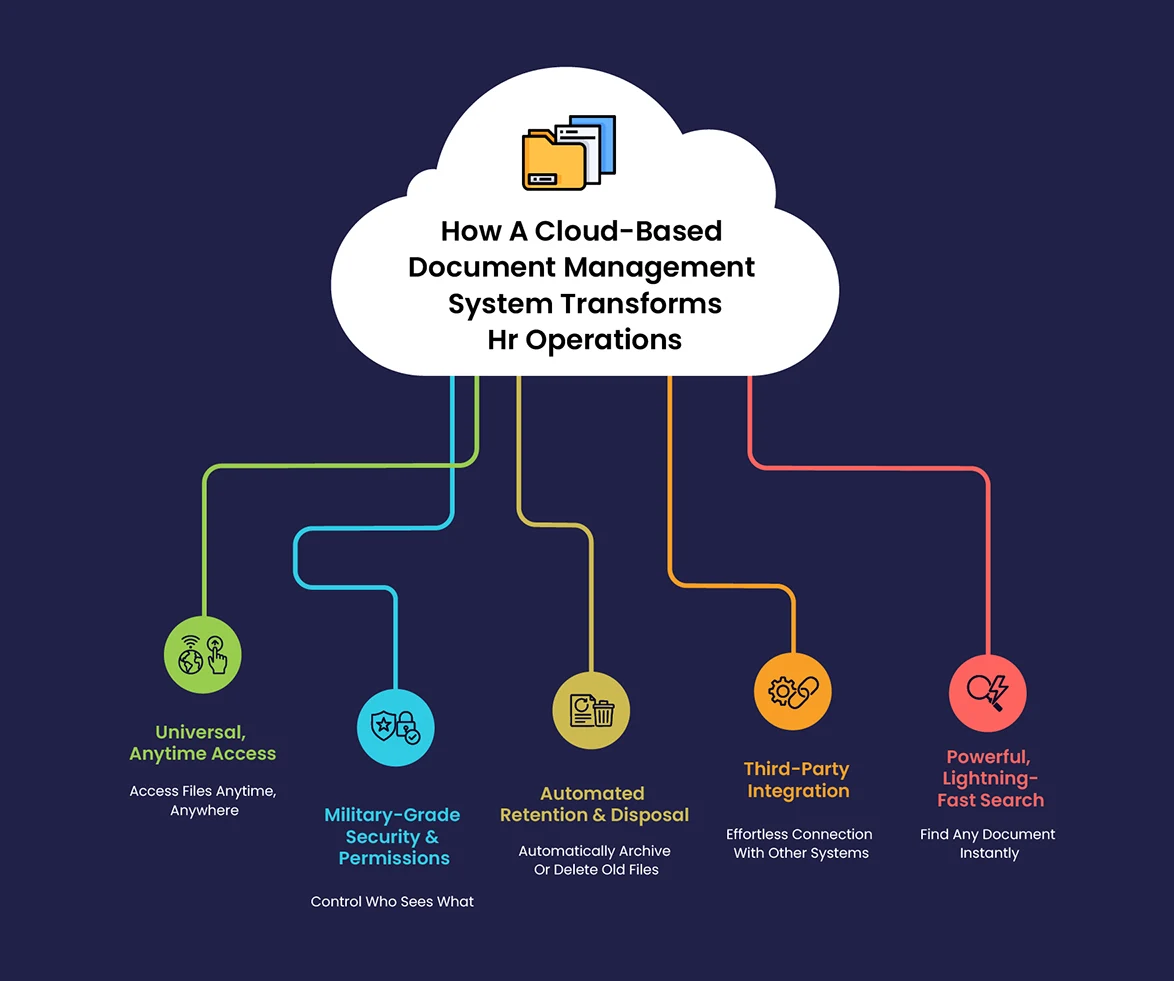
Universal, Anytime Access
Think about a situation where you need to verify the employment contract of a remote employee at 6 pm, just before the office winds up. It is the last day you need to submit this particular document for some audit or compliance. If you can’t get through to the employee right away, you will miss that important deadline.
Now, if you have already deployed a cloud based document management system, you would definitely have shared the employment contract with this particular employee via a certain path or access protocol. Every authorised user can access the files they need from any device, anywhere.
Military-Grade Security and Permissions
Unlike a shared drive, where access control is pretty blunt and all-or-nothing, a sophisticated HR document management system lets you set granular permissions. For instance, you may not want to let an intern see executive compensation details or share all folders with your payroll. The system ensures that each individual only sees the data they are expressly authorised to. The outcome is that both internal and external threats are completely curtailed.
Automated Retention and Disposal
One of the most powerful document management system tools is automated retention scheduling. You don't have to remember to shred old files. The system can be configured to flag or automatically archive/destroy/expire documents based on legal requirements (e.g., purging an I-9 after termination). This is a great feature as far as keeping your digital repository clean and compliance-friendly is concerned.
Third-Party Integration
The best cloud based document management system is one that integrates directly with your other platforms, rather than existing in a vacuum. Whether it's any other basic or in-house employee record management system, or a major platform like an SAP document management system. The integration doesn’t have to be API-level, but it should make importing and exporting documents in standard formats simple. A unified ecosystem will help eliminate data fragmentation and labour-intensive data entry.
Powerful, Lightning-Fast Search
This is the best document management system feature that changes daily life for HR professionals. Instead of knowing which cabinet a file is in, you simply search by the file’s name, document type, or a keyword within the document itself.
Let’s say you were looking for the leave policy of 2020. You can instantly search for it with the keyword ‘leave policy 2020’, and the results it fetches will definitely contain this particular document.
The Before and After DMS: A Side-by-Side Look
The following table illustrates the stark contrast between the traditional approach to file storage and the modern approach using document management system software, and what differences in core HR tasks that are impacted.
| HR Challenges | Older Methods (Physical storage spaces, digital storage devices and shared drives) | Newer Methods (using cloud cloud-based document management system) |
|---|---|---|
| Finding a Document | Labourious search through cabinets or unorganised folder trees. | Instant keyword search across the entire document repository. |
| Ensuring Security | Locked cabinets or broad network drive permissions. | Granular, role-based access controls and encryption. |
| Maintaining Compliance | Manual tracking of retention schedules; risk of human error. | Automated retention policies and secure audit trails. |
| Remote Access | Requires VPN or physical presence in the office. | Secure access from any internet-connected device, tdnywhere. |
| Disaster Recovery | Files are vulnerable to physical damage or local server failure. | Redundant, geographically separate backups ensure data survival |
| Onboarding a New Hire | Printing and assembling a packet; manual filing. | Digital packet sent via link; auto-filed upon comptdetion. |
Cloud Based Document Management System: In A Snapshot
- Instantly find any document using keywords, replacing hours of laborious searching.
- Secure sensitive data with military-grade encryption and granular, role-based access controls.
- Automate retention and disposal schedules to maintain continuous legal compliance.
- Enable authorised staff and remote employees to access files securely from any location.
- Protect business continuity with redundant, geographically separate cloud backups.
- Ensure all employees use the single, latest version of any policy or document, eliminating version-related confusion.
The Final Word
At the end of the day, you have a clear decision to make. You can continue to let your HR team waste time searching through file cabinets and messy digital folders, or you can give them a cloud based document management system that lets them find anything they need instantly.
If you’ve already moved to a cloud-based DMS setup, we would love to hear what’s changed for you. Was it the faster search, the easier compliance, or just the peace of mind of not losing files anymore? And if you’re still managing documents the old way, what’s holding you back from moving to the right DMS?

FAQs
What is a document management system, and how does it work?
A document management system (DMS) is a software solution that helps organisations store, organise, track, and manage digital documents securely. In a cloud based document management system, your files are stored on remote servers and can be accessed via the internet. This means authorised users can retrieve or share these documents anytime, anywhere, without the risks or clutter of physical storage. If you are looking for a comprehensive overview, check out our Complete Guide to Document Management Systems.
How can your cloud based document management system benefit our HR teams?
For your HR teams, Mewurk’s cloud based document management system can completely rule out the laborious filing process and version confusion by centralising all employee records, from offer letters to exit forms, in one secure space. Your HR staff can instantly search, share, and manage the files, which can exceptionally improve their productivity, compliance, and collaboration across departments.
What should I consider before choosing a document management system in India?
When evaluating document management system India options, look for scalability, data security standards, ease of integration with your existing tools, and compliance with local data protection laws. A system that offers cloud storage, role-based permissions, and automated retention scheduling will give your HR department long-term efficiency and peace of mind.
How do document management system companies in India support small and mid-sized businesses?
Document management system companies in India have increasingly focused on providing scalable, affordable, and easy-to-deploy DMS platforms. Through features like cloud backups, permission-based access, and integration with payroll or HRMS software, these solutions cater to both small HR teams and large enterprises.
Are cloud based document management systems suitable for law firms or compliance-heavy industries?
Absolutely. Cloud based document management systems for law firms and other compliance-driven sectors offer robust access controls, audit trails, and encryption standards that meet strict legal requirements. Just like HR departments, law firms benefit from faster document retrieval, secure sharing, and automated retention policies, which reduce their compliance risks.

Most Popular Post

Why Accurate Attendance and Leave Management Matters for Business Growth?
Read More →Why Accurate Attendance and Leave Management Matters for Business Growth?
How To Leverage Attendance Data For Better Workforce Management?
Read More →How To Leverage Attendance Data For Better Workforce Management?