Why AI Jobs Loss Fears Are Spiking (And What To Do About It)
Summary
AI job loss fears are growing across India as automation reshapes IT, BPO, and white-collar work. This blog examines the latest AI jobs loss statistics, identifies roles most at risk, explores opportunities emerging from AI adoption, and outlines practical strategies for professionals and businesses to adapt successfully.
The fear is real. You open LinkedIn and see another post about layoffs at a major IT company. You read that a BPO in Bengaluru replaced 200 customer support agents with a chatbot. You hear from relatives or friends who just graduated with a computer science degree that they are struggling to find a job at the same firms that were hiring in bulk a few years ago.
AI job loss is not a distant Western concept. It is happening here, in India, right now. But panic is not a strategy. Neither is denial.
This blog breaks down what is driving the fear, what the data says, and what Indian professionals and companies should do about it.
Job Loss Due To AI In India - What Do the Numbers Reveal
Let's start with the statistics, because the anxiety people feel is not baseless.
India's IT sector, which employs roughly 5.4 million people and contributes about 7.5% of GDP, is already feeling the pressure. TCS, Infosys, and Wipro together cut more than 63,000 jobs in the 2023-2024 fiscal year. IT hiring in India, which peaked at around 4.5 lakh in 2022, fell to just 1 lakh by 2024. Entry-level salaries, which were Rs 3.5 lakh in 2015, had crawled to just Rs 3.8 lakh by 2024. Nearly flat for a decade.
Beyond IT, the picture is equally sobering. Over 3,600 startup employees were laid off in just the first five months of 2025. Ola Electric cut 1,000 jobs after automating front-end operations. The IMF estimates that close to 40% of global employment faces some level of exposure to AI. For India, projections suggest that between 40% and 50% of current white-collar jobs could change dramatically or disappear altogether over the next decade.
These are not scare numbers from a tech blog. They come from NASSCOM, the IMF, NITI Aayog, and World Economic Forum reports.
AI jobs loss, as a phenomenon, are accelerating faster than most companies and workers were prepared for.
Why This Wave of AI Jobs Loss Feels Different Now?
Every few years, someone warns that the next big technological shift will kill jobs. The Industrial Revolution did not wipe out employment. Neither did the software boom. So why does this time the fear of AI job loss feel more serious?
The honest answer is that previous automation mostly targeted repetitive physical tasks. A machine replaced a factory worker doing the same motion 800 times a day. That was disruptive, but manageable, because cognitive work felt safe.
Generative AI breaks that assumption. It can write code, draft legal briefs, analyse financial data, summarise research papers, handle customer queries, and screen job candidates. These are the very tasks that India built its outsourcing economy around. The IMF specifically flagged this shift, noting that, unlike earlier automation waves, AI extends to cognitive functions and threatens high-skill occupations previously considered immune.
This is why job loss due to AI in India hits differently than in other countries. India's economic engine depends heavily on knowledge work and services. The BPO sector, which employs close to 2.5 million people, could shrink to under 1.8 million by 2031, according to NITI Aayog's projections. The tech services headcount, currently 7.5 to 8 million, could fall to 6 million in a worst-case scenario over the same period.
This is not a doomsday scenario. But it is not something we can ignore, either.
AI and Job Loss: Which Jobs Are At Risk Now?
Not every profession faces equal pressure. Understanding where the risk concentrates is helpful for workers and companies to make better decisions.
High-risk categories in India:
- Data entry and back-office processing
- Tier-1 customer support (call centres, chat support)
- Routine software testing and basic coding tasks
- Document review and paralegal work
- Report generation and compliance filing
- Entry-level financial analysis
Lower-risk categories (for now):
- Roles requiring deep human relationships, such as nursing, social work, and HR counselling
- Creative strategy, brand building, and complex problem-solving
- Field sales and relationship management
- Technical leadership and architecture-level engineering
- Specialised domain expertise combined with AI literacy
The trend is fairly clear from the available AI job loss statistics published by different research firms. Jobs that involve repetitive tasks and follow fixed rules are more likely to be affected. Jobs that require experience, creativity, decision-making, and human interaction are harder to replace.
One important caveat: lower risk does not mean no change. These roles are transforming, although not disappearing. A recruiter who does not know how to use AI-powered hiring tools is at a disadvantage compared to one who does. A software architect who refuses to work with AI coding assistants will be outpaced by one who leverages them daily.
Why AI Jobs Loss Talks Create Anxiety and Uncertainty
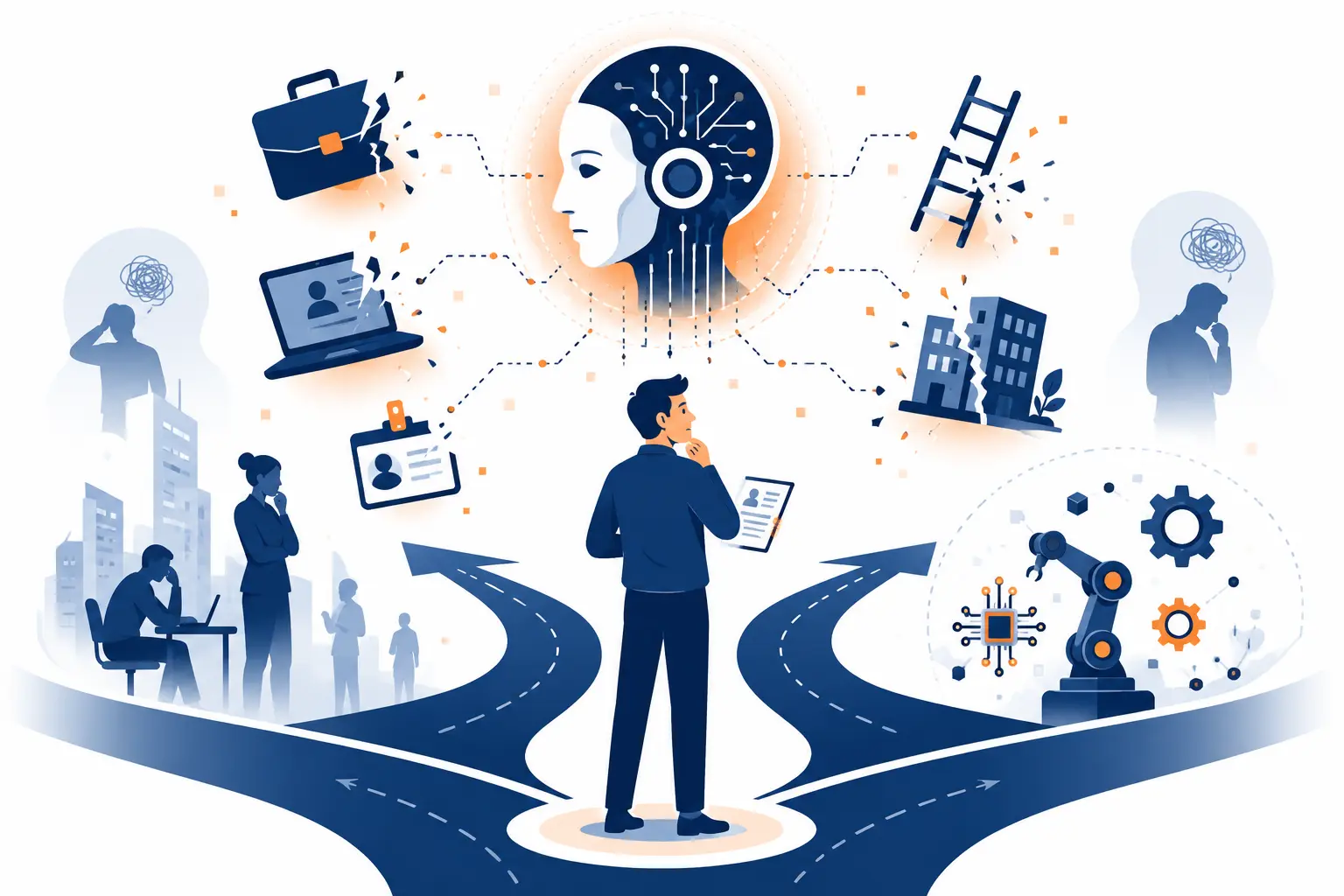
This fear of job loss due to AI in India or anywhere you live is not irrational. You may have built your careers over decades, and now, when it feels threatened, you will have doubts about your future.
Engineers who spent years mastering a specific tech stack now wonder if that skill is still valuable. Middle managers who moved up through volume-heavy processes are uncertain where they fit in an AI-optimized org chart.
As an employer, ignoring this psychological dimension makes a strategic mistake. The anxiety of your workforce will definitely affect your team's productivity, retention, and culture. It also affects hiring. Candidates today are actively looking for employers who take AI and job loss concerns seriously and have a plan for it.
What Companies Should Do About AI Job Loss?
AI will change jobs, whether companies are ready for it or not. Preparing employees for change is what matters for companies. Below are a few things companies should do.
1. Hire for adaptability
The skills that matter in 2026 may not be the skills that matter in 2029. You need to assess how people learn, adapt and respond to new tools and technologies.
This is part of why AI-powered hiring tools are growing so fast. Platforms like Mewurk, which recently launched Maya AI (an AI video interviewer and assessment tool) to help companies evaluate candidates more accurately and efficiently, focusing on competency and adaptability rather than keyword matching.
2. Invest in reskilling
Reskilling cannot be treated as just another HR initiative. It has to become a business priority. Stanford research has shown that AI integration can increase worker productivity by 14% when done right. But those gains only happen when you teach employees how to use new tools.
3. Build internal mobility pathways
The International Labour Organisation (ILO) recommends moving workers into new roles when their existing jobs are being automated instead of relying on layoffs and worsening AI jobs loss. Initiatives like internal mobility programs are helpful in seating employees into different positions and preserving their institutional knowledge.
4. Use HR technology to manage the transition
An increasing number of companies are using modern HRMS systems to automate and track essential workforce operations like attendance, payroll and leave. But AI job loss and workforce transformation require more than operational tracking. You need to invest in modern HR tech that offers learning assessment, hiring and performance management in one place.
Mewurk's cloud HRMS platform covers the full employee lifecycle, from AI-enabled recruitment through payroll and learning assessment, which gives SMEs in India a practical way to manage workforce changes without needing enterprise-level budgets.
What Individual Professionals Should Do To Avoid AI Jobs Loss?
If you are an individual professional reading this and feeling the pressure, here is some practical advice for you.
1. Learn at least one AI tool deeply
There are different types of AI tools: generative AI platforms, AI writing tools, and AI coding assistants. Pick the one most relevant to your work and go past surface-level familiarity. Employers can tell the difference between someone who tried ChatGPT twice and someone who uses it to work faster.
2. Audit your own job
Write down every task you do in a week. Identify which ones are repetitive and rule-based. Those are the tasks at risk. The rest, for instance, judgment calls, relationship management, and creative decisions, are where you should invest your growth energy.
3. Get visible in areas AI cannot easily replace
Domain expertise combined with clear communication is valuable. If you understand a specific industry deeply and can explain complex things simply, you are harder to replace by AI jobs loss than someone with general technical skills alone.
4. Do not wait for your employer to train you
The companies with structured reskilling programs are still in the minority. Most workers in India who are navigating the challenge of AI job loss are doing so largely on their own. Use free resources aggressively. Platforms like NASSCOM FutureSkills Prime, Google's free AI courses, Coursera, and YouTube have more relevant content than most corporate training programs.
The Other Side of the AI Job Loss Story
Here is something the fearful headlines about job loss due to AI in India usually skip: AI is also creating jobs, and India is positioned to benefit from that.
The World Economic Forum projects a net creation of 78 million new jobs globally by 2030. Roles like AI trainers, prompt engineers, data annotators, AI compliance specialists, AI-augmented customer success managers, and automation architects are growing fast. India already has the highest AI skill penetration rate in the world, according to the Stanford AI Index report, which means the talent base for new roles exists.
The transition is not painless. There is a mismatch between which workers are losing jobs today and which workers can access the new roles being created.
But the narrative that AI and job loss simply equals mass unemployment, with no counterbalance, is not accurate. In reality, we'll see major changes in specific fields, and though new jobs will emerge, getting them will take real effort.
Mewurk's Role in the Changing Workforce
Mewurk is an AI-powered HRMS platform built specifically for Indian SMEs. It covers attendance management, leave and shift tracking, payroll processing, expense management, field workforce tools, and an AI biometric kiosk.
The recently launched Maya AI brings AI video interviewing and AI assessment capabilities to the platform. If you are a company trying to hire efficiently in a market where skills are changing fast, Mewurk's Maya AI evaluates candidates across structured competency frameworks using video responses, thus giving hiring managers a better signal in less time.
Mewurk's approach to AI is practical. The goal is not to replace HR teams but to give them better tools, better data, and more time for the decisions that need human judgment. That is, ultimately, what every company navigating the shift needs: technology that amplifies human capability rather than just reducing headcount.
Loss of jobs due to AI is a real concern. The right HR technology stack is one part of the response.
Final Thought
AI jobs losses aren't a future threat. They're already happening, and the fear is backed by real data: layoffs in IT, flat salaries, declining hiring, and a skills landscape that's shifting fast. For Indian professionals and companies, the window to adapt is still open, but it won't stay that way forever. The answer isn't less AI. It's more thoughtful adoption, faster reskilling, smarter hiring, and building a workforce designed for change.
Frequently Asked Questions (FAQ)
1. Is AI job loss in India as serious as in Western countries?
In some ways, yes, and it could be more serious for India. That's because India's economy is built on IT services, BPO, and knowledge-based outsourcing. These are exactly the sectors AI is disrupting first, and thus job loss due to AI in India. Unlike the US or Europe, where earlier automation hit manufacturing and logistics, this wave is striking India's white-collar workforce at its economic centre. The IMF estimates roughly 40% of Indian jobs are exposed to AI.
2. What can Indian professionals do to protect their careers from AI job loss?
The most practical steps are: audit your current role to identify which tasks AI can already automate, then focus your energy on the parts that require judgment and relationships. Learn at least one relevant AI tool at a deep, working level. Build domain expertise in your field combined with clear communication, since that combination is hard to replace. Take advantage of free reskilling platforms like NASSCOM FutureSkills Prime and Google's AI certification programs.
3. How should HR teams and companies respond to AI jobs loss concerns among their workforce?
Companies need to treat workforce anxiety around AI as a real business problem. Acknowledge the concern openly. Build internal reskilling programs with proper resources. Create internal mobility pathways for employees whose current roles are shrinking. Upgrade hiring practices to assess adaptability and learning ability alongside current skills. Tools like Mewurk's Maya AI video interviewer and AI assessment features can help identify candidates who are more likely to grow with the business.
4. Will AI create new jobs to replace the ones it eliminates in India?
Yes, but the timeline and the profile of those jobs matter. The World Economic Forum projects that AI will create 170 million new roles globally by 2030. India's AI skill penetration rate is among the highest in the world, which is a genuine advantage. New roles like AI trainers, data annotators, prompt engineers, AI compliance specialists, and automation architects are already growing.
5. What do AI job loss statistics reveal about large enterprises vs. SMEs?
AI job loss statistics suggest that large enterprises are generally adopting AI faster than small and medium-sized businesses (SMEs). However, larger companies are also more likely to invest in employee training, internal mobility programs, and workforce transition plans. SMEs often face tighter budgets and fewer resources for reskilling workers, which can make adapting to AI-driven changes more difficult. As a result, the risk of AI jobs loss may depend not only on the technology itself but also on an organisation's ability to help employees develop new skills and move into emerging roles.

Most Popular Post
Why Accurate Attendance and Leave Management Matters for Business Growth?
Read More →Why Accurate Attendance and Leave Management Matters for Business Growth?
How To Leverage Attendance Data For Better Workforce Management?
Read More →How To Leverage Attendance Data For Better Workforce Management?