How Document Management Systems Simplify Audits and Regulatory Compliance?
As an organization, one of your key challenges will be to maintain regulatory compliance. There are numerous regulations to follow, such as the Factories Act of 1948, the Employees' State Insurance Act of 1948, the Employees' Provident Funds and Miscellaneous Provisions Act of 1952, the Maternity Benefit Act of 1961, and various state governments' leave policies, to name a few.
During an inspection, compliance with these regulations is verified through the respective documents maintained for each requirement. This raises an important question: how do you keep all these documents compliant, safe, and confidential? Document management systems provide the solution to this challenge.
In this blog, let’s see how a document management system (DMS) can be used to simplify compliance management and auditing of various regulatory documents.
A Closer Look at Audits and Regulatory Compliance for Businesses
Depending on where your business operates, it must adhere to the established regulatory standards of that location regarding finance, HR policies, operations, safety, permissions etc. There are also conditions for how financial records are maintained, what document management systems and methods can be used, and what accepted practices will keep you within the legal frameworks. Regular auditing is a great way to ensure this.
There are two types of auditing to conduct to ensure compliance: internal auditing and external auditing. The former is carried out by the organizations themselves using their own team, while the latter is initiated by independent governmental regulatory bodies.
It is important to note that auditing is not done to find faults and penalize an organization but rather to help and guide it in following the right practices, minimizing discrepancies, and avoiding risks. Through auditing, an organization can determine whether it is on the right track, which gives its stakeholders confidence in its operations.
As for compliance, it mainly concerns the operations and processes. The total of what a business does results from a series of operations and processes—starting with HR operations to production or manufacturing-related operations. For each, there are stipulated rules and regulations to meet.
For instance, regarding HR operations, the employer must ensure that employees can work in safe working conditions, with sufficient rest, and minimum standard pay. Concerning operational processes, there are rules pertaining to environmental safety, pollution, and various other factors. For these, the business needs to obtain approvals from respective agencies and maintain foolproof compliance records.
When all these numerous records are scattered, maintaining compliance and preparing for audits can be challenging. A Document Management System ensures there is no room for compliance and audit issues.
Top Document Management System Features That Simplify Compliance
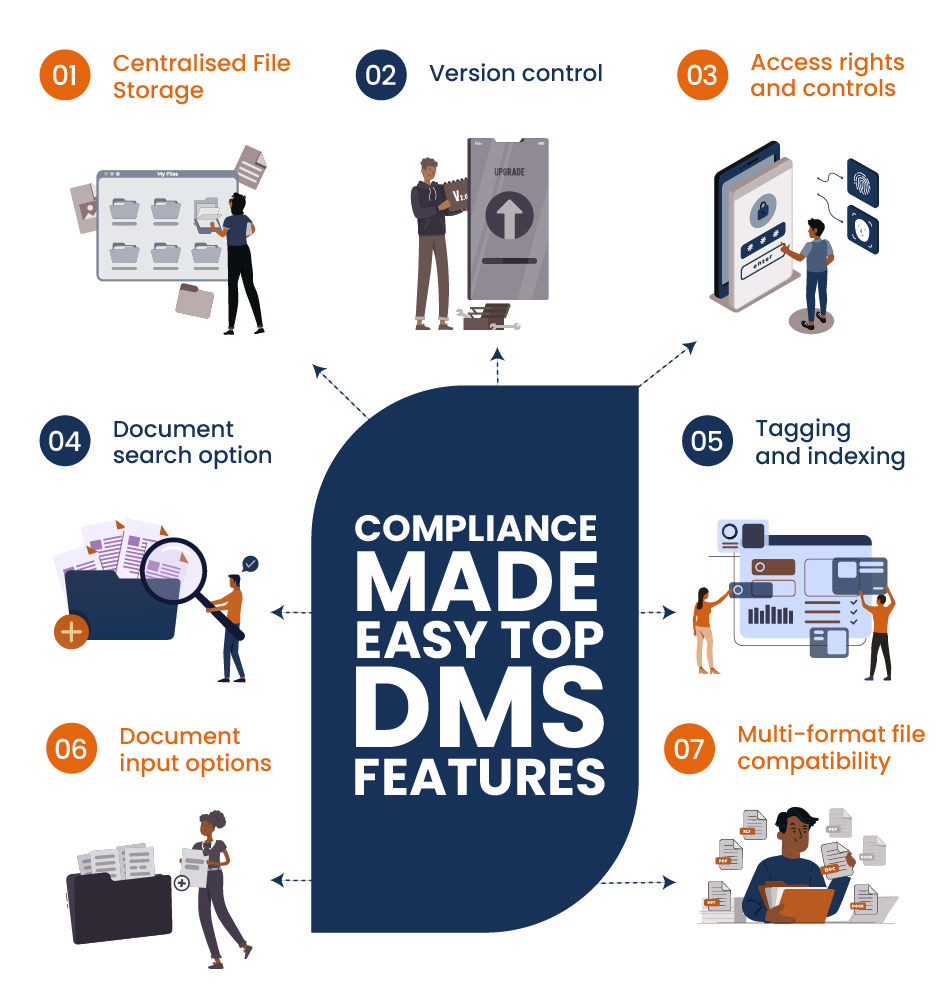
When considering a document management system, you may wonder which features will help you meet regulatory compliance and maintain timely audit trails. Here are the key features you need in a document management system to achieve this.
Centralised file storage:
A document management system should act as a centralised file storage hub where all important documents can be stored safely and are available for instant access. So the HR team or the company management can easily find and manage all their compliance-related documents.
Version control:
Version control is a feature that modern file management systems offer. It keeps logging every interaction with the document as well as changes made to it such as who accessed them, modified them lately etc. While helping improve document traceability and integrity, this feature can also ensure that the latest and relevant document versions are kept in the storage.
Access rights and controls:
Compliance-related documents are important assets for every organization. So, their access needs to be monitored and made available only to the concerned stakeholders, not to everyone. A robust document management system comes with advanced access rights and control features to restrict access to sensitive files.
Document search option:
If the document can’t be found right away when you need it, having a DMS does not make any difference to your workflow. That's why a good document management system should include features like keyword search, filtering, and categorization for easy retrieval.
Tagging and indexing:
Tagging and indexing help organize your files systematically so that they can be easily traced. Tagging involves adding labels, like photos, onboarding docs, tax docs etc. and indexing is creating a list of the documents that the system contains.
Document input options:
An easy method for adding files to the document management system is crucial for long-term use. User-friendly input options, such as drag-and-drop functionality or browsing files from local storage simplify the process for users.
Multi-format file compatibility:
As a company, you will need to manage a variety of document types within your file storage system. These documents cannot all be in a uniform format, as they serve different purposes. Some files require editing, making Word format ideal, while others need to remain unchanged, making PDF the preferred format for such cases. Therefore, a document management system that supports multiple file formats is recommended.
What Are the Benefits of Using DMS for Audits and Regulatory Compliance?
A Document Management System (DMS) goes beyond just simplifying audits and regulatory compliance. It promises long-term benefits such as:
- Gets work done faster each day and thus improves efficiency
- Cuts costs on physical paper and file storage
- Speeds up document search and retrieval process
- Keeps you prepared for surprise audits anytime
- Ensures compliance by tracking necessary requirements
- Reduces risks associated with compliance issues
- Lowers chances of facing regulatory penalties
- Enhances your company’s image and professionalism
Key Takeaways
A document management system is an essential tool for every organisation that wants to improve its standing in auditing and regulatory compliance. We hope this blog helped you understand the significance of a DMS in that context and the basic features to look for when choosing a system for your business.
If you are looking for a user-friendly, multi-purpose and cost-effective document management system, Mewurk might be the perfect fit for you. Our DMS is an integrated feature within our workforce management software and we let you test it free for up to a year. Not just the file management tool but the entire modules within the HR software. So, connect with us today to start your trial.

Most Popular Post

Why Accurate Attendance and Leave Management Matters for Business Growth?
Read More →Why Accurate Attendance and Leave Management Matters for Business Growth?
How To Leverage Attendance Data For Better Workforce Management?
Read More →How To Leverage Attendance Data For Better Workforce Management?